HIGH BLOOD PRESSURE · HEALTH GUIDE
Home Blood Pressure Readings: How to Get a Number You Can Trust
A validated monitor is only part of the picture. Cuff fit, posture, rest, timing and repeat readings all affect what appears on the screen—and how useful that number is to your care team.
The short answer: technique matters as much as the device
A home blood pressure monitor can help show how readings change over time, but the number is only useful when the device and technique are appropriate. A cuff that is the wrong size, a bare arm held below heart level, crossed legs, talking, or measuring right after coffee or exercise can alter a reading. The American Heart Association (AHA) and Centers for Disease Control and Prevention (CDC) recommend a consistent seated setup, a few minutes of quiet rest, and repeat measurements rather than relying on one isolated result.
This is a guide to making a home measurement more consistent—not a way to diagnose yourself, decide whether a medicine is working, or change treatment. Use the schedule and instructions agreed with your clinician or pharmacist. The AHA advises not to stop blood pressure medicine because of home readings. If you have not been diagnosed with high blood pressure, a home monitor cannot establish the diagnosis by itself; readings need interpretation in context.
Start with a monitor and cuff that fit
For most adults, the AHA recommends an independently validated automatic upper-arm monitor. Wrist and finger devices are generally less reliable, and cuffless smart watches or rings should not be assumed to provide interchangeable blood pressure readings unless a relevant regulator and validation evidence support that specific device and use. Ask a health professional or pharmacist to help choose a model on a recognized validated-device list such as ValidateBP. A low price, familiar brand, or phone app alone does not prove accuracy.
Cuff size is important. Measure the upper arm as the manufacturer or care team directs, then select a cuff whose printed range includes that measurement. A cuff that is too small can read too high; a cuff that is too large can also distort a result. Put the cuff on bare skin, with its lower edge just above the elbow crease and the artery marker positioned as the manual shows. Do not roll a tight sleeve up and leave it constricting the arm, and do not wrap the cuff over clothing.
Set up your body before pressing start
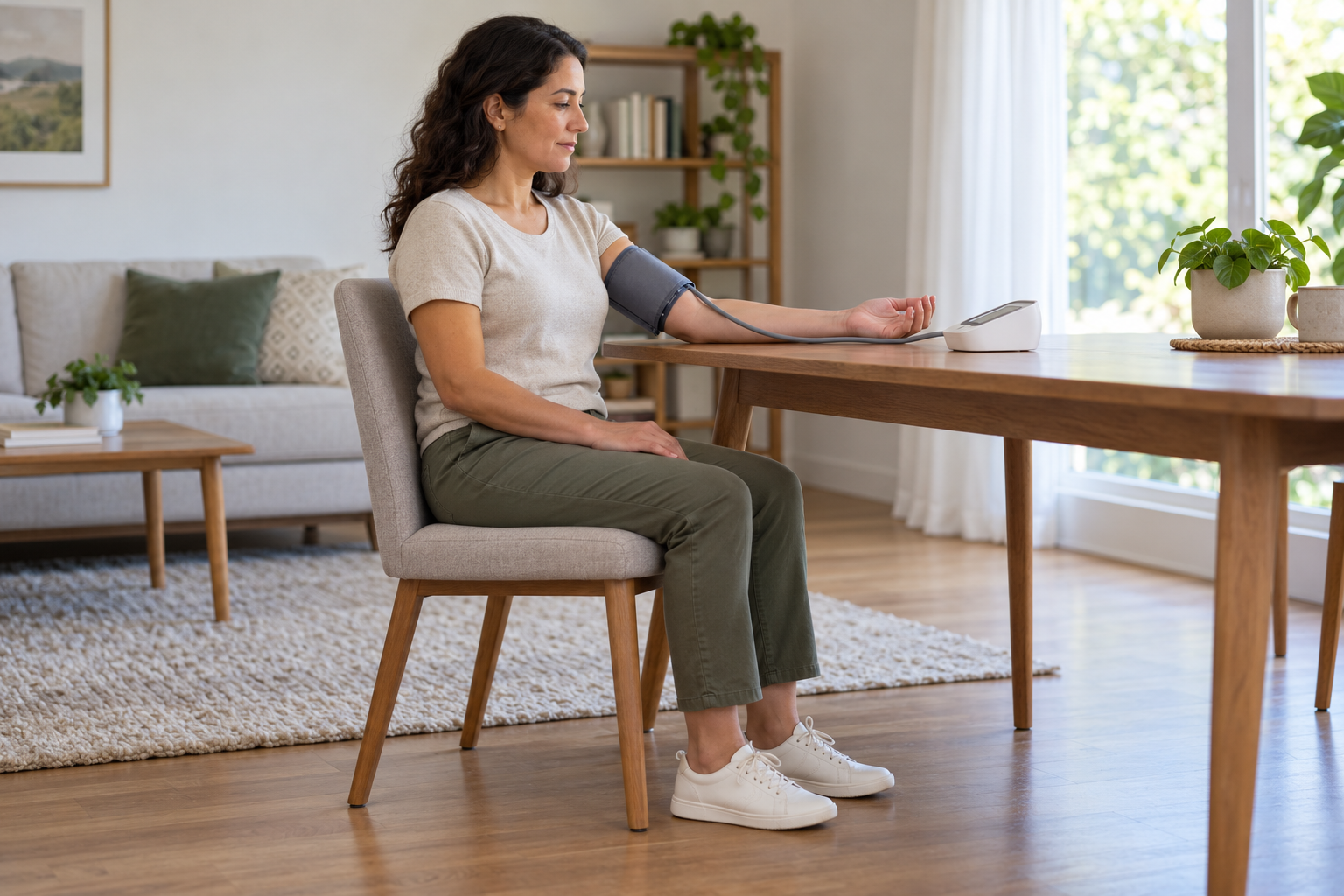
Choose a quiet place and a chair that supports your back. Sit with your back against the chair, both feet flat on the floor, and legs uncrossed. Rest quietly for at least five minutes before taking a measurement. Empty your bladder beforehand if needed. Do not measure while standing, perched on a bed, or sitting on an examination table with your legs unsupported; those positions are not the standard seated home setup used for comparison.
Place your forearm on a table or other firm support so the middle of the cuff is approximately at heart level. Keep your hand relaxed and palm facing upward. Do not hold your arm up using muscle effort, let it hang by your side, or rest it far below the tabletop. Relax your shoulders, do not talk, and avoid answering the phone during rest and measurement. If you need help positioning your arm or placing the cuff, ask someone to learn the method with you rather than guessing each time.
Avoid common pre-measurement traps
For the 30 minutes before a reading, avoid smoking, caffeine, alcohol, and exercise when possible. The CDC says these can temporarily raise a measurement; the AHA also advises avoiding smoking, caffeinated drinks, and exercise during that period. A hurried reading after climbing stairs, carrying groceries, walking briskly, or arguing is not directly comparable with a quiet seated reading. If something unusual happened, note it in the log instead of trying to erase the number.
Take the measurement at the times your care team recommends, and try to use similar conditions each day. Do not skip a prescribed dose, take an extra dose, or move medicine timing just to create a lower reading. If your clinician asks for readings before or after medication, follow that plan and record the time. Keep in mind that fever, pain, stress, a full bladder, poor sleep, a recent meal, or a cold medicine may affect a result or its interpretation. A log can help explain these circumstances later.
Take two readings and write both down
Once seated and ready, start the monitor without moving or speaking. When it finishes, record the systolic number (the top number), diastolic number (the bottom number), pulse if shown, date and time. Wait one minute and take a second reading. The AHA recommends two readings one minute apart; the CDC says at least two readings one or two minutes apart. Record both rather than selecting the lower one or repeatedly measuring until you get a preferred result.
Use the same arm unless a clinician tells you otherwise. The AHA says either arm can generally be used, but follow advice based on your history or clinic measurements. If the device displays an irregular-heartbeat symbol, an error, or a value outside its measurement range, check the manual and tell the care team rather than interpreting the symbol as a diagnosis. Bring your monitor to an appointment so someone can check the cuff fit, technique, and how closely it agrees with the clinic equipment.
Why readings vary—and what a log can show
Blood pressure changes throughout the day. It can rise temporarily with activity, conversation, discomfort, anxiety, caffeine or nicotine, and vary with posture and rest. A reading in a clinic may differ from one taken at home; the CDC notes that some people have a high office reading but normal readings outside the office. The reverse pattern can happen too. One result cannot sort out these possibilities, and a lower home number does not automatically mean that high blood pressure is absent.
A practical record includes both readings, the time, the arm used, the medicine schedule if requested, symptoms, and anything unusual such as exercise or a missed measurement step. Do not create an aggressive schedule on your own; ask how often and for how many days your clinician wants readings. Some monitoring plans use morning and evening measurements over several days, while other situations require a different plan. Share the full log—not just the best reading—so a professional can review patterns alongside your health history.
Use the result as information, not a treatment instruction
Home readings can support conversations about diagnosis or management when they are collected with a reliable device and a repeatable method. They do not replace appointments, laboratory tests, or any follow-up recommended for you. Do not change a dose, stop a prescription, take another person’s medicine, or start a supplement in response to one reading. If repeated results are outside the range your care team gave you, contact them and ask what to do next; the right threshold and response may depend on your individual situation.
If you are pregnant or recently gave birth, helping a child monitor blood pressure, or choosing a device for an older adult with special needs, check that the monitor has been validated for that population and ask a qualified professional to advise on technique and thresholds. The AHA specifically flags monitor validation for seniors, pregnancy and children. A general adult instruction sheet may not cover the correct device or follow-up for every person.
Know when to seek urgent help
If a reading is suddenly above 180/120 mm Hg, the AHA advises waiting at least one minute and measuring again. If it remains that high, contact a health professional immediately. If a very high reading occurs with chest pain, shortness of breath, back pain, numbness, weakness, a change in vision, difficulty speaking, or other severe new symptoms, call your local emergency number rather than waiting for an online answer. Do not drive yourself if you may be experiencing an emergency.
Emergency guidance can differ by location and circumstance. If symptoms are severe, rapidly worsening, or feel life-threatening, seek emergency care even if you do not have a home reading or the monitor shows a different number. Conversely, a number by itself does not tell you what is happening or how quickly it should be lowered. Follow emergency instructions from local services and the care plan you were given; do not try to force a rapid change with extra tablets or someone else’s prescription.
A simple checklist for a useful home measurement
Before you begin, check the device and cuff instructions, use the correct cuff size on bare skin, and sit in a quiet place. Avoid smoking, caffeine, alcohol and exercise for 30 minutes when possible; empty your bladder; rest quietly for five minutes. Then sit with your back supported, feet flat and legs uncrossed, and arm supported at heart level. Stay still and silent while the monitor runs, take two readings one minute apart, and write both down.
The Blood Pressure Program by Christian Goodman is an existing commercial breathing and relaxation guide. It is not a blood pressure monitor, diagnostic service, or substitute for prescribed care. Relaxation may be part of a personal wellbeing routine, but a temporarily calmer reading cannot establish that hypertension has resolved or prove that a commercial program treats it. Use the review to understand what the program offers and what evidence it does—and does not—provide.
Sources and further reading
Medical and measurement sources were opened and checked on October 19, 2026. The linked commercial program is discussed separately from clinical evidence.
- American Heart Association — Home Blood Pressure Monitoring ↗
- American Heart Association — Cuff Size and Home Monitor Fit ↗
- American Heart Association — Cuffless Blood Pressure Devices: Scientific Statement Summary ↗
- Centers for Disease Control and Prevention — Measuring Your Blood Pressure ↗
- American Medical Association — 7-Step Self-Measured Blood Pressure Quick Guide ↗
- ValidateBP — Validated Blood Pressure Device Listing ↗
- American Heart Association — Research on Accuracy of Online Blood Pressure Images ↗
RELATED GUIDE · CHRISTIAN GOODMAN
The Blood Pressure Program
A commercial breathing and relaxation guide. Read our existing review for its scope and evidence limits. It cannot measure blood pressure, diagnose hypertension, or replace prescribed treatment.
Read the program review →
This article is general health education, not personal medical advice or clinical review. Consult a qualified professional about diagnosis, measurement schedules, medicines, device selection, and treatment decisions.