PSORIASIS · SKIN & IMMUNE HEALTH · HEALTH GUIDE
Psoriasis Is More Than Dry Skin: Flares, Joint Symptoms, and When to Seek Care
Psoriasis is a chronic immune-mediated condition, not simply dry skin. Learn what a flare may look like, how to care for irritated skin safely, which joint symptoms deserve prompt attention, and when a widespread rash needs urgent care.
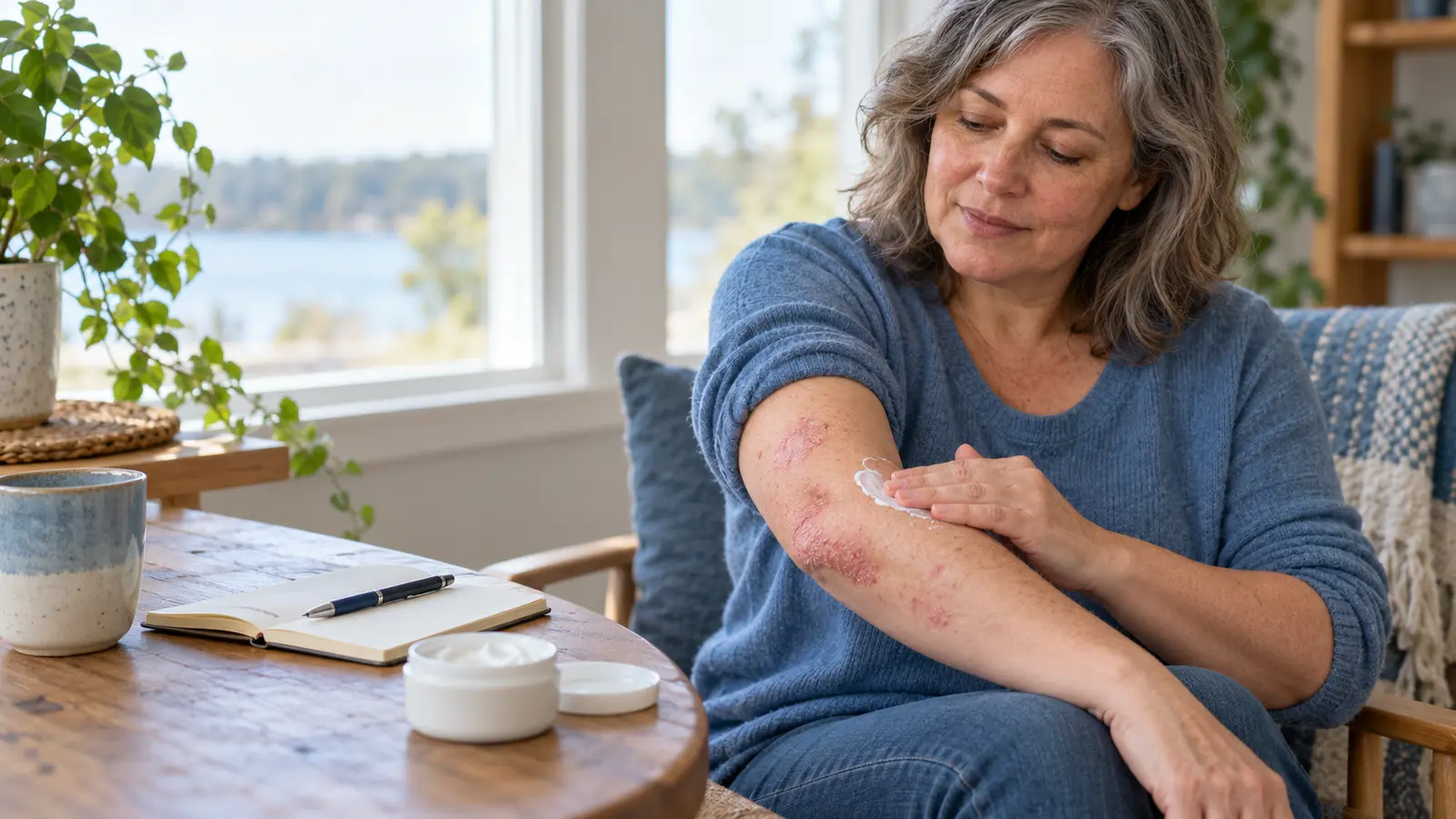
The short answer: psoriasis is an immune-mediated disease
Psoriasis is a chronic disease in which immune activity speeds up the life cycle of skin cells and drives inflammation. The result may be raised, scaly plaques, but the condition can also affect the scalp, nails, skin folds, palms, or soles. Symptoms often cycle through quieter periods and flares. Psoriasis is not contagious, and it cannot be caught by touching a plaque, sharing a towel, or spending time with someone who has it.
Dry skin can crack and itch, but a persistent or changing rash needs a proper diagnosis because eczema, fungal infections, contact reactions, and other disorders can resemble psoriasis. A clinician usually evaluates the skin, scalp, nails, symptom history, medicines, and family history; occasionally a small skin sample is needed. An online photo cannot confirm the diagnosis or determine which treatment is safe.
Psoriasis does not look the same on every body
Plaque psoriasis, the most common form, often produces well-defined patches with scale. On lighter skin, plaques may look red or pink with silvery-white scale; on darker skin, they may look violet, dark brown, gray, or less vividly red, and discoloration can remain after inflammation settles. The scalp, elbows, knees, and lower back are common sites, but psoriasis may occur almost anywhere. In skin folds, inverse psoriasis can look smoother and have little visible scale.
Other patterns include small drop-like spots after an infection, localized or widespread pustules, and rare erythrodermic psoriasis with extensive redness and shedding. Nails may pit, thicken, crumble, discolor, or lift from the nail bed. These features overlap with other conditions, so avoid diagnosing yourself by pattern matching. Record where symptoms started, whether they itch or hurt, and how quickly they changed, then show that history to a qualified healthcare professional.
A flare log can reveal a pattern without assigning blame
Flares vary from person to person. Recognized contributors can include infections, skin injury, sunburn, smoking, stress, weather changes, and certain medicines. A factor that matters to one person may be irrelevant to another, and a flare does not mean that someone failed at self-care. Keep a brief log of dates, affected areas, pain or itch, recent illness, stress, skin injury, new products, and medicine changes. Photos taken in similar light can help document progression for an appointment.
Do not stop a prescribed medicine because you suspect it contributed to a flare. Some medicines need to be tapered, and stopping treatment abruptly can create other risks. Instead, contact the prescriber or pharmacist with the name, dose, timing, and symptoms. A useful question is not simply ‘What triggered this?’ but also ‘Could this be another condition, and does the change require a different treatment or urgency?’
Gentle skin care supports comfort, but it is not a cure
Use short, lukewarm showers or baths rather than very hot water. Pat the skin dry and apply a thick, fragrance-free moisturizer while the skin is still slightly damp. Choose cleansers and laundry products that do not sting or add unnecessary fragrance. A cool compress may ease itch. Keep fingernails short and try not to pick or scratch plaques, because breaking the skin can worsen irritation, lead to infection, or provoke new lesions in injured areas.
Protect skin from cuts, friction, and sunburn. Sunlight is not a do-it-yourself version of medical phototherapy: too much ultraviolet exposure damages skin and can worsen psoriasis after a burn. Ask a dermatologist how to use sunscreen around plaques and whether any prescribed medicine changes sun sensitivity. Moisturizer can reduce dryness and scaling, but it does not switch off the underlying inflammation or replace treatment when symptoms are extensive, painful, or persistent.
Treatment depends on type, location, severity, and the person
Treatment may involve topical medicines, supervised phototherapy, or medicines that work throughout the body, including targeted biologic therapies. The choice depends on more than the percentage of skin involved. Plaques on the face, genitals, hands, feet, or scalp can have a large effect on daily life even when the total area is small. Age, pregnancy plans, infections, other illnesses, previous treatment, monitoring needs, cost, and personal priorities also matter.
Topical corticosteroids and other prescription creams have specific instructions for strength, location, and duration. Phototherapy uses controlled ultraviolet exposure; tanning beds are not an equivalent substitute. Systemic and biologic medicines can be highly effective for appropriate patients but require professional screening and follow-up. Do not share prescriptions, layer several active products without guidance, or assume that a product labeled ‘natural’ is compatible with every medicine or health condition.
Joint symptoms can be part of the same disease
Some people with psoriasis develop psoriatic arthritis, which can damage joints if inflammation is not controlled. Warning signs include a persistently swollen, painful, or stiff joint; morning stiffness; an entire swollen finger or toe; heel pain; and inflammatory back pain. Nail pitting or separation can accompany joint disease. Skin symptoms may be mild, and in some people joint problems appear before obvious psoriasis, so do not judge joint risk by plaque size alone.
There is no single blood test that proves or excludes psoriatic arthritis. Evaluation may include a physical examination, symptom history, blood tests to consider other causes, and imaging. Arrange a timely appointment for new or persistent joint symptoms, especially swelling or reduced function. Sudden severe joint pain with fever or a hot, very swollen joint needs urgent assessment because infection and other emergencies can look similar.
Whole-person health belongs in the conversation
Psoriasis is associated with a higher likelihood of several other health problems, including psoriatic arthritis, cardiovascular disease, obesity, and depression. Association does not mean that every person will develop these conditions, and it does not prove that a plaque directly caused another illness. It does mean routine preventive care deserves attention: blood pressure, cholesterol, diabetes risk, tobacco use, physical activity, and mental health can be reviewed with a healthcare professional based on age and individual risk.
Visible plaques, itch, pain, and sleep loss can affect work, relationships, confidence, and mood. Those effects are real health concerns rather than cosmetic inconveniences. Tell a clinician if symptoms are limiting daily life or if you are withdrawing from activities. Seek immediate help for thoughts of self-harm or an inability to stay safe. Effective care should address the skin, possible joint disease, treatment burden, and quality of life without blaming the patient.
Be skeptical of psoriasis diets, detoxes, and supplement cures
No single food plan has been shown to cure psoriasis. A balanced eating pattern can support general health, and weight management may be part of an individualized plan for some people, but restrictive diets can create nutrient gaps, expense, or anxiety. An apparent improvement after removing several foods at once does not identify which change mattered, and normal fluctuations can be mistaken for a cure. Food should not be used as a reason to delay evidence-based treatment.
Supplements and herbal products can have side effects, interact with prescription medicines, or contain inconsistent ingredients. Bring the actual bottles or a complete list to a clinician or pharmacist. Ask what evidence exists for the exact product, what outcome was studied, and what monitoring is needed. Be especially cautious when a seller claims to ‘heal the gut,’ ‘detox inflammation,’ or guarantee permanent clearance while discouraging medical care.
Know the red flags that need urgent care
Seek urgent medical assessment for a rapidly worsening rash, widespread redness or skin peeling, extensive pustules, severe skin pain, or a rash accompanied by fever, chills, weakness, dehydration, or feeling very unwell. Generalized pustular psoriasis and erythrodermic psoriasis are uncommon but can be life-threatening. Do not wait for a routine appointment or try a new supplement when large areas of skin are suddenly affected and the person is systemically unwell.
Emergency symptoms may have causes other than psoriasis, including a serious drug reaction or infection. Call local emergency services for trouble breathing, swelling of the face or throat, fainting, confusion, or other sudden severe symptoms. For a new painful swollen joint, eye pain or vision change, signs of skin infection, or a flare that is disrupting sleep and function, contact an appropriate healthcare professional promptly for triage.
Prepare for an appointment with concrete observations
Bring a timeline, photos, a list of affected locations, and notes on itch, pain, bleeding, sleep, and daily function. Include every prescription, over-the-counter medicine, skin product, and supplement. Mention nail changes, heel pain, swollen digits, morning stiffness, recent infections, and any family history of psoriasis or inflammatory arthritis. This information helps a clinician consider both skin and joint disease rather than treating each symptom in isolation.
Useful questions include: What supports this diagnosis, and what else could look similar? How should I use each treatment, and where should I avoid it? What side effects or infections should I report? Do my joint symptoms need a rheumatology assessment? How will we measure improvement, and when should we change course? A clear plan should include follow-up and safety instructions, not just a product list.
Where an optional commercial guide fits
The Psoriasis Strategy by Julissa Clay is an existing commercial wellness guide that discusses food, stress, and daily routines. It may give interested readers a structured way to reflect on habits, but it is not a diagnosis, prescription, emergency resource, or replacement for dermatology or rheumatology care. We have not identified evidence that this specific guide cures psoriasis or can prevent joint damage.
Use the program review to understand what the guide contains and where its claims or evidence may be limited. Check any dietary restriction or supplement against allergies, pregnancy, other conditions, and prescribed medicines. Widespread or painful skin disease, possible infection, joint swelling, and treatment decisions belong with qualified healthcare professionals—not with a commercial program alone.
Sources and further reading
Medical sources were opened and checked on October 29, 2026. The linked commercial program is discussed separately from clinical evidence.
- NIAMS — Psoriasis: Overview, Symptoms, and Causes ↗
- NIAMS — Psoriasis: Diagnosis, Treatment, and Steps to Take ↗
- NIAMS — Psoriatic Arthritis: Diagnosis, Treatment, and Steps to Take ↗
- American Academy of Dermatology — Psoriasis Signs and Symptoms ↗
- American Academy of Dermatology — Tips for Managing Psoriasis ↗
- NHS — Psoriasis ↗
This article is general health education, not personal medical advice, diagnosis, treatment, or clinical review. Consult a qualified healthcare professional about persistent, painful, or changing symptoms, and use local emergency services for sudden severe warning signs.