Sleep health · Sleep apnea testing
Home Sleep Apnea Test vs. Lab Study: What Each Can—and Cannot—Show
A home test can be convenient for some adults, while an overnight lab study records more signals. Learn why the choice depends on the clinical question, the test’s limits, and what happens when a result is unclear.
A sleep test is chosen to answer a question
If someone notices loud snoring, pauses in breathing, gasping during sleep, or substantial daytime sleepiness, a clinician may discuss whether a sleep evaluation is appropriate. The next question is often which test makes sense. An overnight sleep-laboratory study and a home sleep apnea test (HSAT) are not interchangeable versions of the same thing. They record different signals, are suited to different situations, and may lead to different next steps. This article explains general testing concepts, not whether a particular person has obstructive sleep apnea or which test they should choose. Access and local pathways vary, including in Thailand.
What an overnight lab study records
An in-laboratory polysomnogram (PSG) is an overnight recording conducted in a sleep center. Sensors can record brain activity, eye movements, muscle activity, heart rhythm, airflow, breathing effort, oxygen level, and body position. These signals help a sleep clinician see when sleep occurs and how breathing events relate to sleep stages and awakenings. The room may feel unfamiliar, and the sensors can take time to get used to, but staff explain the setup and remain available. NHLBI notes that the sensors can cause minor skin irritation that typically resolves after they are removed.
What a home sleep apnea test usually measures
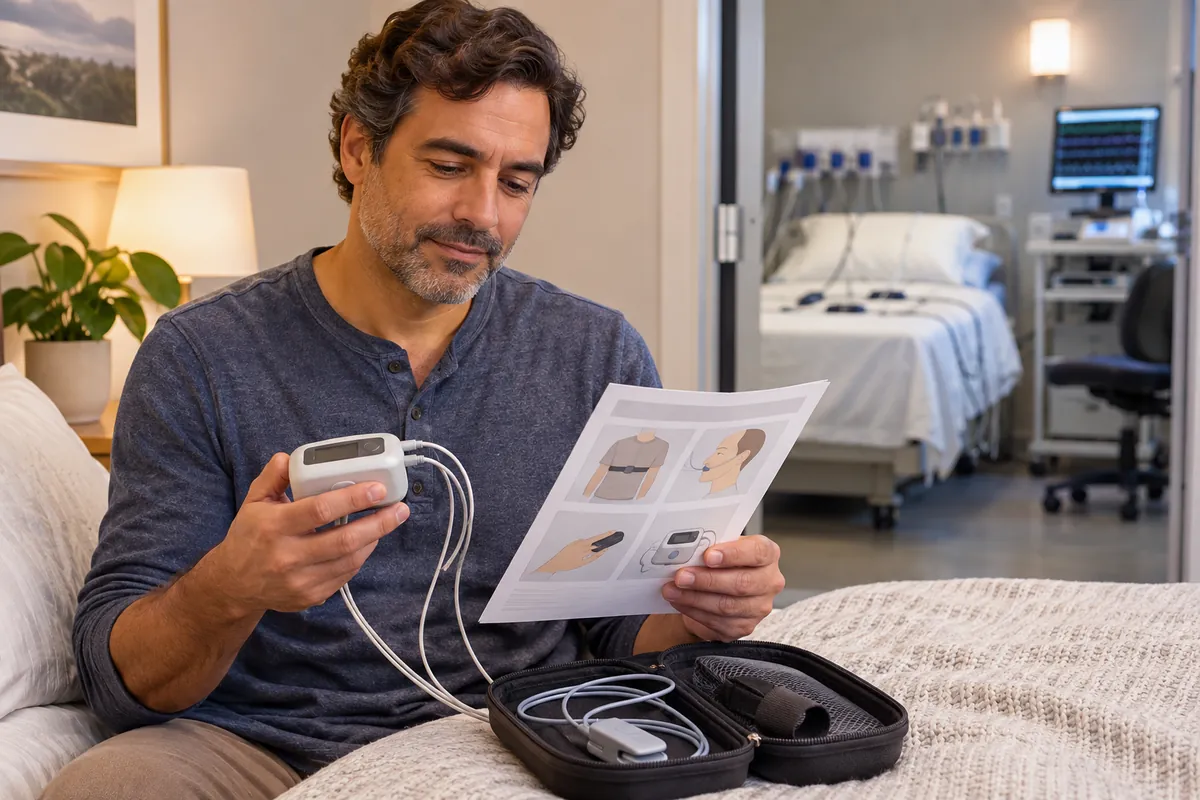
A home sleep apnea test uses a portable device while a person sleeps at home. Depending on the device, it may record breathing airflow, respiratory effort, oxygen level, pulse, and movement or position. Technically adequate systems use particular sensors and enough usable data; a smartwatch or a generic oxygen meter is not automatically an HSAT. The American Academy of Sleep Medicine (AASM) guideline describes clinician-supervised testing for appropriately selected adults, with the device and data reviewed in a clinical pathway. The exact equipment, instructions, and scoring depend on the service and device.
Why a home test is not simply a smaller lab study
Many HSAT systems do not record brain waves and therefore do not directly know when a person is asleep. The AASM guideline explains that a home test may calculate a respiratory event index using recording time rather than measured sleep time; it can also miss some breathing reductions tied only to brief brain arousals. Loose sensors, interrupted recordings, or low-quality signals add uncertainty. Those limits can make an index appear lower than the person’s actual breathing-event rate during sleep. A neat-looking number from a device should not be interpreted without the clinical report and its stated limitations.
Who may be considered for home testing
The AASM guideline allows either PSG or a technically adequate HSAT for some uncomplicated adults whose symptoms and evaluation indicate an increased risk of moderate-to-severe obstructive sleep apnea. “Uncomplicated” matters: home testing is not a universal first step for every snorer, every sleep complaint, or every person with another health condition. A sleep evaluation comes first, and the clinician decides whether the home pathway is suitable, what device to use, and how results will be followed. Questionnaires and symptom checklists can help organize a discussion but do not diagnose sleep apnea on their own.
When a lab study may be preferred
The AASM guideline recommends PSG rather than HSAT in several complex situations, including significant heart or lung disease, possible weakness of breathing muscles, awake or suspected sleep-related hypoventilation, chronic opioid use, a history of stroke, or severe insomnia. A laboratory study can also be more useful when another sleep disorder is suspected or a broader set of signals is needed. These are examples from a professional guideline, not a self-selection checklist. A qualified clinician considers the full history, examination, local availability, and the purpose of testing before making a plan.
A negative home result may not end the evaluation
A negative, inconclusive, or technically inadequate HSAT does not always rule out obstructive sleep apnea. The AASM guideline recommends an in-lab PSG when one home test has those results. A clinician may also consider another evaluation when symptoms remain concerning despite an initial test. That is not a reason to assume the home test was “wrong”; it means the limits of that method and the person’s clinical context still matter. Do not repeat a test, buy another device, or dismiss ongoing symptoms based only on a dashboard result. Ask who will explain the result and what follow-up is planned.
Consumer watches and phone apps are different tools
Watches, rings, phone apps, and consumer pulse-oximeters may estimate movement, pulse, oxygen, or sleep timing. They can provide personal observations, but they are not equivalent to a clinician-directed HSAT or PSG and cannot establish a diagnosis by themselves. Different products measure different signals, and their algorithms may not identify sleep stages or breathing events reliably enough for a medical conclusion. If a device shows repeated low oxygen or an unusual pattern, keep the report and ask a clinician whether it is relevant; do not change a prescribed therapy or start a treatment based on an app notification.
What the test can—and cannot—tell you
A sleep test can help identify whether sleep-disordered breathing is present and, depending on the test, how often breathing events occur. A test result does not by itself explain every cause of fatigue, headache, insomnia, or poor concentration. It also does not determine the best treatment without considering symptoms, health history, preferences, and the details of the recording. PSG may identify other patterns because it records additional signals, but not every study is designed to answer every sleep question. The report should state whether the recording was technically adequate and what the interpreting professional can conclude.
Preparing for a home test
For a home test, follow the instructions supplied by the sleep service rather than a generic online video. Ask whether to keep your usual sleep schedule, how and when to apply each sensor, what to do if a lead comes loose, and whom to contact if the device does not start. Tell the service about medicines, oxygen, PAP devices, or other equipment you normally use; do not change prescribed treatment unless the clinician directs you. If you are unsure whether the device recorded correctly, report that rather than assuming the test was normal or trying to repair the data yourself.
Preparing for an overnight lab study
For an overnight lab study, ask when to arrive, whether to bring sleepwear or personal items, and whether there are instructions about caffeine, naps, or usual medicines. The laboratory may ask about your normal schedule so the study reflects your typical sleep as closely as possible. Sensors are attached to the scalp, face, chest, limbs, and finger depending on the protocol. Most people can move and change position, though the wires may feel unfamiliar. Tell the staff if a sensor is uncomfortable or you need help; the goal is a usable recording, not a perfect night of sleep.
What happens after the recording
After either test, a qualified professional reviews the recording with the symptoms and evaluation that led to testing. The result may support a diagnosis, show that more testing is needed, or fail to answer the question because the signals were insufficient. Ask for an explanation in plain language: Which signals were captured? Was the study technically adequate? What does the index measure in this report? Could another condition or the test method affect interpretation? What follow-up is recommended? A raw score or automated report is not the same as a complete medical assessment.
Daytime sleepiness is a safety issue
Untreated sleepiness can affect driving, work, and safety around equipment. NHLBI advises people with sleep apnea not to drive when tired or sleepy. If you are struggling to stay awake at the wheel, stop driving when safe and arrange another way to travel; do not rely on caffeine or an alertness app to make drowsy driving safe. Seek timely professional guidance for recurrent sleepiness, witnessed pauses, gasping, or breathing concerns. Severe breathlessness, chest pain, fainting, or blue lips warrants urgent local medical assessment. This article cannot triage a specific person’s symptoms.
Questions worth asking before testing
Before testing, useful questions include: What condition are we investigating? Why is a home test or lab study being considered for me? What does this device measure and what does it leave out? Who will interpret the result? How will I receive it? If the recording is negative or incomplete but symptoms continue, what is the next step? Should I report medicines or another diagnosis before the study? What should I do if I am too sleepy to drive? Writing down answers and bringing a medication list can make follow-up clearer without trying to diagnose yourself.
An optional commercial program is not a sleep test
Blue Heron Books has an existing Stop Snoring And Sleep Apnea Program page. The three optional links below lead only to that existing commercial review. It was not used as evidence for this article and cannot measure breathing, diagnose sleep apnea, interpret a test, or replace prescribed care. There is no claim here that the program prevents or treats sleep apnea. Readers who choose to review it should assess its scope and claims separately, and should not delay a sleep evaluation or stop a prescribed device or treatment because of commercial material.
The practical takeaway
Home testing can be convenient for selected adults, while an in-lab study records more signals and may be better suited to complex questions. A home test is not a consumer gadget, and a negative or inadequate result may need follow-up when clinical concern remains. The most useful choice is the one made after an appropriate sleep evaluation, with a clear plan for interpretation and next steps. This article is general health education, not a diagnosis or personal medical advice. Mr.Hotsia’s editorial review is limited to source checking and clarity; it is not a clinical review, and he is not presented as a medical professional.
Sources and further reading
Medical information was checked against these public health sources on November 5, 2026.
- American Academy of Sleep Medicine — Clinical Practice Guideline for Diagnostic Testing for Adult Obstructive Sleep Apnea (2017) ↗
- NHLBI (NIH) — Sleep Studies ↗
- NHLBI (NIH) — Sleep Apnea Diagnosis ↗
- NHLBI (NIH) — Living With Sleep Apnea: Safety and Follow-Up ↗
- PubMed — AASM Diagnostic Testing Guideline Citation and Abstract ↗
This article is general health education, not a diagnosis or personal medical advice. Do not change treatment or supplements based on this article. Discuss individual results with a qualified healthcare professional.