Sleep health · Restless legs and movement
Restless Legs Syndrome: Symptoms, Sleep Disruption, and What an Evaluation May Cover
An urge to move that appears at rest and eases with movement can have several explanations. Learn the characteristic pattern, why look-alike symptoms matter, and what information may help a healthcare professional assess disrupted sleep.
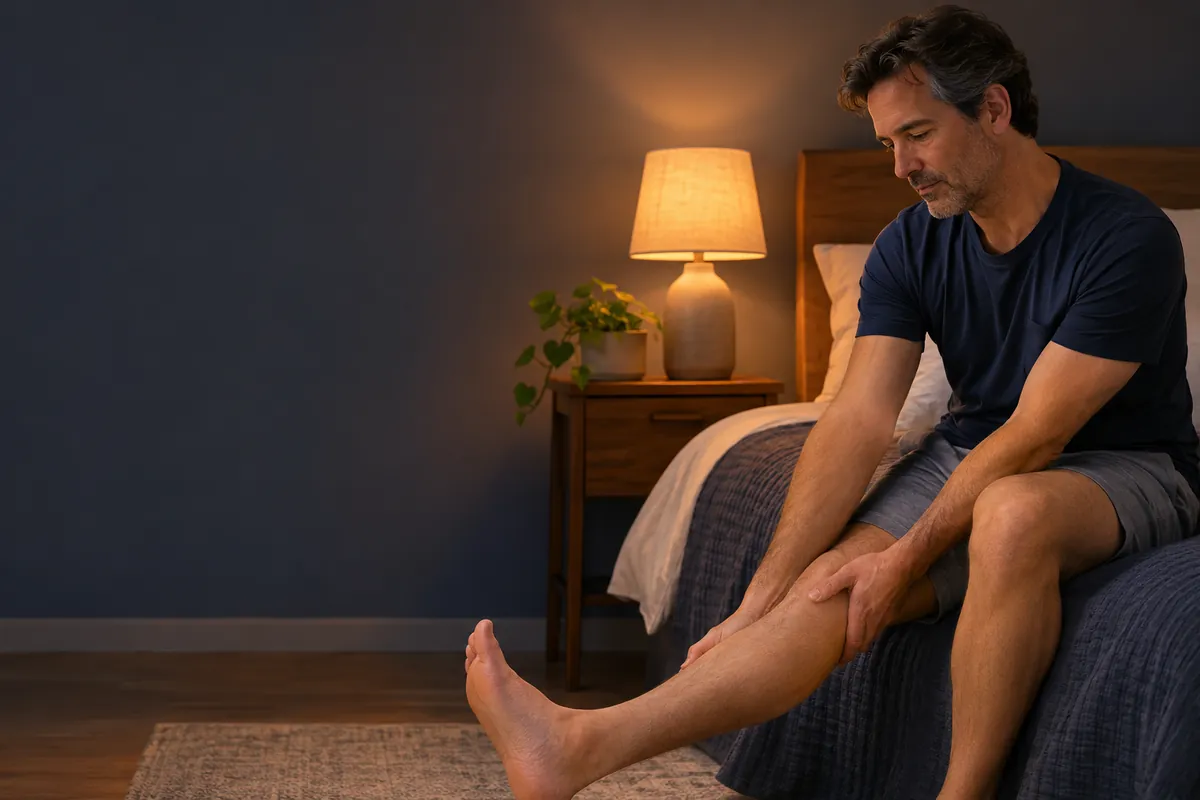
A restless feeling is a clue, not a diagnosis
A need to move your legs while settling down for the night can be frustrating, especially when it repeatedly interrupts sleep. Restless legs syndrome (RLS), also called Willis–Ekbom disease, is one possible explanation—but a restless sensation is not enough to diagnose it. Leg cramps, nerve symptoms, discomfort from a position, medicine effects, and other problems can feel similar. This guide describes the pattern that characterizes RLS, what a professional assessment may ask about, and why a lab result or sleep-device graph cannot replace the whole history. It is general education, not a way to label your own symptoms.
The pattern clinicians listen for
The American Academy of Sleep Medicine describes RLS as an urge to move one or both legs, sometimes the arms, while immobile; uncomfortable sensations may accompany it, movement relieves it, and symptoms are most prominent in the evening or night. The NHS also describes a strong urge to move and unpleasant feelings that commonly worsen during rest at night and can affect sleep. A clinician looks at how these features occur together and whether another condition better explains them. No single phrase such as ‘tingling at bedtime’ is specific enough by itself.
The sensations do not always have an easy name
People describe the feeling in different ways: crawling, pulling, aching, itching, tingling, or an internal restlessness that is difficult to put into words. Some feel it mainly in the lower legs; others notice it elsewhere or on one side. Not everyone has pain. The important detail is often the urge to move, rather than the exact adjective. Temporary relief while walking or stretching may be part of the pattern, but relief is not proof of RLS. A symptom can have several causes, and those causes may need different kinds of assessment.
Why evenings and stillness can matter
RLS is linked to rest or inactivity: symptoms may arise while sitting through a film, travelling, reading in bed, or trying to fall asleep. Movement can ease the sensation for a time, but it may return when a person becomes still again. Symptoms often occur more in the evening or night than earlier in the day. That timing can make it hard to fall asleep or return to sleep after waking. The pattern may fluctuate, so a few symptom-free nights do not necessarily describe the overall experience. Record what actually happens rather than trying to match a checklist perfectly.
Restless legs and periodic limb movements are not identical
Periodic limb movements during sleep are brief, repeated movements that may be seen during a sleep study. The AASM notes that these movements are associated with RLS in many people, but the sleep movements and RLS are not interchangeable concepts. A person does not need a sleep study showing limb movements to describe RLS symptoms, and movements detected during a study do not automatically explain a person’s daytime or nighttime difficulties. The sleep specialist’s interpretation depends on symptoms, other sleep conditions, and clinical context. A recording or partner’s observation can be helpful background, not a stand-alone diagnosis.
Why symptoms can be confused with other problems
Several conditions can resemble RLS. The AASM guideline names neuropathy, akathisia, spasticity, positional discomfort, joint discomfort, and nighttime leg cramps among possible mimics in adults. The NHS specifically notes that cramps and peripheral neuropathy may feel similar. A cramp may be a sudden painful muscle tightening; nerve-related symptoms may include burning or altered sensation; medication-related inner restlessness can involve more than the legs. These are broad descriptions, not a self-sorting test. If the experience is new, changing, painful, or unusual for you, describing the details to a qualified professional is safer than assuming it is RLS.
There is no single confirmatory home test
There is no single blood test, scan, or consumer tracker that confirms RLS. The AASM guideline says diagnosis depends on careful clinical history because there is no objective test to make the diagnosis. The history usually matters more than a number from a watch or a sleep-app score. A professional may ask when symptoms begin, what makes them better or worse, whether they occur during the day, how often they happen, and how sleep and daytime activities are affected. An examination or tests may be used to look for other explanations or contributing conditions; the exact evaluation depends on the person.
What an evaluation may include
An appointment can cover the symptom pattern, sleep timing, health history, family history, pregnancy where relevant, kidney or nerve conditions, and a review of prescription and non-prescription products. The clinician may ask whether a symptom is an urge to move or mainly pain, whether movement brings temporary relief, and whether stillness or nighttime changes it. They may also ask how much sleep is lost and whether daytime alertness, mood, or work is affected. These questions help distinguish RLS from similar complaints and decide whether further evaluation is appropriate. They are not evidence that a particular diagnosis has already been made.
Why iron studies may come up
Iron status is one area that may be discussed. The AASM’s 2025 clinical practice guideline includes a good-practice statement that clinicians should regularly check iron studies, including ferritin and transferrin saturation, in people with clinically significant RLS. It also says the thresholds used for RLS-related decisions differ from those used for the general population and are based on consensus guidance. That does not mean everyone with restless legs should take iron. Iron can be harmful when unnecessary, and the cause of low iron may need attention. Do not start a supplement or interpret a result in isolation; ask the professional ordering the test what it means for you.
Medicines and other factors deserve a careful review
A review of medicines and other factors may be part of the conversation. The AASM guideline identifies caffeine, alcohol, some antihistamine, serotonin-related, and dopamine-blocking medicines among potential exacerbating factors, as well as untreated obstructive sleep apnea. These are discussion prompts—not proof that a particular product caused someone’s symptoms. A medicine may have been prescribed for an important reason, and stopping it suddenly may create harm. Bring a current list that includes over-the-counter sleep or allergy products and supplements. A pharmacist or prescriber can review whether any change is sensible and how to make it safely, if a change is appropriate.
Pregnancy, kidney disease, and family history add context
RLS can occur in people with a family history, during pregnancy, and alongside some health conditions. NHS information notes links with pregnancy, iron-deficiency anemia, kidney disease, and some medicines; the AASM guideline also describes increased prevalence in conditions associated with systemic iron deficiency. These associations help explain why context matters, but they do not establish a cause for an individual. Pregnancy and kidney disease can change how tests and treatments are considered, so self-treatment is particularly unwise. Mention these circumstances when asking about symptoms. The relevant next step may differ depending on age, health history, and the reason sleep is being disrupted.
Low-risk routines may support comfort—but are not a cure
Some general habits may make evenings more comfortable for some people, although they do not diagnose or cure RLS. NHS guidance suggests daytime exercise, a regular sleep and wake time, walking, stretching or massage during symptoms, and a warm bath or heat pad. It also advises avoiding caffeine after midday and alcohol close to bedtime. The AASM similarly recommends addressing potential aggravating factors as an early management consideration. Responses vary, so treat a routine as an optional experiment—not a replacement for evaluation when symptoms are persistent or severe. Avoid vigorous late-night exercise if it makes you feel worse, and stop any activity that causes pain or injury.
When it is worth asking for help
Consider contacting a healthcare professional if the urge or sensation repeatedly disrupts sleep, affects daytime functioning or mental well-being, is worsening, or has not improved with simple comfort measures. The NHS advises seeing a GP when symptoms stop sleep, affect mental health, or self-help has not helped. An evaluation is also reasonable when the symptoms are hard to describe, occur during the day, or seem different from a familiar pattern. Ask which service is appropriate where you live; referral pathways vary. If you have a new, severe, or rapidly changing symptom, do not delay care simply because it happens at night or resembles a prior episode.
Make a short symptom record useful
A brief record can make a visit easier without turning sleep into a data project. For one or two weeks, if practical, note the approximate time symptoms begin, whether you were resting, where you feel them, whether you feel compelled to move, how movement affects the sensation, and how sleep or the next day is affected. Note meaningful medicine or routine changes and how often the symptoms occur. You do not have to quantify every sensation or buy a tracker. The goal is to describe a pattern in your own words. Stop tracking if it increases anxiety or becomes burdensome; a conversation can start without a perfect diary.
Medication changes should not be improvised
Treatment decisions depend on the evaluation, the person’s health, and the balance of likely benefits and harms. The AASM guideline includes recommendations for several prescription and iron-based approaches, but those are clinician-facing recommendations and are not a personal treatment plan. It also advises against standard long-term use of some dopamine medicines because symptoms can worsen over time in a phenomenon called augmentation; the guideline describes earlier symptom onset and spread as possible signs. Never change a prescribed dose, stop a medicine, or begin iron or another supplement based on this article. If you already use an RLS medicine and the pattern is changing, contact the prescriber to discuss it.
Optional Blue Heron program pages
Blue Heron Books has existing pages for The Insomnia Program, Stop Snoring And Sleep Apnea Program, and The Parkinson’s Protocol. These are optional commercial program pages, not medical care, diagnostic services, or sources for the clinical statements in this article. Their appearance here does not mean they treat or prevent restless legs syndrome. Do not delay assessment, change prescribed care, or buy a product because of a program link. The links are provided only as existing site resources for readers who wish to review them separately from the health information and sources listed below.
The main takeaway
The practical summary is that RLS is identified by a particular pattern: an urge to move, symptoms associated with rest, temporary relief with movement, and worsening in the evening or night—while considering other explanations. Sleep loss is a reason to seek help, not a reason to diagnose yourself. An assessment may include a careful history, medicine review, and iron studies; any results need to be interpreted in context. Gentle routines may support comfort, but supplements and medication changes require professional guidance. This article is general health education, not diagnosis, personal medical advice, or a treatment plan. Mr.Hotsia’s editorial contribution was limited to sourcing and clarity; it was not a clinical review, and no medical credentials are implied.
Sources and further reading
Medical information was checked against these public health sources on November 6, 2026.
This article is general health education, not a diagnosis or personal medical advice. Do not change treatment or supplements based on this article. Discuss individual results with a qualified healthcare professional.