Metabolic health · Triglycerides and alcohol
Triglycerides and Alcohol: What a Blood Test Can—and Cannot—Tell You
Alcohol can contribute to high triglycerides, but a lipid result cannot identify the cause or measure a drinking pattern. Learn how fasting instructions, other health factors, and timely follow-up fit into the picture.
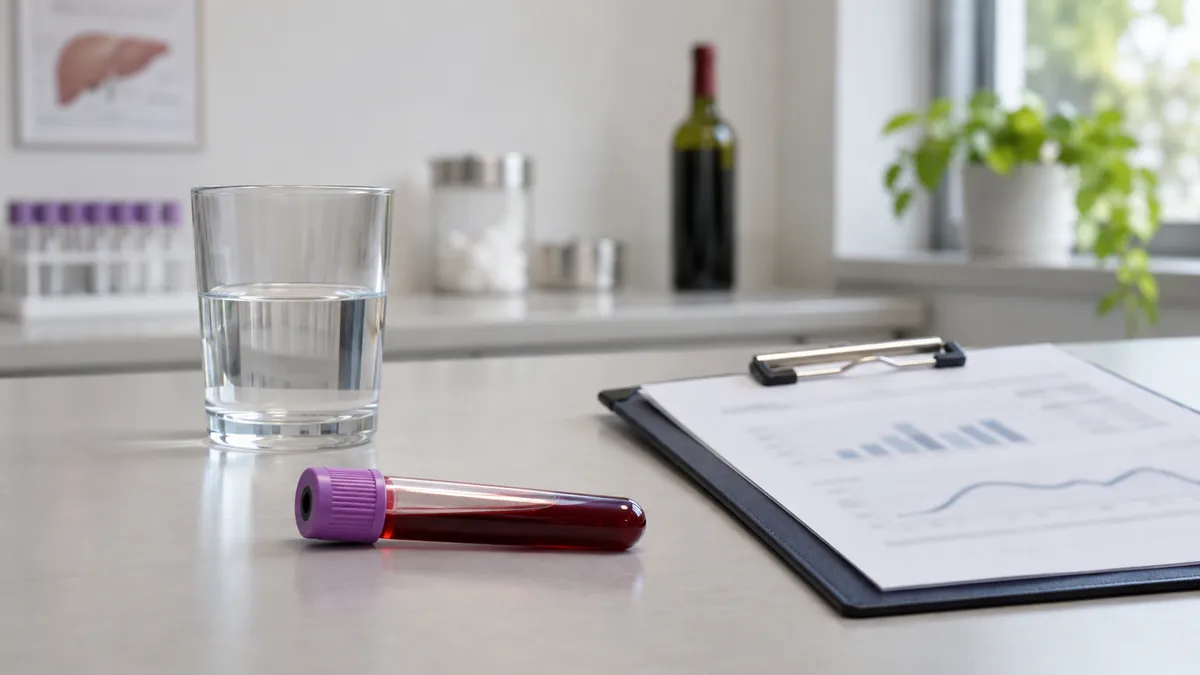
A number can start a conversation, not explain the cause
An elevated triglyceride result can raise an understandable question: could alcohol be part of the reason? It can be one contributor, but a blood test cannot identify alcohol as the cause, estimate how much someone drinks, or diagnose an alcohol-related condition. The result is one piece of a larger health picture. Its meaning depends on whether the sample was fasting, the value and laboratory reference range, other lipid measurements, health conditions, medicines, and the reason the test was ordered. This guide explains what the test can and cannot show; it is not a personal interpretation of a lab result.
What triglycerides measure
Triglycerides are a type of fat carried in the blood and used by the body to store energy. A triglyceride measurement is usually included in a lipid panel alongside cholesterol-related measures such as LDL and HDL. It is not the same as a cholesterol measurement, and one number does not summarize cardiovascular risk. The American Heart Association explains that triglycerides are considered with other risk factors; high levels may matter especially when LDL is high or HDL is low. Your report may display a reference range, but the clinician who ordered the test can explain how that value fits your history and other results.
Why alcohol is part of the discussion
Public-health and cardiology sources list drinking too much alcohol among factors that can raise triglycerides. The National Heart, Lung, and Blood Institute (NHLBI) also lists diabetes, kidney or liver disease, thyroid disease, body weight, physical activity, and diets high in fat or sugar among factors that may affect levels. The American College of Cardiology’s consensus guidance includes alcohol among possible secondary contributors. These sources support a careful question about alcohol; they do not establish that any one person’s elevated result was caused by drinking. Several contributors can coexist, and sometimes the reason is not immediately clear.
One result cannot measure a person’s drinking pattern
A lab result is not a breath test, alcohol biomarker, or record of what someone consumed. It gives a concentration of triglycerides in a blood sample at a particular time. It cannot distinguish alcohol from other contributors or reveal whether someone drinks occasionally, regularly, or not at all. Even a change on a repeat test does not prove why the number changed: fasting status, recent food, health changes, medicines, and ordinary biological variation can all be relevant. A respectful clinician may ask about alcohol because the answer can help interpret risk and plan care, not because a lipid panel has already supplied that answer.
Fasting and nonfasting tests answer related questions
Some lipid panels are collected after fasting and some are not. The American Heart Association notes that a health professional may order either type, depending on the situation. A fasting sample may be requested when a clinician needs a particular measurement or wants to clarify a result. ACC guidance says fasting measurements are useful in certain circumstances, including assessing severe triglyceride levels. These approaches are not contradictory: the appropriate test depends on the question. If a nonfasting result is unexpectedly high, the ordering professional can decide whether a repeat fasting panel or other evaluation is useful.
Follow the laboratory’s preparation instructions
Do not assume that every lipid panel requires fasting, and do not decide on your own to skip food or alter your usual routine. MedlinePlus says triglyceride testing may require fasting for about 9 to 12 hours, while its general fasting guidance says instructions vary by test and that some tests may have additional directions, such as avoiding alcohol for a longer period. Follow the exact instructions from the ordering clinician or laboratory. Ask in advance whether water is allowed, what to do with regular medicines, and whether alcohol avoidance is requested. If instructions were missed, tell the laboratory rather than hiding it or guessing how to proceed.
How to read common adult ranges cautiously
Adult reference categories commonly place triglycerides below 150 mg/dL in the healthy range, 150–199 as borderline high, and 200–499 as high. Labels differ slightly among sources at the 500 mg/dL boundary: MedlinePlus calls 500 mg/dL and above very high, while NHLBI describes levels above 500 mg/dL as very high and ACC guidance uses 500 mg/dL or higher for severe elevation. The practical point is not to debate a single cutoff. Ask how your laboratory reports the result, whether the sample was fasting, and what follow-up the ordering professional recommends. Pediatric ranges are different and should not be interpreted using adult categories.
Why a result near 500 deserves timely follow-up
Very high triglycerides can increase the risk of acute pancreatitis, an inflammation of the pancreas. This is one reason a result around or above 500 mg/dL should not be ignored or interpreted only as a lifestyle score. A number does not mean pancreatitis is present, and it does not predict with certainty what will happen to an individual. MedlinePlus notes that pancreatitis is associated most often with triglycerides above 1,000 mg/dL, while NHLBI describes increased risk at very high values. Contact the clinician who ordered the test for timely, individualized guidance, especially when the value is markedly elevated or the report says it is critical.
Other factors can raise triglycerides too
Alcohol is only one possible factor. NHLBI identifies diabetes, kidney disease, liver disease, thyroid disease, weight, physical activity, and food patterns as possible contributors. ACC lists additional medical conditions and some medicines as potential secondary causes. Family history and inherited lipid disorders can matter too. A clinician may review these alongside the full lipid panel and other relevant tests. Do not stop a medicine or start a supplement because it appears on a list of possible contributors; a medication’s benefits, risks, and alternatives depend on why it was prescribed and on the person taking it.
What a clinician may review next
A follow-up conversation may include whether the sample was fasting, how high the result was, earlier results, family history, alcohol and food patterns, medicines, and health conditions such as diabetes or thyroid disease. The clinician may consider repeating a test, checking other parts of the lipid panel, or looking for a secondary cause. ACC guidance describes persistent hypertriglyceridemia in the context of repeated measures and attention to secondary factors—not from one isolated result. That is a clinical framework, not an instruction for readers to order their own tests or wait a specific number of weeks before asking for help.
Bring context—not just the lab number
A few details can make the conversation more useful: the test date and value; whether you ate or drank anything besides water beforehand; whether the laboratory gave alcohol-specific instructions; recent illness or major routine changes; and the names of prescription medicines, over-the-counter products, and supplements. If comfortable, share an honest description of alcohol use, including typical amount and frequency, because it can inform a clinician’s assessment. You do not have to determine a label or cause before asking for support. Questions such as ‘Was this fasting result?’ and ‘What else could explain it?’ are reasonable starting points.
A normal result does not answer every alcohol question
A triglyceride result within a reference range cannot prove that alcohol use is harmless, rule out alcohol-related health concerns, or show that a person does not have a drinking problem. Conversely, a high result does not diagnose an alcohol use disorder. Those questions require a broader conversation and, when appropriate, assessment by a qualified professional. Alcohol can affect health in ways a lipid panel does not measure. If drinking is causing concern, a clinician can discuss options and connect someone with evidence-based support without relying on this single laboratory result.
Do not change prescribed care on your own
Do not start, stop, or change a statin, fibrate, prescription omega-3 medicine, diabetes treatment, or another prescription based on this article or a single online interpretation. NHLBI notes that clinicians may use several types of medicine to manage triglycerides, but treatment depends on the level, cardiovascular history, other conditions, and potential interactions. Over-the-counter fish-oil supplements are not the same as prescription products. If a report is marked very high or critical, contact the ordering clinic promptly for instructions. If you cannot reach the clinic and feel acutely unwell, use local urgent or emergency care rather than waiting for an online reply.
If you are considering changing alcohol use
Someone who drinks heavily over a long period may be at risk of dangerous withdrawal if they suddenly stop. NIAAA warns that alcohol withdrawal can be life-threatening and says medical support may be needed. Therefore, a suggestion to limit or stop alcohol when triglycerides are very high should not be treated as a do-it-yourself detox plan. If you are worried that you may have withdrawal symptoms or cannot safely cut down, contact a healthcare professional or local addiction-treatment service to plan support. Seizures, severe confusion, or other severe withdrawal symptoms require emergency care. This safety point matters even when the motivation is a laboratory result.
Know when symptoms need urgent care
Seek urgent medical care for sudden, severe, persistent pain in the upper abdomen, particularly when it spreads to the back or occurs with repeated vomiting, fever, or feeling very ill. These symptoms can have several causes, and this article cannot diagnose pancreatitis; they deserve prompt assessment. A very high triglyceride result without symptoms still merits timely follow-up with the ordering clinician, but it is not by itself proof of an emergency. Follow the laboratory’s critical-result instructions and local medical advice. When in doubt about severe or rapidly worsening symptoms, contact emergency services rather than attempting to manage them at home.
Keep commercial resources separate from evidence
The optional program links below lead only to existing Blue Heron program pages. They are commercial wellness resources, not the sources for this article’s medical information, and their inclusion is not an endorsement by NHLBI, MedlinePlus, AHA, ACC, or NIAAA. They should not be treated as a diagnostic service, a substitute for a clinician, or a reason to delay care. A program page cannot determine why a triglyceride result is high or advise a safe alcohol-withdrawal plan. Readers should review any commercial resource critically and make decisions about tests and treatment with an appropriately qualified healthcare professional.
The practical takeaway and limits of this article
The key distinction is simple: alcohol can contribute to higher triglycerides, but a lipid result does not reveal the cause or measure drinking. Follow the test instructions, ask whether the sample was fasting, and review the result in context—especially when it is markedly elevated. Do not change prescribed care or abruptly stop heavy, prolonged alcohol use without medical support. This article is general health education, not diagnosis, individualized medical advice, or a treatment plan. Mr.Hotsia’s editorial review is limited to sourcing and clarity; it is not clinical review and does not imply medical credentials.
Sources and further reading
Medical information was checked against these public health sources on November 7, 2026.
- NHLBI (NIH) — High Blood Triglycerides ↗
- MedlinePlus (U.S. National Library of Medicine) — Triglycerides Test ↗
- MedlinePlus — Fasting for a Blood Test ↗
- American Heart Association — What Your Cholesterol Levels Mean ↗
- American College of Cardiology — 2021 Consensus on ASCVD Risk Reduction in Hypertriglyceridemia ↗
- NIAAA (NIH) — Alcohol Use Disorder: From Risk to Diagnosis to Recovery ↗
- MedlinePlus — Acute Pancreatitis ↗
This article is general health education, not a diagnosis or personal medical advice. Do not change treatment or supplements based on this article. Discuss individual results with a qualified healthcare professional.