Heart & circulation · Peripheral artery disease
Leg Pain While Walking: Could It Be Peripheral Artery Disease?
Leg discomfort that appears with walking and eases with rest can have several explanations. Learn what PAD is, how an ankle-brachial index test works, and which symptoms deserve prompt professional attention.
A walking symptom that deserves context
A recurring ache, cramp, heaviness, or tired feeling in a leg during a walk can change how far someone goes—and it can be tempting to label it as age, fitness, or a joint problem. One possible explanation is peripheral artery disease (PAD), a condition affecting blood flow in arteries outside the heart. The familiar pattern is discomfort with activity that improves after stopping, but symptoms vary and many other conditions can look similar. This guide explains why a clinician may ask about the pattern and consider an ankle-brachial index (ABI) test. It cannot tell whether an individual has PAD or what evaluation they need.
What peripheral artery disease means
PAD in the legs generally refers to narrowed or blocked arteries that carry blood to the lower limbs. Atherosclerosis, the buildup of plaque in artery walls, is a common cause. Reduced blood flow may limit oxygen delivery during activity, when muscles need more. PAD is not the same as a blood clot in a leg vein, and the phrase ‘poor circulation’ is too broad to identify a cause. The 2024 ACC/AHA multisociety guideline describes PAD as a systemic vascular condition associated with risk to the limbs and cardiovascular health. A diagnosis requires clinical assessment; a description of symptoms alone is not enough.
Leg discomfort has more than one possible cause
Pain with walking is sometimes called claudication, but the pattern is not a diagnostic test. NHLBI notes that arthritis, vein problems, and nerve-related pain can also cause leg symptoms. The place where discomfort begins, what brings it on, whether a change in posture matters, and how quickly it eases can help a professional distinguish among possibilities. Joint disease may hurt with particular movements; nerve pain may radiate from the back or change with position. These are broad patterns, not reliable rules for self-diagnosis. Sudden, severe, or rapidly worsening pain should not be assumed to be routine PAD or ordinary muscle soreness.
Symptoms may be subtle—or absent
Not everyone with PAD has the classic calf-cramp story. The CDC notes that some people have no leg pain, while others report discomfort in the buttock, hip, thigh, or calf. A person may instead notice reduced walking ability, a foot that feels unusually cool, numb toes, changes in skin, or a sore that does not heal. Symptoms can be mild, absent, or hard to recognize, especially when another health condition affects sensation or mobility. A lack of textbook symptoms therefore cannot rule PAD in or out. New or persistent changes are worth describing to a healthcare professional, especially when risk factors are present.
Who may be at higher risk
Risk is influenced by more than one factor. CDC lists smoking, high blood pressure, diabetes, high cholesterol, and older age among PAD risk factors. A history of vascular disease or kidney disease may also be relevant to a clinician’s assessment. Risk does not mean a person has the disease, and having no obvious risk factor does not prove that symptoms are harmless. It is not helpful to frame PAD as a personal failure: age, health history, access to care, and many other factors shape risk. Share current and past tobacco exposure and known conditions honestly so an evaluation can be based on the full picture.
The ankle-brachial index, explained
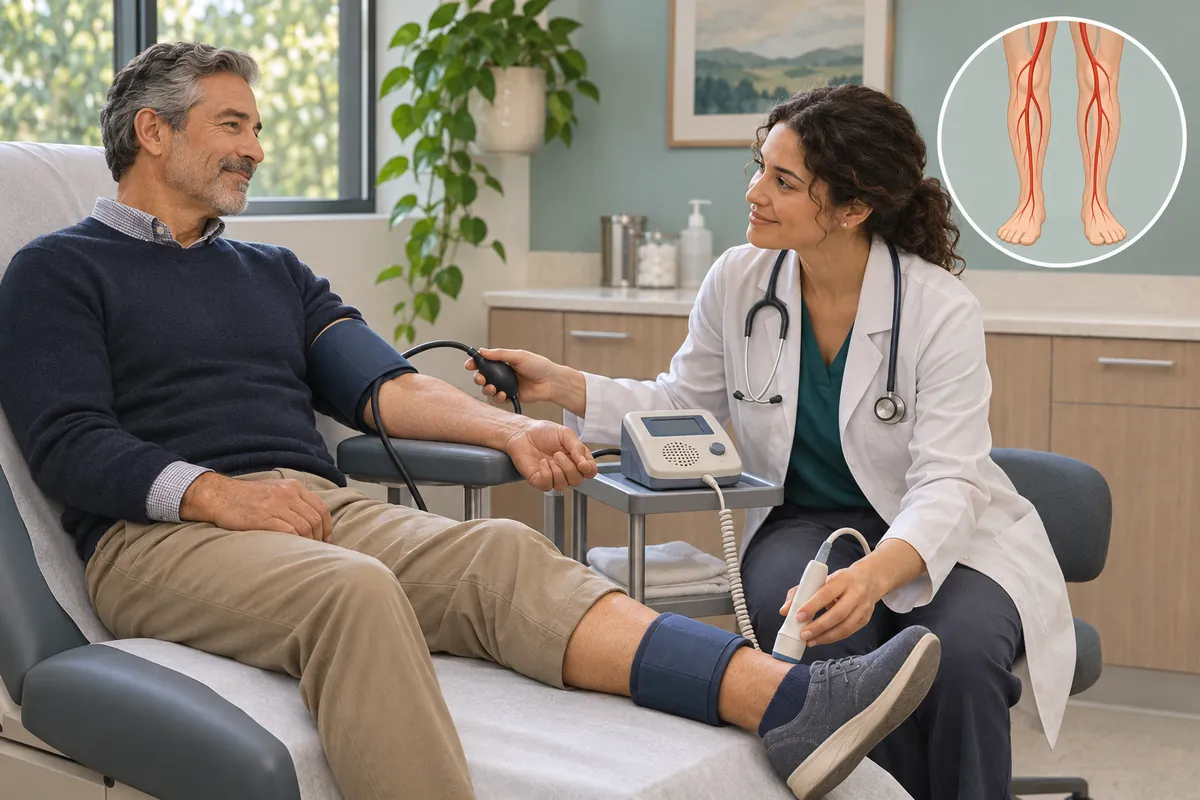
The ABI is a noninvasive test that compares blood pressure measured at the ankle with pressure measured at the arm. A clinician typically uses cuffs and a Doppler device to detect blood flow. The 2024 guideline recommends a resting ABI, sometimes with additional pulse-volume recordings or Doppler waveforms, to establish PAD when symptoms, history, or examination findings suggest it. NHLBI describes ABI as a common first test. It is not a home blood-pressure reading and should not be interpreted using a number found in isolation online. The technician or clinician can explain the method, what was measured in each leg, and whether the result answers the clinical question.
A normal resting test may not end the evaluation
A resting ABI does not answer every question. The multisociety guideline says that when someone has exertional, non-joint leg symptoms but a normal or borderline resting ABI, an exercise treadmill ABI may be used to evaluate for PAD. When an ABI is unusually high and arteries cannot be compressed normally, a toe-brachial index or other assessment may be considered. These are clinician-directed choices based on the history and test pattern—not a menu for patients to demand or order themselves. Additional ultrasound or imaging may be considered when it would clarify the diagnosis or guide care. More testing is not automatically better if the result would not change management.
Why screening is not the same as symptom evaluation
Testing people without symptoms is different from evaluating symptoms. The 2024 guideline says screening with ABI is reasonable for people at increased risk, but does not recommend screening people who are not at increased risk and have no history or examination findings suggesting PAD. Recommendations can evolve and may be applied differently across countries and health systems. An online risk calculator or program page is not a substitute for this decision. If someone has symptoms, that is not simply ‘screening’; the clinician can consider their complaint, examination, medical history, and appropriate testing. If there are no symptoms, ask a professional whether testing would be useful in the person’s particular circumstances.
What happens after a diagnosis is considered
A clinician may ask how far someone can walk before discomfort starts, whether the pattern is stable, and whether rest reliably helps. They may review foot sores, skin changes, pulse findings, tobacco history, diabetes, blood pressure, cholesterol, kidney health, medicines, and family history. An examination can include checking pulses and looking at the feet and legs. Depending on the findings, the next step might be an ABI or another test—or a search for a different cause. There is no universal workup that applies to every person. The goal is to understand symptoms and risk, not to turn one symptom or one test value into a complete diagnosis.
Questions that make an appointment more useful
Before an appointment, note when the discomfort began, where it occurs, what activity triggers it, how long it lasts, and what makes it better or worse. Record changes in walking distance, new numbness, skin or color changes, and any wounds. Bring a list of prescriptions, over-the-counter medicines, and supplements, along with relevant medical history. Useful questions include: ‘What possibilities could explain this pattern?’ ‘Would ABI testing help in my case?’ ‘If the resting test is normal, what would that mean?’ and ‘Which changes should prompt urgent follow-up?’ These prompts help organize a discussion; they do not imply that every person needs testing or a vascular referral.
Why heart and vascular risks are reviewed together
PAD is a leg-artery condition, but the assessment may also consider overall cardiovascular health. CDC and the guideline describe associations between PAD and coronary or cerebrovascular disease. A care team may review blood pressure, cholesterol, diabetes, and tobacco use because these factors affect vascular risk. That does not mean a leg symptom proves that someone has heart disease, or that a general wellness program can evaluate PAD. If a person has known high blood pressure, cholesterol concerns, or kidney disease, those existing issues can be discussed with their usual clinician as part of a broader health review. Do not begin, stop, or change medicines based on this article.
Exercise and treatment should be individualized
For people who are diagnosed, guideline-based care can include medical risk reduction, foot care, structured exercise, and—in selected situations—procedures. The 2024 guideline emphasizes structured exercise therapy for chronic symptomatic PAD; it may be supervised or delivered through a structured community-based program. This is not the same as telling every reader with leg pain to start walking through it. A clinician can advise whether exercise is appropriate and what kind of program fits the diagnosis, mobility, wounds, and other conditions. Medicines such as antiplatelet or cholesterol-lowering therapy are selected for individual reasons and carry risks. Never self-prescribe aspirin or alter prescribed treatment based on a general article.
Foot changes and urgent warning signs
Foot sores that are slow to heal, persistent pain while resting, or a foot that is unusually cold or discolored deserve prompt professional assessment, particularly for someone with known PAD or vascular risk. Sudden severe leg pain, sudden loss of sensation or strength, a markedly cold or pale limb, or rapidly worsening symptoms may signal an urgent problem. Use local emergency services for severe or sudden symptoms; pathways and numbers differ by location. Do not wait for an online article to decide whether an acute change is serious. If a wound is present, avoid applying an unprescribed treatment or delaying care while trying a home remedy.
Keep program pages separate from medical care
Blue Heron Books lists existing commercial wellness program pages, but these are not medical authorities and none is a PAD diagnostic or treatment service. The Blood Pressure Program and The Oxidized Cholesterol Strategy are optional commercial reading for people interested in those separate wellness topics; neither evaluates leg arteries or replaces a clinician’s assessment. The Chronic Kidney Disease Solution is likewise not a PAD test or treatment. These links are included only as navigation to existing program pages and are separate from the public-health sources below. Do not use them to delay care, change a prescription, or decide whether a foot wound or leg symptom needs attention.
A practical, non-diagnostic takeaway
Leg discomfort during activity that improves with rest is one pattern worth mentioning, but it does not prove PAD. Many different conditions can cause pain, and some people with PAD have few or no symptoms. A clinician can use the history, examination, and—in appropriate cases—an ABI or other tests to sort out the possibilities. New foot wounds, rest pain, sudden severe symptoms, or a cold or discolored limb merit timely attention. This article is general health education, not a diagnosis, personal medical advice, test order, or treatment plan. Mr.Hotsia’s editorial review is limited to sourcing and clarity; it is not clinical review and does not imply medical credentials.
Sources and further reading
Medical information was checked against these public health sources on November 7, 2026.
- 2024 ACC/AHA Multisociety Guideline for the Management of Lower Extremity Peripheral Artery Disease (Circulation) ↗
- NHLBI, NIH — Peripheral Artery Disease: Diagnosis ↗
- CDC — About Peripheral Arterial Disease (PAD) ↗
- American Heart Association — How Is PAD Diagnosed? ↗
- Society for Vascular Surgery — Peripheral Artery Disease ↗
This article is general health education, not a diagnosis or personal medical advice. Do not change treatment or supplements based on this article. Discuss individual results with a qualified healthcare professional.