Bone health · Recovery and fracture prevention
After a Low-Impact Fracture: What Bone-Health Follow-Up Can Cover
Once a broken bone is being treated, follow-up may also look at future fracture risk, falls, bone health, and recovery. Here is what a fracture liaison service or care team may review—and what questions can help.
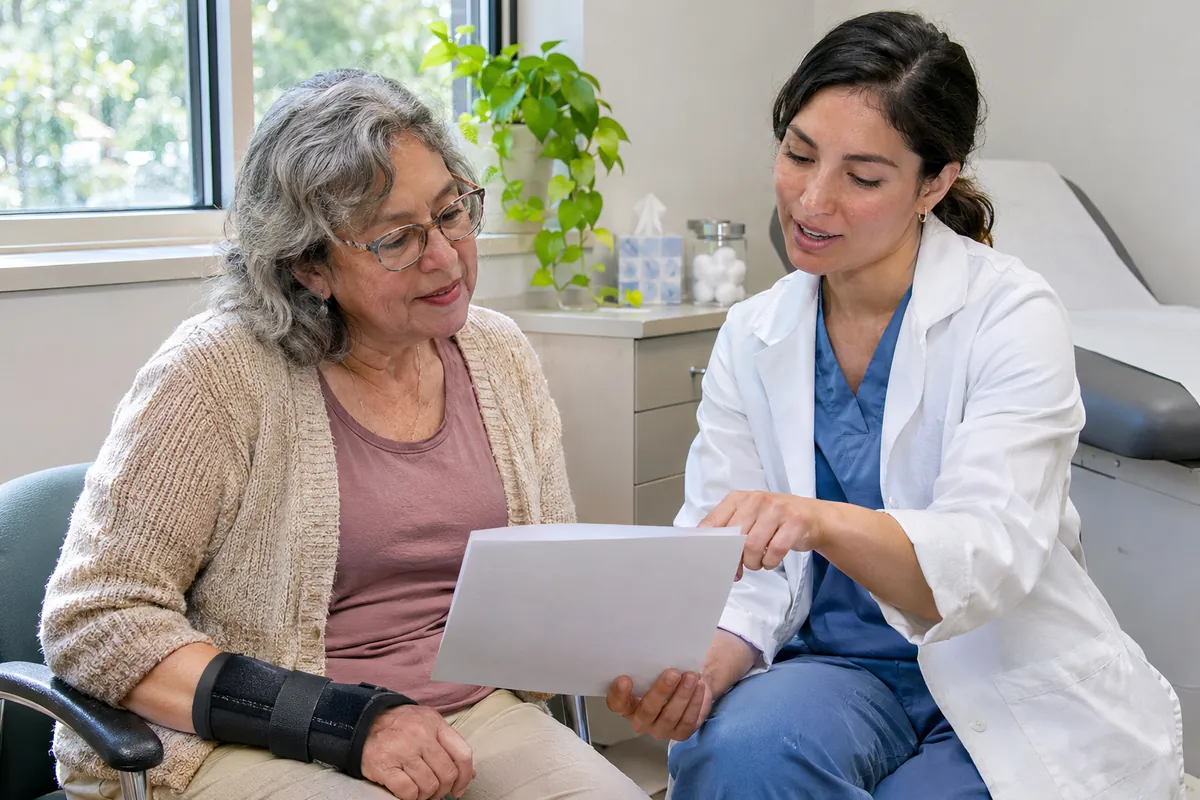
A healed fracture is not always the end of the story
A wrist, hip, or spinal fracture can take over daily life: appointments, pain control, mobility, work, and the practical task of healing. When the immediate injury is stable, another conversation may be useful: could this event reveal a chance to review bone health and reduce the likelihood of another fracture? That question does not assume that osteoporosis caused the break. It simply recognizes that some fractures after a fall from standing height or less can be a signal to assess future risk, particularly in older adults. The type of fracture, force involved, age, medicines, health history, and local guidance all matter. This article explains what follow-up can cover; only a qualified professional with your history can decide what applies to you.
What clinicians mean by a low-impact fracture
A low-impact or fragility fracture is generally a fracture that happens after a fall from standing height or less, or another force that would not usually break healthy bone. The label is a clinical description, not a diagnosis of osteoporosis and not proof that a person did anything wrong. A fall, a stumble, or even a fracture during a routine activity may be interpreted differently depending on the bone involved and the circumstances. Some injuries happen because of substantial trauma, and some people have factors that weaken bone without having been diagnosed. If you are unsure how your injury was classified, ask the treating team what was recorded and whether that classification changes the recommended follow-up. Do not try to calculate your personal fracture risk from a single event or an online score.
Why follow-up can be missed after the urgent injury is treated
Emergency and orthopedic care focuses first on the injury: confirming the fracture, stabilizing it, controlling pain, and helping a person move safely. Bone-health review can be less visible, especially when several teams are involved or when recovery involves discharge from hospital to home. A person may assume that no further assessment is needed because the fracture was repaired or placed in a cast. Conversely, a bone-density result may feel like the only next step, even though the decision can depend on more than one test. The National Osteoporosis Guideline Group (NOGG) recommends coordinated follow-up for people who sustain a fragility fracture, while the Royal Osteoporosis Society notes that some hospitals refer patients to a fracture liaison service. Availability varies by health system and location.
A fracture liaison service can connect the next steps
A fracture liaison service (FLS) is a coordinated service designed to identify people after a fracture and connect assessment, investigation, treatment decisions, and follow-up. NOGG recommends multidisciplinary, coordinator-based FLS care for people with fragility fractures; its guidance describes assessing both fracture and falls risk and arranging tests or treatment where appropriate. In practice, the service may be led by a nurse or another trained coordinator and work with orthopedics, primary care, radiology, pharmacy, or osteoporosis specialists. Not every hospital has an FLS, and the exact pathway differs. If no one has mentioned follow-up, you can ask the hospital discharge team or primary-care office whether an FLS or local bone-health pathway exists. Asking does not mean you need a specific medicine or scan.
Assessment begins with the story of the fracture and your health
A useful assessment starts with details that are easy to forget later: which bone broke, what happened, whether there have been earlier fractures, and how recovery is going. The clinician may ask about falls, balance, vision, mobility, family history, menopause or hormone-related history where relevant, smoking, alcohol, long-term conditions, and medicines. Some of these factors affect bone strength; others affect the chance of falling or the consequences of a fall. They do not all apply to everyone, and the questions are not a test of lifestyle or character. Bring a medicine list and any relevant imaging or discharge summary if you have them. If something is uncertain, say so rather than guessing. Your care team can decide which parts need clarification.
A bone-density scan may help—but it is not the whole decision
A dual-energy X-ray absorptiometry scan, often called a DXA or DEXA scan, measures bone mineral density at selected sites. It may help estimate risk or guide treatment choices, but it is not the only factor and is not automatically required after every fracture. NOGG guidance uses a combination of clinical risk assessment and bone-density measurement in selected situations; the threshold and approach depend on age, fracture history, and health context. A prior fracture can matter even when a scan is not available or cannot be performed promptly. Ask what question the scan is intended to answer, whether the result would change the plan, and how it fits with your fracture history. A normal-looking number at one site should not be used alone to dismiss symptoms or another risk factor.
Sometimes clinicians look for other contributors
Sometimes a clinician considers whether an underlying condition or treatment has contributed to weaker bones. The decision about blood tests or imaging depends on age, fracture pattern, symptoms, history, and examination; there is no universal panel for every person. For example, long-term oral glucocorticoid use is a recognized bone-risk factor in osteoporosis guidelines, while other medical conditions or medicines may also be relevant. A new, unexplained, or repeated fracture may prompt a different evaluation from a single injury after substantial trauma. This is a reason to share your complete medical history—not to order tests on your own or infer a cause from one lab value. Ask which findings would change care, what can wait, and who will explain the results.
Prevention treatment is a shared decision, not a one-size-fits-all rule
For some people, guidelines recommend medication to lower future fracture risk; for others, a clinician may first gather more information or discuss alternatives. NOGG advises treatment for people judged to be at high or very high risk and emphasizes prompt action after a fragility fracture when treatment is indicated. That population guidance does not tell an individual which drug to take. Options can differ in how they are taken, likely benefits, potential harms, interactions, kidney function considerations, cost, and follow-up. A useful discussion includes what is known about your risk, what remains uncertain, and how a proposed treatment fits your preferences and other conditions. Do not start, stop, or change osteoporosis medicine, calcium, vitamin D, or another prescription based on this article. Ask your prescriber or pharmacist to explain the plan.
Ask what should happen next—and when
A simple question can open the discussion: “Now that the fracture is being treated, who will review my risk of another fracture?” You might also ask whether a fracture liaison service is available, whether a bone-density test or other evaluation is appropriate, when you should expect results, and which professional is responsible for follow-up. If you are discharged with a temporary cast, boot, or walking aid, ask when and how activity should change. The timing can depend on the injury and recovery; there is no single schedule for everyone. If appointments are difficult to coordinate, ask whether the hospital, primary-care team, or specialist can share a written plan. A clear handoff is especially helpful when more than one service is involved.
Falls risk deserves its own review
A fracture review can also look at falls, because preventing another injury is not only a bone question. NOGG recommends assessing falls risk in people with osteoporosis or fragility fractures and offering balance and strength exercise to those at risk. A professional may ask about previous falls, dizziness, balance, vision, footwear, home hazards, blood-pressure symptoms, and medicines that can affect alertness or steadiness. The right response might involve vision care, a medication review, an occupational-therapy visit, or supervised exercise; it depends on the person. Avoid copying a balance routine from a video if you feel unsafe standing or are still under fracture restrictions. Ask what is safe now and whether support is needed. A falls review should be practical, respectful, and matched to daily life.
Rehabilitation should protect recovery while rebuilding confidence
Recovery and fracture prevention overlap, but they are not the same plan. The Royal Osteoporosis Society says many broken bones take around six to twelve weeks to heal, though healing time varies by bone and person; a hip fracture often involves surgery and rehabilitation. A physiotherapist or treating clinician can explain what movement is safe, when weight-bearing or exercises may change, and what symptoms need review. As strength and confidence return, the goal is not to rush to a previous routine or test the injury. Use the support and equipment recommended for your fracture, and ask before changing a brace, cast, walking aid, or activity restriction. If fear of falling makes you avoid ordinary movement, tell the care team; graded, supervised rehabilitation may help address function safely.
Food, calcium, vitamin D, and supplements need context
Nutrition supports general health during recovery, but food or supplements cannot replace fracture care or an indicated osteoporosis treatment. NOGG recommends a balanced diet and sufficient calcium and vitamin D intake, with supplements used as necessary. Whether someone needs a supplement can depend on diet, age, medical conditions, test results, medicines, and local recommendations. High doses are not automatically safer or more effective. If you have kidney disease, kidney stones, a history of high calcium, or several supplements, ask a clinician or pharmacist before adding calcium or vitamin D. The Royal Osteoporosis Society also recommends a healthy balanced diet, including protein, during healing. If appetite or access to food is a problem, mention it—practical nutritional support may matter more than a complicated list of products.
Bring a complete medicine list, especially steroid use
Write down all prescription medicines, over-the-counter products, vitamins, and supplements, including dose and how often you actually use them. Long-term oral steroid medicines such as prednisolone can be relevant to fracture risk; do not stop them suddenly or change a dose on your own. Ask the prescriber whether your current treatment should trigger a bone-health review and whether any monitoring is due. If you have already been prescribed an osteoporosis medicine, ask what to do if you miss a dose or have side effects; the answer can differ between drugs. Bring the name of the medicine rather than relying on color or memory. A pharmacist can help clarify labels, interactions, and practical administration questions, while the prescribing clinician remains responsible for individualized decisions.
Know when a new problem needs urgent attention
Follow the emergency instructions from the team treating your fracture. Seek urgent medical help for a new injury with severe pain, obvious deformity, an open wound, inability to use or bear weight on a limb, or a sudden major change in sensation or circulation. After a fall with a head strike, confusion, repeated vomiting, loss of consciousness, or severe headache also needs urgent assessment—especially if you take a blood-thinning medicine. These are general warning examples, not a complete triage tool; local emergency services should guide acute decisions. For a cast or splint, contact the treating service promptly if it becomes too tight, the fingers or toes become numb or blue, swelling worsens rapidly, or pain is uncontrolled. Do not wait for a routine bone-health appointment when an urgent symptom is present.
A short appointment checklist can make follow-up easier
Before a follow-up visit, note the fracture date and site, how it happened, prior fractures or falls, current mobility aids, and any new or worsening symptoms. Bring your medication and supplement list, discharge paperwork, and questions. Useful prompts include: “Was this considered a fragility fracture?” “Is there a fracture liaison or bone-health service?” “Would DXA or another test change my plan?” “Who will review fall risk and rehabilitation?” “Should any medicines or supplements be discussed?” “When and how will I hear the results?” If you need language support, a family member, or accessible written instructions, ask in advance. You do not need to solve the case yourself. The purpose of preparation is to help the clinical team understand what happened and agree on the next step.
The takeaway: one fracture can prompt a useful prevention conversation
A fracture that has been treated still deserves a clear ending to the care pathway: a recovery plan, a named follow-up point, and an explanation of whether bone and falls risk need review. Some people will need testing or treatment; others will not. A fracture liaison service can coordinate that process where available, while local teams may use different pathways. Keep the focus on specific questions rather than assuming one scan, food, exercise, or product is right for everyone. Optional program resources linked on this page are commercial wellness education, not medical evidence or fracture treatment. This article is general education only. It does not diagnose osteoporosis, assess personal fracture risk, or replace care from a qualified professional who knows your history.
Sources and further reading
Medical information was checked against these public health sources on November 10, 2026.
- National Osteoporosis Guideline Group (NOGG) — Summary of main recommendations (updated September 2024) ↗
- NOGG — Section 9: Models of care for fracture prevention ↗
- Royal Osteoporosis Society — Broken hips, wrists and other bones (reviewed April 1, 2026) ↗
- Royal Osteoporosis Society — Fracture Liaison Services ↗
- Bone Health and Osteoporosis Foundation — The clinician’s guide to prevention and treatment of osteoporosis (2022) ↗
This article is general health education, not a diagnosis or personal medical advice. Do not change treatment or supplements based on this article. Discuss individual results with a qualified healthcare professional.