Parkinson’s disease · Walking, freezing, and fall safety
Freezing of Gait in Parkinson’s: Triggers, Safety, and What to Discuss
A temporary feeling that the feet are stuck can raise fall concerns for people with Parkinson’s. Learn what freezing may look like, which patterns to report, what rehabilitation evidence can—and cannot—say, and why sudden new symptoms need urgent attention.
Freezing is a real movement symptom—not a choice
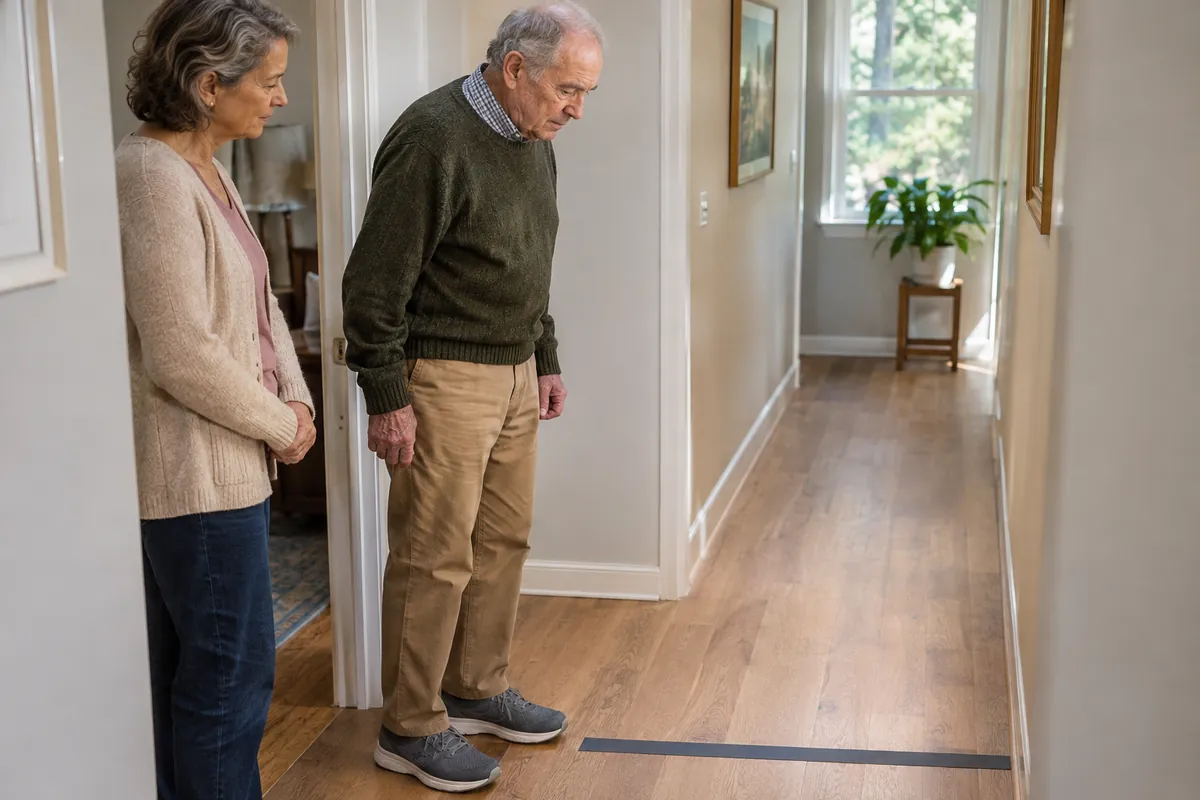
A person starts toward a doorway and their feet seem not to follow. They may make tiny steps in place, hesitate at a turn, or feel briefly “glued” to the floor. Parkinson’s-related freezing of gait is a temporary, involuntary difficulty starting or continuing a step. It is not stubbornness, fear alone, or a failure to try hard enough. A pause may last only seconds, yet it can feel unsettling and can raise the risk of losing balance. This article explains the symptom in general terms and offers a framework for a safer care conversation; it cannot tell an individual why a walking change is happening.
How it can look and feel
The Parkinson’s Foundation describes freezing as a temporary inability to move that can affect walking and, in some people, other movements or speech. A person may notice that their feet make quick steps without making forward progress, or that the first step will not begin. Others may see short shuffling steps, a pause, or difficulty turning. Freezing does not happen to everyone with Parkinson’s, and not every pause in walking is freezing. New, worsening, or unexplained mobility problems need assessment rather than an assumption that Parkinson’s is the cause.
Common situations that may bring it on
Freezing can appear during transitions: starting to walk after standing, turning, going through a narrow doorway, approaching an elevator, or changing from one surface to another. The Parkinson’s Foundation also notes that stress, rushing, and multitasking may be associated with episodes. These are patterns to notice, not guaranteed triggers. One person may freeze at a doorway while another does not. A familiar setting can help reveal whether the difficulty occurs at a particular time of day, after a medication dose is late, or during a certain task—but a pattern alone does not establish its cause.
Why the pattern is worth reporting
A change in walking can affect confidence, independence, and everyday decisions such as whether to cross a room or go outside. Freezing is also associated with falls, especially when the person or a companion tries to force movement during an episode. That does not mean a fall is inevitable. It does mean that recurrent episodes, near-falls, or a new need for help are worth bringing to a qualified clinician. Describe what happened and any injury, rather than relying on a label or a video search to explain the episode.
Medication timing is information, not a self-adjustment plan
Some people notice episodes near the time their next Parkinson’s medicine dose is due. The Parkinson’s Foundation calls this “off” freezing and notes that freezing may lessen after medication in some cases; other people can have freezing even when other symptoms seem controlled. Medication response is individual and should be reviewed with the prescriber. Do not take extra doses, change timing, skip medicine, or alter a prescription based on an article, an episode, or a commercial program. A simple record of dose times and symptoms can help the clinical team decide whether further review is appropriate.
What an assessment may include
An assessment may start with the story: when the difficulty began, what the person was doing, whether it is changing, and whether there have been falls. The Movement Disorder Society notes that a clinician may review history and perform a neurological examination, including observing starting, turning, stride, and foot clearance. Depending on the situation, a clinician may recommend a physical or occupational therapist familiar with Parkinson’s. The goal is not to reproduce a symptom unsafely at home. A professional can choose an appropriate setting and consider other possible contributors to a change in mobility.
A short log can make a visit more concrete
A short, low-burden note can make a visit more useful. If safe and manageable, write down the date and approximate time, the activity, whether a turn or doorway was involved, how long the pause seemed to last, any fall or near-fall, and when the last prescribed dose was taken. Note what helped or did not help without treating it as a proven remedy. A companion’s observations can add context, but ask the person’s permission and keep the record private. If tracking becomes stressful or unsafe, stop; a few examples may be enough to describe the concern.
Cueing and rehabilitation: promising, but individualized
Physical therapy may include gait training and external cues such as visual, auditory, or tactile prompts. The American Physical Therapy Association’s clinical practice guideline found evidence that cueing can improve some walking and gait measures in Parkinson’s, while findings for freezing itself were mixed across studies. Importantly, the guideline found no studies in its review showing whether cueing reduces fall rates or the number of falls. This distinction matters: a change in a measured walking outcome is not proof that every person will freeze less or avoid a fall. Rehabilitation should be tailored and monitored by a qualified professional.
Why one trick does not work for everyone
A cue that works for one person may not work for another, and some techniques can create risk if balance is poor or the environment is unsafe. A therapist may explore whether a visual line, rhythm, focused attention, or another prompt suits the person, then practice it in a controlled setting. Do not assume an online instruction to step backward, march, or turn is safe for someone whose balance and mobility have not been assessed. Ask a physical therapist or occupational therapist how to respond to a freezing episode, what support is appropriate, and what to avoid in that person’s circumstances.
Doorways, turns, and transitions deserve attention
Doorways and turns are common situations to mention because a narrow path or quick change of direction may coincide with freezing. Practical home questions can include whether routes are cluttered, whether lighting is adequate, and whether furniture or loose objects make a turn tighter. The aim is not to redesign a home from a checklist or remove every useful item. A therapist can review important routines—such as moving between rooms, getting to the bathroom, or entering a shower—and help identify changes that fit the person’s home, mobility, and preferences. Avoid adding floor tape or other cues without considering slip and trip hazards.
Home safety is part of the conversation
Fall prevention is broader than freezing alone. The Parkinson’s Foundation’s resources recommend discussing fall risks and asking about physical or occupational therapy. A clinician may also consider issues such as balance, blood pressure changes, vision, medication effects, cognition, footwear, or the home environment. Which factors matter varies. A recent fall, fainting, new weakness, or a sudden change in walking deserves prompt attention rather than a home exercise challenge. Do not start a strenuous balance routine or stop an activity that matters to you solely because an online article says it is safe or unsafe.
How a companion can help without pulling
During a freezing episode, a companion may feel pressure to hurry the person along. The Parkinson’s Foundation cautions that trying to force someone to move can contribute to loss of balance and falls. A calmer response is to pause, give the person time, and follow a plan developed with their care team. Ask ahead of time what words or cues they prefer and whether they want physical support. Do not pull an arm, push the torso, or move a mobility aid without permission and a safe plan. Respectful support preserves the person’s control and can reduce the pressure of being rushed.
Walking aids should be selected for the person
A cane or walker can help some people, but a mobility aid that is unstable or difficult to manage could introduce another hazard. The American Parkinson Disease Association notes that a therapist can help select an aid suited to an individual; some walkers may continue rolling unless their brakes are engaged. That is a reason to seek professional fitting and instruction, not a reason to purchase a specific device from an article. If an aid is already in use, ask whether its height, brakes, turning space, and use during freezing have been checked. Needs can change over time, so review the plan when walking changes.
Sudden new walking trouble can be an emergency
Do not assume a sudden walking problem is Parkinson’s freezing. The CDC lists sudden trouble walking, dizziness, loss of balance or coordination among stroke warning signs, along with sudden weakness or numbness, vision changes, confusion, trouble speaking, or a severe unexplained headache. If these occur suddenly, call local emergency services immediately; do not wait to see whether the symptoms pass. A transient ischemic attack can also produce symptoms that resolve and still requires urgent medical attention. For a fall with a head injury, severe pain, inability to get up, or another serious concern, seek urgent local medical help.
Questions to bring to a care visit
Useful questions for a visit include: “Could anything besides Parkinson’s be contributing?” “Should a physical or occupational therapist assess freezing and fall risk?” “Which details would be useful to track?” “Could the timing relate to my prescribed medication, and who should review that?” “What should I do if I freeze while walking?” “Would a cane or walker help, and can someone check its fit?” and “Which changes should prompt urgent care?” If possible, bring a current medication list and a trusted companion, but the person living with Parkinson’s should guide what is shared and which goals matter most.
The takeaway: describe the pattern and plan safely
Freezing of gait is a recognized movement symptom that can make starting, turning, and navigating transitions difficult. Details about timing, context, falls, and prescribed medication can help a clinician and therapist plan an appropriate assessment. Cueing and rehabilitation may help some walking outcomes, but evidence is mixed for freezing and does not establish that cueing prevents falls for every person. Three existing Blue Heron program pages may interest readers who want separate consumer resources: The Parkinson’s Protocol, The Vertigo & Dizziness Program, and Brain Booster. These commercial pages are not Parkinson’s treatment, rehabilitation, clinical assessment, or evidence sources; they cannot diagnose freezing, choose medication, assess a mobility aid, or replace care from qualified professionals. Their inclusion is not an endorsement or promise of benefit; do not delay care to view them. Do not adjust medication or try a potentially risky maneuver on your own. Sudden new trouble walking or other stroke warning signs require emergency help. This article is general education, not diagnosis or personal medical advice. Mr.Hotsia reviewed sourcing and clarity only; this was not a clinical review and does not imply medical credentials.
Sources and further reading
Medical information was checked against these public health sources on November 10, 2026.
- Parkinson’s Foundation — Freezing: triggers, falls, and when to ask about professional support ↗
- American Physical Therapy Association — Physical Therapist Management of Parkinson Disease: Clinical Practice Guideline ↗
- International Parkinson and Movement Disorder Society — Gait Disturbances and Freezing in Parkinson’s Disease ↗
- American Parkinson Disease Association — Freezing of Gait ↗
- CDC — Signs and Symptoms of Stroke ↗
This article is general health education, not a diagnosis or personal medical advice. Do not change treatment or supplements based on this article. Discuss individual results with a qualified healthcare professional.