Stress & everyday wellbeing · Relaxation skills
A Gentle Breathing Pause for Everyday Stress: How to Try It Without Forcing Your Breath
A practical, evidence-aware guide to a brief comfortable breathing pause, what research can say about relaxation, and when to stop or seek individual support.
A pause, not a cure
A short breathing pause can be one low-cost way to interrupt a busy moment and pay attention to how you feel. It is not a cure for stress, anxiety, panic, high blood pressure, or a heart or lung condition. Nor does a person need to achieve a particular breathing rate to do it correctly. Public-health sources describe breathing as one of several relaxation practices, while emphasizing that evidence for specific health outcomes is limited. The purpose here is modest: offer a gentle optional routine, explain its boundaries, and make it easy to stop if it does not feel right.
What people mean by slow breathing
In this article, “slow breathing” means breathing gently and comfortably rather than taking unusually large breaths, holding the breath, or trying to force the body into a pattern. The NHS suggests allowing the breath to flow as deeply as is comfortable, breathing gently and regularly, and using a count only if helpful. That description is intentionally different from competitive breathwork or techniques that involve prolonged holds. There is no need to inhale maximally or push the abdomen outward. A normal breath that feels comfortable is a better guide than a target number copied from a video or app.
A comfortable starting position matters
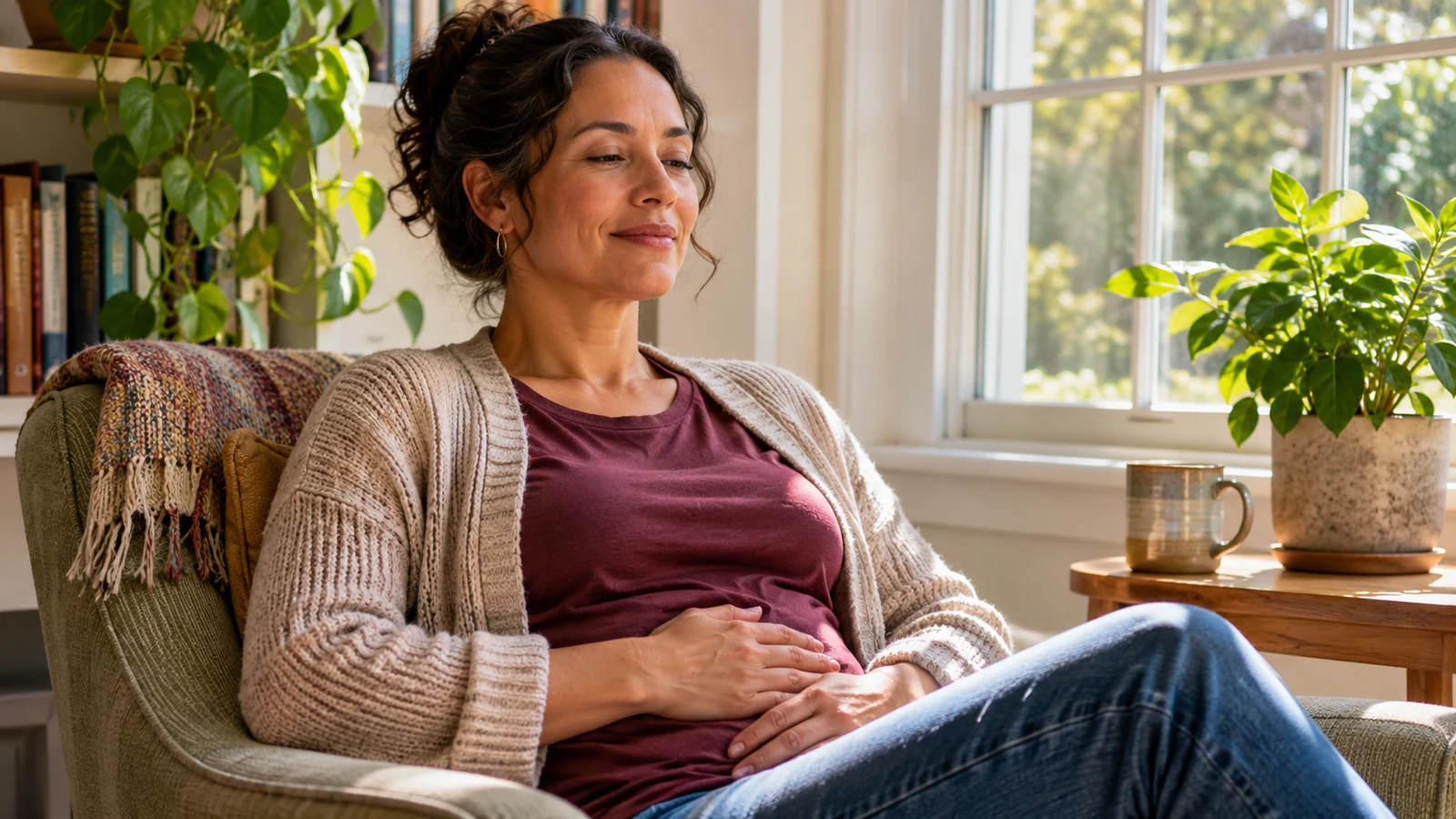
Choose a position in which you feel steady. The NHS describes sitting in a supportive chair, standing, or lying down as options; if sitting or standing, feet can rest flat on the floor. Loosen clothing only if it feels restrictive and is easy to adjust. You do not need a special cushion, timer, wearable, or quiet room. If closing your eyes feels uncomfortable, keep them open and let your gaze rest on an ordinary object. The point is to make the pause accessible—not to recreate a perfect studio setup or to treat posture as a medical intervention.
Try an unforced, even rhythm
If you want to experiment, start by noticing one ordinary breath without changing it. Then, if comfortable, let the next few breaths be gentle and regular. You might breathe in through the nose and out through the mouth, as the NHS example describes, or simply breathe in a way that feels natural. Some people like counting slowly on the way in and out; others find counting distracting. There is no evidence-based requirement in the sources for a precise ratio or a fixed number of breaths. Keep the effort light, and allow the rhythm to return to its usual pattern whenever you wish.
Counting is optional
Counting can provide a simple anchor when attention is scattered, but it is optional. The NHS suggests counting steadily from one to five during an easy inhale and again during an easy exhale, while noting that not everyone will reach five at first. That is an example, not a test. You could instead notice the feeling of your feet on the floor, the contact of your back with the chair, or a sound in the room. If numbers make you feel pressured, skip them. The exercise is not meant to prove that you can breathe slowly or to measure a personal health score.
Why a gentler exhale may feel calming
Some public guidance explains that relaxation techniques may prompt a relaxation response, which can include slower breathing and changes in heart rate or blood pressure. NCCIH says relaxation methods generally aim to create that response, but it also cautions that evidence for usefulness in specific health conditions is limited. A slower exhale may feel soothing for some people, yet no one should assume that a particular sensation means a medical problem has improved. The experience can vary from one person to another and from one day to the next.
What the evidence can—and cannot—say
Research summaries are not the same as a promise that a technique will work for every reader. NCCIH notes preliminary evidence from a small review that diaphragmatic breathing exercises may help reduce stress, while stressing that research is ongoing and evidence for particular conditions is limited. The American Heart Association (AHA) describes slow breathing as a possible stress-management technique, but advises people with heart or lung conditions to consult a healthcare professional before trying its breathing techniques. This article therefore avoids presenting breathing as treatment, as a substitute for counseling or medication, or as a way to control a diagnosis.
Practice in an ordinary moment
A useful first try can be brief and happen during a neutral part of the day, rather than only when distress is already intense. For example, you might pause after sitting down at home, before a routine task, or while waiting for a kettle—provided you are not driving, operating equipment, or responsible for something that needs your full attention. Try a few comfortable breaths and then return to what you were doing. NHS guidance describes a five-minute routine, but there is no need to begin there or continue if you feel uncomfortable. A shorter trial is completely reasonable.
Notice comfort, not performance
A helpful measure is whether the practice feels acceptable, not whether you can maintain a particular pace. There is no need to monitor oxygen, pulse, blood pressure, or breath count as part of this simple exercise. If you do track a health measure for a clinician, follow the instructions you were given rather than substituting an informal breathing session. You may notice no change, feel a little calmer, or prefer another kind of pause. None of those responses is a personal failure. The most useful routine is one that is safe, optional, and compatible with your circumstances.
When focusing on breath feels uncomfortable
For some people, paying close attention to breathing can increase discomfort, worry, or a sense of losing control. NCCIH notes that relaxation techniques are generally considered safe for healthy people, but some people report negative experiences such as increased anxiety, intrusive thoughts, or fear of losing control. The AHA advises stopping a technique if you feel dizzy or light-headed. If this happens, stop focusing on the breath. Open your eyes, return to natural breathing, notice your surroundings, or choose a different grounding activity. You are not required to push through distress to complete an exercise. If similar reactions keep happening or interfere with daily life, consider discussing them with a qualified professional.
Health conditions deserve individual context
A general article cannot account for every health history. The AHA specifically advises consulting a healthcare professional before trying its breathing techniques if you have a heart- or lung-related medical condition. People who have been told to follow a particular breathing plan, use oxygen, or avoid certain maneuvers should follow their own clinician’s instructions rather than trying a general routine. If you are pregnant, recovering from surgery, or managing a condition that affects breathing, seek advice appropriate to your situation when unsure. Do not change prescribed treatment or delay care because a relaxation exercise seems promising.
Breathing practice is not emergency care
A breathing pause is not a response plan for sudden or severe symptoms. NHS guidance says to seek emergency help for severe difficulty breathing, a tight or heavy chest, pain spreading to the arms, back, neck, or jaw, very pale or blue/gray lips or skin, or sudden confusion. Use the emergency number where you are; the NHS page’s 999 instructions apply in the UK. Do not try to manage a possible emergency by counting breaths or waiting to see whether relaxation helps. For less urgent but persistent symptoms, arrange an assessment rather than using this article to decide what caused them. The older article “Shortness of Breath: What to Notice—and When to Seek Help” offers general context, but it cannot assess an individual situation either.
Stress support can be broader than breathing
Stress often has practical, social, and health-related contributors. A brief pause may sit alongside sleep routines, movement, connection with supportive people, problem-solving, or professional mental health care, depending on what is going on. NCCIH describes relaxation as one approach among others and advises not to use it to replace conventional care or postpone seeing a doctor about a medical problem. If worry is persistent, interferes with work or relationships, or feels hard to manage, a conversation with a mental health professional or primary-care clinician may be more useful than repeatedly trying to perfect a breathing technique.
A simple way to make the pause repeatable
To make an optional pause easier to remember, connect it with a routine cue: after closing a laptop, before a meal, or when sitting down at the end of the day. Keep the plan flexible. You might decide in advance that one or two gentle breaths are enough, and that stopping is always allowed. If the practice is not helpful, choose another brief reset, such as stretching comfortably, stepping outside, or naming a few things you can see. A small routine should reduce pressure, not create another task to complete or another reason to judge yourself.
Optional program pages are commercial resources
Blue Heron Books lists existing wellness program pages such as Overthrowing Anxiety, The Blood Pressure Program, and The Insomnia Program. These are commercial resources, not the evidence base for this article, and their inclusion is not a recommendation that any reader needs to buy a program. They do not diagnose a condition, replace a qualified healthcare professional, or establish that breathing practice treats anxiety, hypertension, or insomnia. Review any program’s scope and claims carefully, and discuss personal symptoms or treatment decisions with a qualified professional. No program page should be used to stop prescribed care or delay assessment.
A modest takeaway and editorial disclosure
The practical summary is simple: if you wish, try a few gentle, natural-feeling breaths while safely seated or standing; count only if it helps; and stop if the exercise feels uncomfortable. No special pace, breath hold, or health outcome is promised. People with heart or lung conditions or specific breathing instructions should ask their healthcare professional before trying a new technique. Seek urgent care for alarming symptoms and do not substitute relaxation for evaluation or treatment. This article is general health information, not diagnosis, personal medical advice, or a treatment plan. AI tools assisted with drafting and organization. Mr.Hotsia reviewed sourcing and clarity only; no clinical review or medical credentials are implied.
Sources and further reading
Medical information was checked against these public health sources on November 12, 2026.
- NHS — Breathing exercises for stress (page reviewed June 12, 2026) ↗
- NCCIH — 5 Things To Know About Relaxation Techniques for Stress ↗
- American Heart Association — Stress Management: Deep Breathing Benefits and Techniques ↗
- NCCIH — Anxiety and Complementary Health Approaches ↗
- NHS — Shortness of breath: when to get urgent or emergency help ↗
This article is general health education, not a diagnosis or personal medical advice. Do not change treatment or supplements based on this article. Discuss individual results with a qualified healthcare professional.