Nutrition literacy · Added sugars and food labels
Added Sugars vs. Total Sugars: How to Read a Label in Context
A calm, practical guide to serving sizes, added sugars, total sugars, and percent Daily Value—plus the important difference between a U.S. label reference and a personal nutrition target.
AI assistance was used to draft and organize this article. Mr.Hotsia’s editorial review is limited to checking sources and clarity; it is not clinical review and does not imply medical credentials.
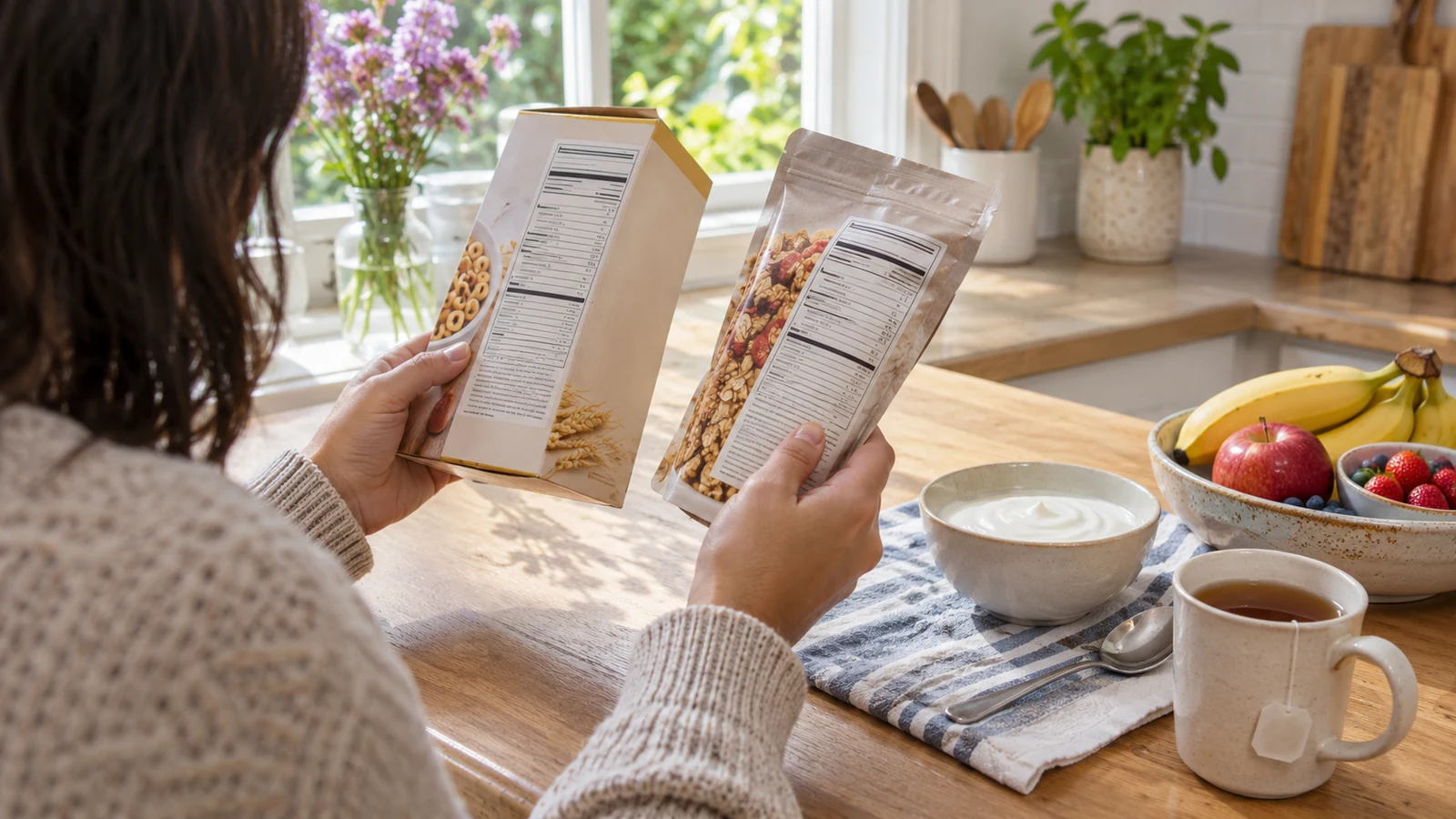
A label is a comparison tool, not a verdict
Nutrition labels can make a routine grocery choice feel more complicated than it needs to be. One package lists total sugars; another also shows added sugars and a percent Daily Value. A useful reading does not require sorting foods into perfect and forbidden categories. Instead, treat the label as a tool for answering a specific question: what does one stated serving contain, and how does that compare with a similar option? The label cannot describe every feature of a food or predict an individual health outcome. It can make one part of a decision easier to see.
Start with the serving size and the amount you actually eat
Begin near the top of the Nutrition Facts panel. Note the serving size and the number of servings in the package. Nutrient amounts on the U.S. label are generally listed for one serving, not necessarily the amount someone will pour, scoop, or eat. If a package contains two servings and a person consumes the whole package, the sugars and other listed amounts would be about twice the per-serving figures. The serving size is a standardized reference for the panel; FDA says it is not a recommendation about how much a person should eat. The comparison only works when you account for the portion you actually use. A familiar bowl or cup may hold more than one labeled serving, so checking grams, milliliters, or pieces can help make the comparison less abstract. There is no need to measure every meal; this is simply a way to avoid comparing unlike amounts.
Total sugars include more than added sugars
On the U.S. Nutrition Facts label, total sugars include sugars naturally present in foods such as milk and fruit, plus any sugars added during processing or preparation. The added-sugars line is included within—not on top of—the total-sugars amount. For example, FDA’s sample yogurt label shows 15 grams of total sugars, including 7 grams of added sugars; the remaining 8 grams are naturally occurring milk sugars. Reading both lines prevents a common mistake: assuming that the total-sugars number represents only table sugar or sweeteners added by a manufacturer.
What the FDA means by added sugars
FDA describes added sugars on the U.S. label as sugars added during processing or preparation, including familiar sweeteners such as sucrose and dextrose, sugars packaged as sweeteners, honey and syrups, and some sugars from concentrated fruit or vegetable juices. The exact legal label definitions and exemptions are jurisdiction-specific. Honey or syrup can count as an added sugar in a mixed food; when sold as a single-ingredient product in the United States, its label may show the percent Daily Value in a footnote rather than a gram amount on the Added Sugars line. A front-of-package phrase such as “made with honey” does not by itself tell you how much is in a serving. The ingredient list and Nutrition Facts panel answer different questions, and package rules may vary across countries.
Why milk and whole fruit can show total sugar
A plain milk product can list total sugars because milk naturally contains lactose. A whole fruit may also contain naturally occurring sugars while providing fiber and other nutrients. That does not make all foods nutritionally identical, and the label does not say that a fruit or milk serving is “sugar-free.” It means the total-sugars number alone cannot separate naturally occurring sugars from added sugars. On the U.S. label, the separate Added Sugars line helps with that distinction. For foods without added sweeteners, the added-sugars amount may be zero even when total sugars are present. Looking at the whole food, serving size, ingredient list, and other nutrients gives more context than reacting to one number.
How to use the added-sugars line and % Daily Value
For products using the U.S. Nutrition Facts panel, the Added Sugars row usually presents both grams and % Daily Value. FDA’s general guide treats 5% Daily Value or less per serving as low and 20% or more as high for a nutrient. These are quick comparison cues for one serving, not grades for the whole product or a personalized limit. The percent column is especially helpful when two similar packages have different serving sizes, although equalizing serving amounts is still important. A low %DV for added sugars does not automatically mean a food is the best choice overall, and a higher %DV does not make a food unsafe to eat. It answers a narrower question about that nutrient in the listed serving.
The 50-gram Daily Value is a U.S. label reference
The FDA lists 50 grams as the Daily Value for added sugars on the U.S. Nutrition Facts label, based on a 2,000-calorie reference diet. That number lets the label calculate a consistent %DV across packaged foods. It is not a prescription that every person should consume 50 grams, a goal for a child, or a personalized maximum. Energy needs and nutrition plans differ, and another country may use a different label system or reference amount. It is also important not to confuse a label’s Daily Value with an individual clinician’s advice. If a package uses a nutrition panel from a different jurisdiction, read that panel’s definitions and local guidance rather than importing U.S. figures without checking.
Free sugars and added sugars are related—but not identical
The World Health Organization uses the term free sugars in its guidance. WHO defines free sugars to include sugars added by a manufacturer, cook, or consumer, and sugars naturally present in honey, syrups, fruit juice, and fruit-juice concentrates. This category overlaps with the FDA’s added-sugars definition but is not identical to it: WHO includes sugars in honey and juice as free sugars even when they were not added during manufacturing. The terms answer related but different questions. If you compare an international recommendation with a U.S. panel, keep the definitions in view; the added-sugars number may not capture every sugar that WHO includes as free sugar.
What international guidance can tell you
WHO’s guideline recommends reducing free sugars to less than 10% of total energy intake for adults and children, and conditionally suggests a further reduction below 5%. WHO has also described the relationship between free-sugar intake and dental caries. These are population-level recommendations expressed as a share of energy, not a direct gram target printed on every package. They do not tell an individual what to eat at a specific meal or diagnose a health condition. The 5% recommendation is conditional, not a rule that every person must meet. A useful takeaway is that label literacy works best alongside broad dietary guidance, local health advice, and practical circumstances—not as a reason to fear every food that contains sugar.
Ingredient lists add useful context
An ingredient list can help answer whether and where sweeteners appear, particularly when a panel does not give a separate amount for every ingredient. Look for names such as sugar, syrup, honey, or other sweetening ingredients, while remembering that ingredient names and order are governed by local labeling rules. An ingredient list does not usually tell you the exact grams contributed by each ingredient. The Nutrition Facts panel tells you the total or added-sugar amount under that country’s rules; the ingredients tell you what was used. Neither list reveals the entire story of a food’s taste, affordability, role in a meal, or fit with a person’s preferences. Front-of-pack claims are another layer, not a substitute for those details.
Compare like with like before deciding
Compare two versions of the same kind of food: for example, two yogurts or two breakfast cereals, rather than a yogurt with a fruit. First align the serving size or convert each product to an equivalent amount. Then compare added sugars, total sugars, and whichever other nutrients matter to the decision—such as fiber, sodium, or saturated fat. A package that is lower in one measure may differ in another, and taste, price, availability, and how much is actually eaten all count. FDA notes that %DV can help compare products when the serving sizes are the same. If the serving sizes differ, compare equal amounts or use grams per 100 grams when that information is available and appropriate on local packaging.
A worked example without a perfect-food score
Imagine two plain-looking breakfast products with the same serving size. Product A lists 8 grams of total sugars and 0 grams of added sugars; Product B lists 13 grams of total sugars, including 5 grams added. The numbers would support a narrow conclusion: in those listed servings, Product B has more added sugars, while Product A’s total sugars may be naturally occurring or otherwise explained by its ingredients. They would not establish that Product A is “healthy” for everyone, that Product B should never be eaten, or that either product changes an individual’s blood glucose or weight. The rest of the panel and the person’s needs still matter. The example is illustrative, not a label from a real product.
What a label cannot reveal about your whole diet
A packaged-food label cannot show the whole pattern of what someone eats over days or weeks. It does not account for every portion, home recipe, restaurant meal, or beverage, and a single nutrient cannot summarize overall nutrition. FDA’s current U.S. guidance says the label can help people make informed choices; the U.S. Dietary Guidelines for 2025–2030 emphasize reducing highly processed foods, including those with added sugars. WHO guidance approaches sugars through its own free-sugars definition. Those public-health documents provide context, not an individual meal plan. Food access, culture, budget, allergies, medical conditions, and preferences may change what options are realistic.
Small changes can be practical, not punitive
If you want to use the information, choose one practical comparison instead of trying to audit every item in the kitchen. You might compare two drinks you buy regularly, select a less-sweet version if you like it, or keep a preferred food and balance it with other choices. FDA describes %DV as a way to compare and make trade-offs; it does not say that people must give up favorite foods to eat well. Small changes are optional and should not become a source of shame. If a substitution costs more, tastes unsuitable, or does not fit your household, a different option may be more workable. Sustainable routines are usually easier to keep than strict rules built around one label line.
When personal nutrition advice matters
People managing diabetes, kidney disease, liver conditions, eating-disorder recovery, pregnancy, or a prescribed nutrition plan may need guidance that goes beyond a general label explanation. A registered dietitian or other qualified healthcare professional can help interpret food labels in light of a person’s full medical and nutrition context. Do not change prescribed medicines, restrict whole food groups, or alter a treatment plan because of an online article. A person with symptoms or a health concern should seek appropriate professional advice rather than using a nutrition label to self-diagnose. If you are comparing products for someone else, their clinician’s instructions and preferences should guide the decision.
A short shopping checklist and the main takeaway
A quick label check can be simple: (1) confirm the serving size; (2) decide how much you would actually use; (3) distinguish total sugars from added sugars; (4) use %DV only as a U.S. label comparison cue; and (5) check the ingredient list and other nutrients that matter. If the package uses a different country’s panel, follow its definitions and local guidance. The bigger picture matters more than a single line. Optional program links below are commercial resources for broader wellness topics, not sources for the medical evidence here and not treatment recommendations. AI helped draft and organize this explainer; Mr.Hotsia’s editorial review covers sourcing and clarity only. No clinical review is implied. This article is general health education, not diagnosis or personal medical advice.
Sources and further reading
Medical information was checked against these public health sources on November 14, 2026.
- Added Sugars on the Nutrition Facts Label — U.S. Food and Drug Administration ↗
- How to Understand and Use the Nutrition Facts Label — U.S. Food and Drug Administration ↗
- Daily Value on the Nutrition and Supplement Facts Labels — U.S. Food and Drug Administration ↗
- Guideline: Sugars Intake for Adults and Children — World Health Organization ↗
- Sugars and Dental Caries — World Health Organization, updated August 14, 2025 ↗
- Current Dietary Guidelines, 2025–2030 — U.S. Office of Disease Prevention and Health Promotion ↗
This article is general health education, not a diagnosis or personal medical advice. Do not change treatment or supplements based on this article. Discuss individual results with a qualified healthcare professional.