Heart & circulation · Home blood-pressure measurement
Blood Pressure Cuff Fit: Why Size Matters for a Reliable Reading
A cuff that does not fit the measured upper arm can affect a home blood-pressure reading. Learn how to check the manufacturer’s size range, compare measurements, and ask for help without trying to diagnose yourself from a single number.
AI assistance was used to draft and organize this article. Mr.Hotsia reviewed sourcing and clarity only; no clinician reviewed the article and no medical credentials are implied.
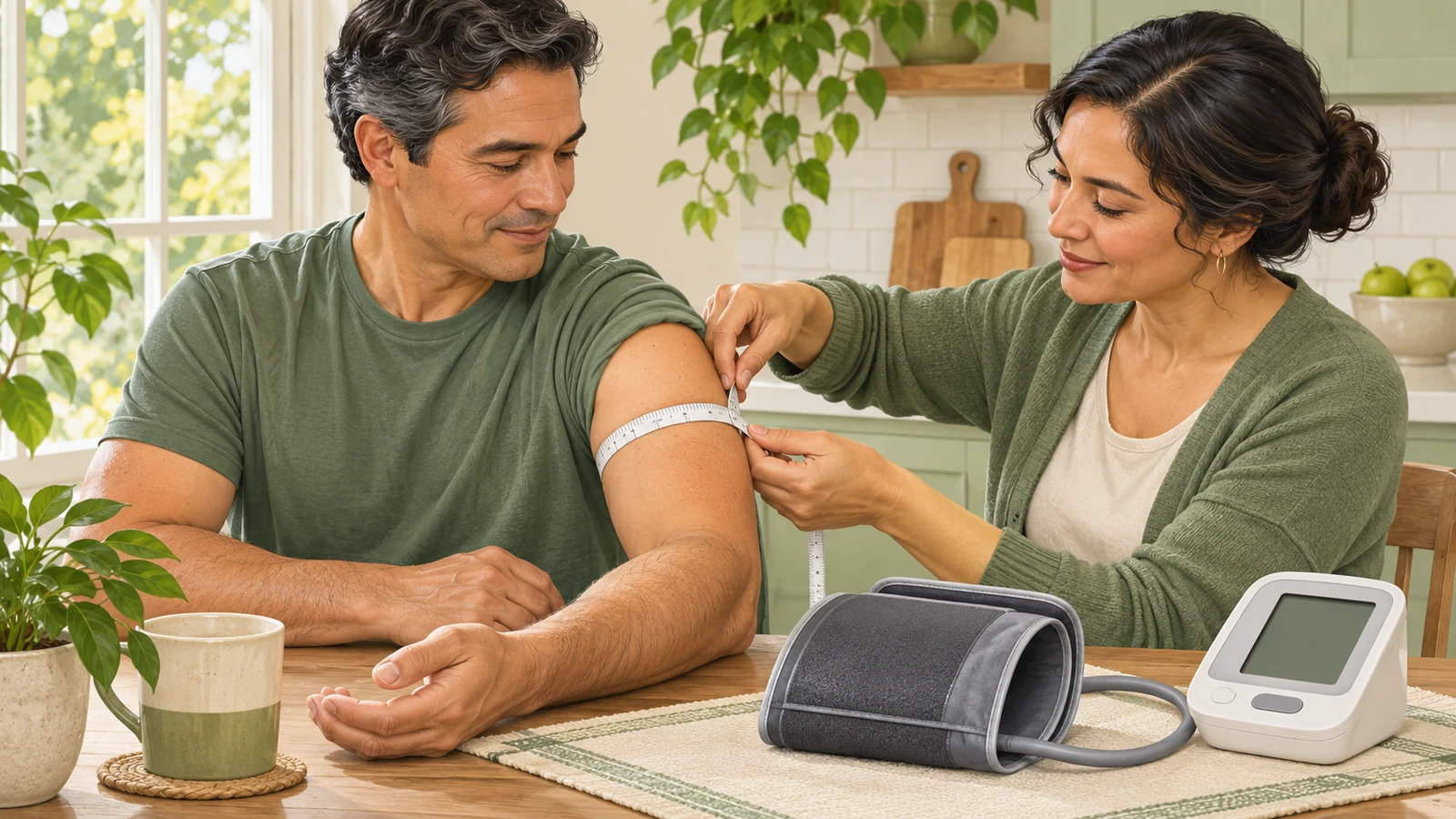
A small setup detail can change a measurement
A home blood-pressure monitor can look simple: wrap on a cuff, press a button, and read two numbers. Yet the cuff has to be the right size for the arm and the device. The American Heart Association (AHA) notes that an incorrectly sized cuff can produce an inaccurate reading. That matters because measurements are only useful when their limits and setup are understood. Cuff fit is one part of the process—not a diagnosis, a treatment, or a reason to change medication. This guide explains what to check and what a general article cannot determine for you.
What research says about using the wrong cuff
The problem is sometimes called miscuffing: using a cuff that is too small or too large for the measured arm. In a randomized crossover study of 195 adults, readings taken with a regular cuff instead of the size selected for the participant differed in opposite directions depending on the cuff that person needed. The mean systolic difference was modest for small cuffs, larger for large cuffs, and greatest for extra-large cuffs. The study shows why size matching matters; it does not mean every person’s reading will shift by the same amount. An optional existing Blood Pressure Program review is commercial material, not evidence or clinical advice.
A study is not a correction chart for your reading
A group average cannot tell you what adjustment, if any, applies to your own measurement. Do not add or subtract a number from a home result based on a study, and do not use cuff size to decide whether you have hypertension. Research methods, devices, arms, and measurement conditions differ. A clinician interprets repeated measurements together with the person’s history and the method used. If you are uncertain whether your cuff is appropriate, verify the arm range printed on that cuff and the monitor’s instructions, then ask a healthcare professional or pharmacist to check the fit and operation.
Start with the cuff’s printed arm-circumference range
Turn to the cuff label, user manual, or manufacturer’s product information. Most upper-arm cuffs list a circumference range, such as a minimum and maximum number of centimeters or inches. Measure the arm as the manufacturer instructs and compare the result with that range. Do not choose by the words “small,” “adult,” or “large” alone: naming and ranges can vary across brands and models. Some cuffs use a printed index line to show whether the overlap falls in the approved zone. These markings and the device manual are more useful than guessing from appearance or comparing your cuff with another person’s.
Measure the part of the arm the instructions specify
The measuring location and technique matter. The AHA scientific statement describes measuring arm circumference at the midpoint of the upper arm for cuff selection in clinical measurement. For a home device, follow the cuff and monitor maker’s own directions because the approved range and placement diagram are specific to that model. A flexible tape should lie against the skin without being pulled tight or left loose. If you cannot locate the measurement point, have difficulty handling a tape, or receive a number near the edge of the cuff’s range, a pharmacist or healthcare professional can help check it. An optional existing Chronic Kidney Disease Solution page is a separate commercial program review, not an individualized diet or blood-pressure recommendation.
Choose a monitor with a cuff that is made for it
AHA recommends an automatic, cuff-style monitor for the upper arm for most home monitoring. The monitor and cuff should be compatible; a cuff that happens to fit around the arm is not necessarily approved for another monitor. Check the model number, accessory list, and manual before purchasing a different cuff. Wrist and finger devices are not the usual first choice in AHA guidance, though a clinician may advise an alternative for a particular person who cannot use an upper-arm cuff. Don’t force an arm into a cuff that falls outside its marked range. Ask about options rather than adapting the equipment yourself.
Correct size is only one part of a careful reading
A correctly sized cuff does not guarantee a good measurement by itself. CDC and AHA instructions also emphasize preparing in a consistent way: avoid exercise, smoking, or caffeine shortly beforehand; sit quietly with your back supported and feet flat; rest the arm at heart level; and do not talk during the reading. Use the bare upper arm rather than placing the cuff over clothing. These steps help reduce avoidable variation, but they cannot make an incompatible cuff accurate or confirm that a device has been validated. Follow your monitor’s instructions and any measurement routine your healthcare team has asked you to use.
Wrap the cuff as the device maker shows
Positioning details vary somewhat by cuff design, so use the maker’s diagram rather than relying on a generic picture. A typical upper-arm cuff is placed on bare skin with its lower edge above the elbow crease and its tube or marker aligned as directed. It should be secure without being painfully tight before inflation. If a cuff has a range indicator, check that it lands in the stated zone after wrapping. A caregiver or professional can show you the correct fit. Do not keep tightening, repositioning, or repeating readings until one matches what you expected; ask for help if the cuff will not sit as instructed.
A cuff that looks close may still be the wrong size
Some cuffs include an arrow, index line, or printed circumference band. If the marker lands outside the manufacturer’s indicated range, the cuff may not be intended for that arm. But visual fit alone is not a reliable substitute for the stated centimeter range. Thick sleeves, rolled fabric, a twisted cuff, or positioning over clothing can interfere with the setup. A cuff’s size markings are not the same as the blood-pressure result, and they do not indicate disease severity. When the label is worn, missing, or hard to interpret, check the manual online using the exact model number or contact the manufacturer or a healthcare professional.
Why two readings can differ for many reasons
Blood pressure changes from moment to moment. Rest, posture, talking, recent activity, stress, and the time of day can all affect a measurement. CDC notes that arm position and legs crossed can change readings; AHA recommends taking measurements consistently and recording them. A cuff-size concern is one possible setup issue, not the explanation for every difference between readings. If a number seems unexpected, pause and follow the repeat-measurement instructions you were given. A series of properly taken measurements is more informative than trying to interpret one number in isolation, but only a qualified professional can diagnose hypertension.
Bring the monitor and cuff to a health visit
A practical way to check your equipment is to bring the monitor, cuff, and manual to a routine appointment. The AHA suggests having a healthcare professional check that the device is being used correctly and compare it with office equipment. Ask them to confirm which arm measurement to use, whether the cuff range matches, and whether you have placed it correctly. If a reading method has been prescribed for pregnancy, a child, or a particular medical condition, confirm the monitor is validated for that group. Optional existing Blood Pressure Program material is not a substitute for this device check or for advice from your own care team.
When arm shape or mobility makes fitting difficult
Some people find that ordinary cuff choices are awkward because of arm shape, size, injury, limited movement, or a medical device. A cuff may not sit flat or may not fit comfortably even when the tape measurement is taken correctly. Do not wrap it around a different body part unless the device is specifically designed and validated for that use. Ask a clinician or pharmacist about a suitable monitor and cuff option. If you have been told to use a particular measurement method, follow that plan rather than switching devices based on a general article. The right equipment choice is individual and cannot be prescribed here.
A helper can make the check easier
If you help a family member measure, first check the device instructions and ask permission before handling their arm. A second person may make it easier to place the cuff and read its size marker, but should not squeeze the arm, force movement, or continue if the person feels pain or numbness. Make sure the person is seated safely and supported. For older adults, people who are pregnant, or children, the AHA advises choosing a monitor validated for that population. If there is uncertainty about the cuff or the measurement routine, pause and contact the care team rather than improvising.
What to do with a surprising result
A single high reading is not enough to diagnose a condition. AHA advises repeating a higher-than-usual result after at least one minute and recording both readings, then checking with a healthcare professional about the result or possible monitor problems. Follow any personalized instructions you already have. If you obtain an extremely high reading, repeat it only as directed and contact a healthcare professional promptly; if it occurs with chest pain, shortness of breath, weakness, numbness, vision change, or difficulty speaking, seek emergency help through your local emergency number. This article cannot assess an individual reading or replace urgent care.
Keep measurement questions separate from treatment changes
Do not stop or alter prescribed blood-pressure medication because of one home result, or because you suspect the cuff is the wrong size. The AHA specifically says not to stop medication based on home-monitoring numbers without checking with a healthcare professional. If you think the cuff is unsuitable, tell the clinician which device and cuff you used, what the arm-range label says, and how the reading was taken. They can advise how to continue monitoring and whether the device should be checked or replaced. An existing commercial guide such as The Oxidized Cholesterol Strategy is optional reading about a separate program; it does not interpret blood-pressure values or change treatment.
A practical takeaway: verify fit, then follow your care plan
The simplest checklist is: identify the exact monitor model; read the cuff’s circumference range; measure the arm using the maker’s instructions; confirm the cuff is compatible and placed on bare skin as shown; then use the measurement routine recommended by your care team. Bring the device to an appointment if anything is unclear. Correct cuff fit can improve the reliability of a measurement, but it cannot explain all variation, diagnose a condition, or guarantee a particular result. This article is AI-assisted general health education. Mr.Hotsia reviewed sourcing and clarity only; no clinician reviewed it, and no medical credentials are implied. It is not personal medical advice. Do not change treatment based on this article; consult a qualified healthcare professional about individual readings or urgent symptoms.
Sources and further reading
Medical information was checked against these public health sources on November 16, 2026.
- American Heart Association — Home Blood Pressure Monitoring ↗
- Centers for Disease Control and Prevention — Measuring Your Blood Pressure ↗
- American Heart Association — Measurement of Blood Pressure in Humans: A Scientific Statement ↗
- Cuff(SZ) Randomized Crossover Trial — Effects of Cuff Size on the Accuracy of Blood Pressure Readings ↗
This article is general health education, not a diagnosis or personal medical advice. Do not change treatment or supplements based on this article. Discuss individual results with a qualified healthcare professional.