Strength and movement · Beginner resistance-band basics
Resistance Bands for Beginners: A Practical Guide to Starting Strength Training
Elastic bands can be one option for muscle-strengthening activity, but the color or number on a package is not a universal measure of resistance. Learn how to begin gently, check equipment, and keep a routine in perspective.
AI assistance was used to draft and organize this article. Mr.Hotsia checked source links and editorial clarity only; he is not a clinician, and this was not a clinical review.
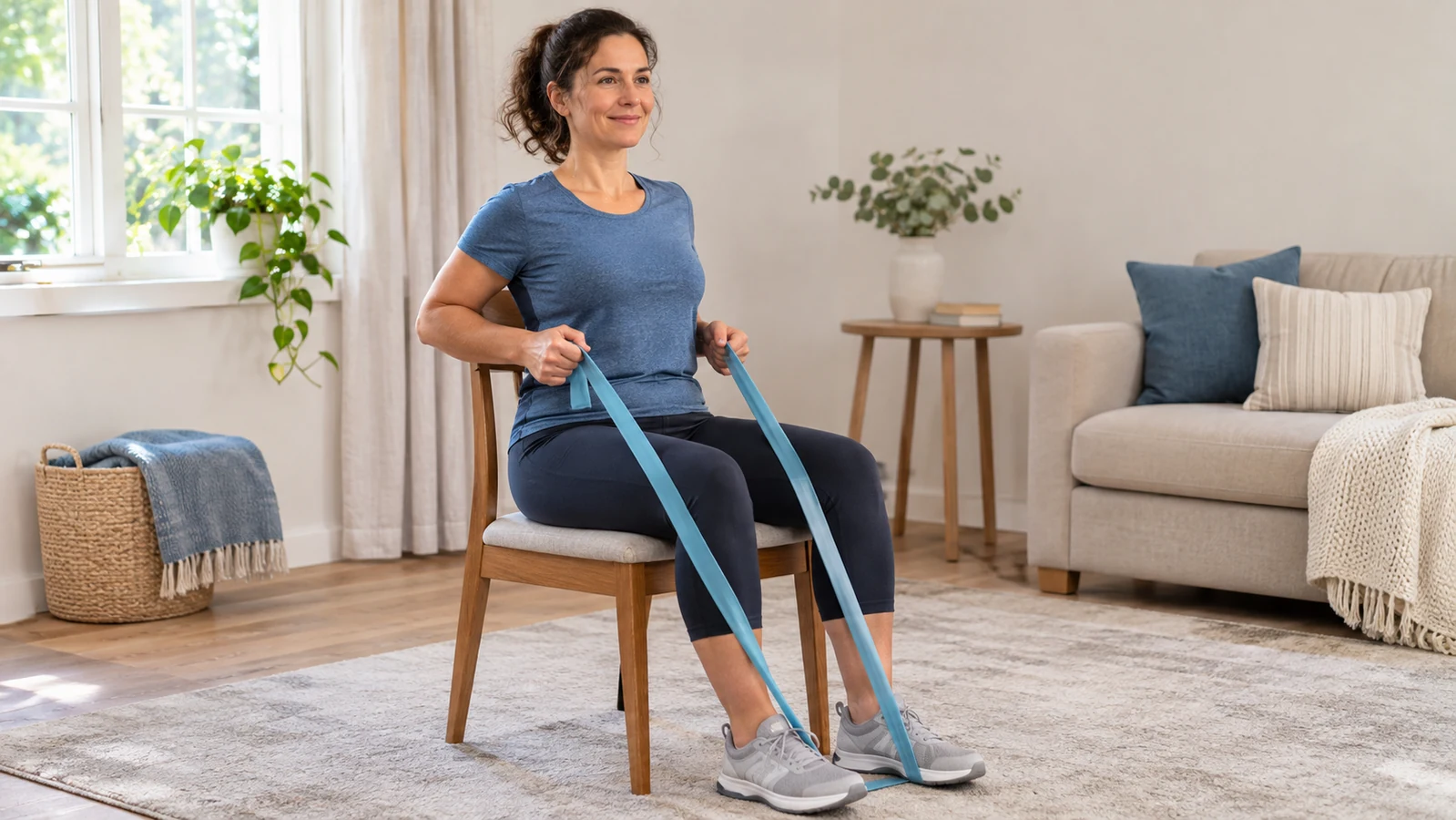
A band is a tool, not a test of fitness
Resistance bands look simple, but using one still calls for judgment: the band stretches, the force changes through a movement, and a poor grip or damaged elastic can make an exercise uncomfortable or unsafe. For a beginner, the goal is not to prove toughness or to exhaust a muscle. It is to understand a controlled movement, notice how it feels, and select a level that allows you to keep good form. Bands are one tool among several—not a required purchase, a medical treatment, or a shortcut to a promised result.
Where resistance bands fit in public-health guidance
U.S. public-health guidance includes working with resistance bands among examples of muscle-strengthening activity. The CDC describes strength activity as part of a broader weekly mix, alongside aerobic activity. Its general adult guidance recommends muscle-strengthening work on at least two days each week and activities that involve major muscle groups. Those are population-level guidelines, not a personal prescription or a requirement to begin with a particular band, exercise, or schedule. People can choose activities that fit their abilities, preferences, access, and health circumstances.
Choose a band by how the movement feels
Bands may be sold as loops, flat strips, or tubes with handles, and brands use different colors, labels, and resistance scales. A color that means “light” in one set does not necessarily match another company’s product. If a package lists a resistance range, treat it as a manufacturer’s description rather than a direct prediction of how difficult a specific movement will feel. Stretch length, grip position, body position, and the exercise itself all influence tension. If possible, test a gentle movement with a low-resistance band before purchasing a set.
Inspect the band and your setup first
Before using a band, look along its full length for cuts, cracks, thinning, sticky or brittle patches, and damaged handles or connectors. Follow the manufacturer’s instructions for inspection, cleaning, storage, and any maximum stretch limit. A band that is worn, torn, or altered should not be used. Clear enough room to move without tripping over furniture, and keep the band away from sharp edges. If you use a door anchor, use only an anchor and setup designed for exercise bands, secure it exactly as instructed, and check that it cannot shift toward your face.
Anchor-free movements can simplify a first session
An anchor-free movement can make the first experience easier to manage. For example, a seated row may be demonstrated with a band held securely around the feet while sitting upright in a stable chair; an arm curl can be shown with the middle of the band beneath both feet. These are illustrative options, not instructions for everyone. Keep the band’s path away from your face, hold it firmly, and do not wrap it around a joint or neck. If a position feels awkward, painful, or difficult to control, stop rather than pulling harder.
Use smooth, controlled motion
Move at a pace that lets you control both the stretching and return of the band. Avoid snapping it back, bouncing through the movement, or using momentum to finish a repetition. A shorter range that feels manageable is preferable to forcing a large range. Keep the path predictable and the band under control at the end of each movement. You do not need to copy a fast online demonstration. If you are unsure about technique, an in-person session with a qualified exercise professional or physical therapist can help you learn safer form for your own movement needs.
Breathing and posture matter more than speed
Try to keep breathing naturally rather than holding your breath during effort. The National Institute on Aging’s strength-training guidance recommends breathing out as you exert effort and breathing in as you relax, while avoiding locked joints. That is a general cue, not a guarantee that an exercise is safe for a particular person. Sit or stand in a stable position; use a chair or wall nearby if balance is uncertain. Keep shoulders, wrists, and knees in a comfortable position rather than forcing a rigid “perfect” posture.
What a set of repetitions means
A repetition is one complete cycle of a movement; a set is a group of repetitions performed before a rest. CDC guidance describes one set of 8–12 repetitions as an example for muscle-strengthening activities, with at least one set and two or three sets as another option for greater benefit. This is not a must-hit target for every beginner. If the final repetitions become jerky, painful, or impossible to control, the band may be too strong or the set may be too long for you right now. You can stop sooner.
Build a balanced week instead of chasing one exercise
A band exercise does not automatically count as a balanced strength session. CDC guidance names major muscle groups including legs, hips, back, chest, abdomen, shoulders, and arms. A routine can gradually include more than one area rather than focusing only on arms because those movements are easy to see. Band rows and presses are examples often demonstrated for upper body; lower-body options exist too, but setup and balance vary. A qualified instructor can help choose movements that match mobility, equipment, and experience without turning a general article into a personal program.
Progress in small, observable steps
If a movement feels controlled and comfortable over time, progress one feature at a time: slightly more repetitions, a small increase in stretch, a different band, or another set. Changing one variable makes it easier to notice how your body responds. There is no need to advance every week or to use the strongest band in a package. The National Institute on Aging advises gradual increases in resistance, repetitions, sets, or weekly sessions; it also cautions beginners to become comfortable with the movements first. A pause for travel, illness, or a busy week is not failure—you can resume gently.
Soreness is not the goal or a score
Some people notice mild muscle soreness after doing unfamiliar activity, but soreness is not required for a session to “work.” Joint pain, sharp pain, numbness, dizziness, or loss of control are reasons to stop the movement rather than pushing through. CDC arthritis guidance recommends bands or weights that do not cause joint pain and starting slowly, paying attention to how the body feels. If symptoms are severe, persist, or are unusual for you, seek advice from an appropriate health professional. This article cannot tell you what a symptom means or diagnose its cause.
Adapt the plan to your body and circumstances
People recovering from surgery or an injury, living with a chronic condition, experiencing balance limitations, or following a clinician’s restrictions may need a tailored plan. The CDC advises people with chronic conditions or disabilities to choose activity according to their abilities and condition; the National Institute on Aging also suggests asking a doctor or physical therapist when unsure about a movement. That does not mean everyone needs medical clearance before ordinary activity. It means that personal restrictions, significant symptoms, or a complicated health situation deserve individual guidance rather than guesswork from a generic web page.
When to stop and ask for guidance
Stop and seek urgent help if exercise is accompanied by a medical emergency such as chest pressure, fainting, severe or unusual shortness of breath, or sudden weakness. For less urgent but troubling symptoms, pause and contact a qualified professional for advice. Do not use a band routine to test whether a condition has improved, to replace prescribed rehabilitation, or to change medicine or treatment. If a clinician or physical therapist has provided limits on lifting, stretching, or joint movement, follow that individualized advice and ask them how a band fits within it.
Keep commercial wellness pages separate from evidence
The three program pages linked here are optional commercial wellness resources: The Arthritis Strategy, The Bone Density Solution, and Weight Loss Breeze. Their pages are not medical evidence for this guide, do not establish that resistance bands prevent or treat a condition, and are not a substitute for professional care or a supervised rehabilitation plan. Their inclusion is navigation to existing Blue Heron program pages, not a recommendation to buy a product or a promise of an outcome. The movement information above comes from the cited public-health and government sources.
A simple checklist for a first week
A low-pressure first week can be as simple as checking a band for damage, choosing one comfortable movement, and noticing whether you can control it without pain. You might practice the motion without a band first, use a very light band, or ask a qualified instructor to show a technique. Rest between sessions, and avoid training the same muscle group on consecutive days if you are following a strengthening schedule. If you are not ready for a band, body-weight movements or other accessible activity may be an alternative. The equipment should adapt to you—not the other way around.
The takeaway: repeatable beats impressive
Resistance bands can provide adjustable resistance and are included in public-health examples of muscle-strengthening activity, but a particular band cannot guarantee strength, balance, weight, joint, or disease outcomes. Begin with equipment that is intact, use movements you can control, progress gradually, and seek individualized guidance when your health or safety calls for it. National recommendations describe broad population goals; your own needs may differ. This is general education, not diagnosis or personal medical advice. AI assistance helped draft and organize the article; Mr.Hotsia checked sourcing and clarity only, and no clinician reviewed it.
Sources and further reading
Medical information was checked against these public health sources on November 16, 2026.
- CDC — What Counts as Physical Activity for Adults ↗
- U.S. Department of Health and Human Services — Physical Activity Guidelines Questions & Answers ↗
- National Institute on Aging — Three Types of Exercise Can Improve Your Health and Physical Ability ↗
- CDC — About Physical Activity and Arthritis ↗
- CDC — Physical Activity for Adults with Chronic Health Conditions and Disabilities ↗
This article is general health education, not a diagnosis or personal medical advice. Do not change treatment or supplements based on this article. Discuss individual results with a qualified healthcare professional.