Nutrition · Whole-grain labels and everyday food choices
Whole-Grain Labels: How to Compare Bread, Cereal, and Other Grain Products
“Multigrain,” “wheat,” and “whole grain” are not interchangeable clues. Learn how ingredient lists, front-label wording, and serving information can help you compare products—without turning a grocery choice into a medical prescription.
AI assistance was used to draft and organize this article. Mr.Hotsia checked sourcing and editorial clarity only; no clinician reviewed this article and no medical credentials are implied.
Front-label words are a starting point, not the whole story
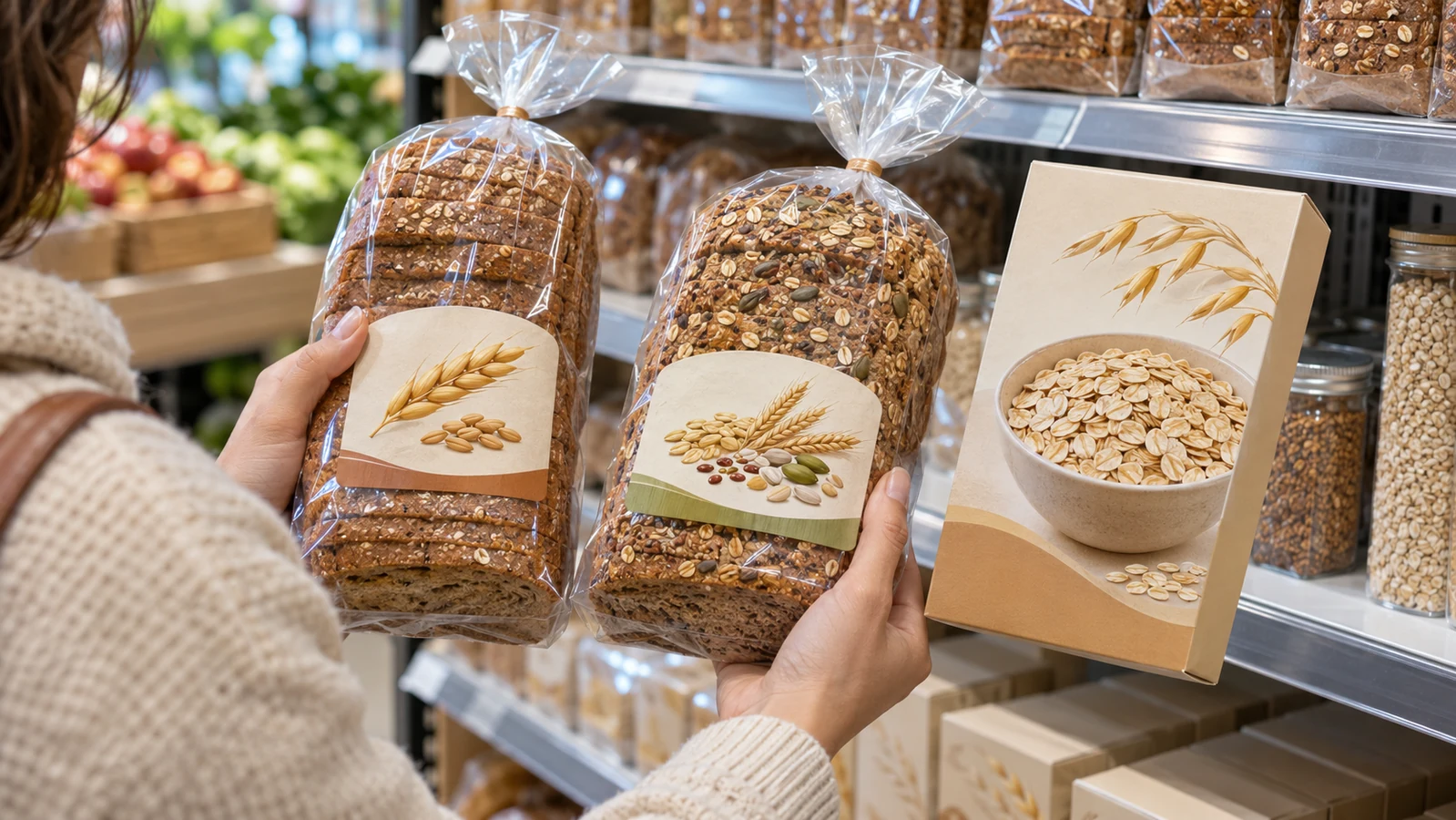
Bread and cereal packages often use confident front-panel phrases: “wheat,” “multigrain,” “made with whole grains,” or “100% whole wheat.” Those words can be useful prompts, but they do not all mean the same thing. A colorful loaf with visible seeds may contain a mix of refined and whole grains; a plain-looking oatmeal may be made from a whole grain. For a fair comparison, turn the package around. Check the product name and ingredient list first, then use the Nutrition Facts panel for serving size, fiber, and other information you care about. No single phrase ranks a food for every person or meal.
What makes a grain whole
The FDA describes a grain kernel as having three parts: bran, germ, and endosperm. A whole grain contains all three parts in their original proportions, while refined grains are milled to remove some parts. Examples include whole wheat, oats, brown rice, barley, and quinoa. This structural distinction is more useful than judging by color or texture. Brown bread is not automatically whole grain, and a pale grain food is not automatically refined. Ingredients and product wording give more reliable clues than appearance, though processed foods can contain a mixture of grain types.
“Multigrain” describes variety, not necessarily whole grains
“Multigrain” generally signals that a product contains more than one kind of grain; it does not, by itself, tell you that every grain—or even the first grain ingredient—is whole. A loaf can include several grains while also containing refined flour. Likewise, “wheat bread” may simply mean bread made with wheat flour, because wheat can be refined or whole. If the specific question is whether a product contains whole grains, look for the word “whole” in the grain ingredient names and evaluate how prominent those ingredients are in the list.
Start with the ingredients list
In the United States, ingredients are generally listed in descending order by weight, with the ingredient used in the greatest amount listed first. FDA explains this rule for ingredient declarations. That makes the first few entries a useful place to look, but it does not give an exact percentage of the product. A food may have more than one whole-grain ingredient, and ingredients can be grouped or named in ways that take a moment to parse. Read the full list rather than relying on one phrase or a small “contains whole grain” badge on the front.
Find the first grain ingredient and read its full name
Look for specific names such as “whole-wheat flour,” “whole oats,” or “whole-grain oats.” By contrast, “wheat flour” or “enriched flour” on its own does not say that the entire grain kernel is included. FDA’s draft guidance on whole-grain labeling discusses possible ways to describe whole grains and provides examples, but it is explicitly draft and nonbinding; it is not a final rule or a universal consumer grading system. For U.S. whole-wheat bread, a separate standard of identity in federal regulation specifies whole-wheat flour as the grain ingredient. Product rules and label conventions can differ by country.
Compare similar products, not unlike foods
Compare similar products side by side: one loaf with another loaf, one breakfast cereal with another cereal, or one pasta with another pasta. Check serving sizes and units before comparing the Nutrition Facts panel. Ingredient order is helpful, but because it is based on weight, it cannot tell you an exact grams-of-whole-grain amount unless the package provides that information. Claims such as “made with whole grains” can mean that some whole grain is present without telling you how much. If amount matters, look for a clear quantitative statement, when available, and check whether it refers to one serving or the whole package.
The Nutrition Facts panel answers different questions
After looking at ingredients, turn to the Nutrition Facts panel. The panel reports nutrients for a stated serving; it does not usually identify every grain ingredient as whole or refined. Serving sizes may differ across similar products, so fiber amounts cannot be compared fairly without noticing the serving basis. If one cereal lists a smaller serving than another, the per-serving numbers may reflect different amounts of food. Some packages provide additional information per package or per unit amount. Use the numbers for the question they answer, and avoid treating one nutrient as a complete score for overall quality.
Fiber can add context, but it is not a shortcut label
Dietary fiber appears on the Nutrition Facts panel and can provide context when comparing packaged foods, but fiber alone does not prove that a product is whole grain. Fiber can come from ingredients other than whole-grain kernels, and a whole-grain product can vary in fiber depending on ingredients and portion. A number on the panel also does not describe taste, affordability, sodium, added sugars, or how a food fits a meal. The label is most helpful when several details are read together: grain ingredients, serving size, fiber and other nutrients relevant to your priorities.
Bread wording has a specific legal context
Bread terms can be especially confusing because wheat flour may refer to refined wheat flour, while “whole-wheat flour” refers to flour that includes the whole wheat kernel. The federal standard of identity for whole-wheat bread, rolls, and buns in 21 CFR 136.180 sets out which grain ingredient is used for products represented by that name in the United States. This rule is specific to those bread products; it does not create a single simple label rule for every grain food. If a product is imported, sold under another country’s rules, or uses a different product name, local labeling requirements may apply.
Cereal, pasta, crackers, and rice each need their own comparison
For oatmeal and many plain grain foods, ingredient lists may be short, so comparing them can be straightforward. Breakfast cereals, crackers, snack bars, and ready-made pasta dishes may combine several grain ingredients with sweeteners, oils, salt, or other components. The relevant comparison depends on what you are choosing between and what matters to you. A package with a whole-grain first ingredient is not automatically the best fit in every circumstance; price, allergies, taste, preparation time, and the rest of the meal matter too. The goal is to understand the product, not award it a universal health score.
Understand the limits of “healthy” and other claims
The FDA’s current criteria for using the word “healthy” on a food label consider food groups and limits for certain nutrients; what qualifies depends in part on the type of food. A “healthy” claim is not a claim that a product is whole grain, and a whole-grain claim does not guarantee that the product meets every criterion for a healthy claim. Other front-panel statements may have separate definitions or be voluntary marketing language. If a particular claim affects your decision, check the ingredient list and Nutrition Facts panel rather than assuming the front label answers every question.
A simple aisle routine
A quick routine can make label reading less complicated: (1) decide what similar products you are comparing; (2) look for “whole” in the grain ingredient names; (3) notice where those ingredients appear in the ingredient list; (4) compare serving sizes and relevant Nutrition Facts details; and (5) check any front-panel claim against the back of the package. If the package gives a whole-grain amount per serving, note its units and serving basis. This is enough for many everyday shopping comparisons. You do not need to memorize every grain or translate the label into a precise health outcome.
Cost, access, culture, and preference are part of nutrition
Food choices are shaped by more than label information. Whole-grain products may cost more, be less available in a neighborhood, or not suit someone’s taste, cooking equipment, family traditions, or food sensitivities. A label guide should not imply that people need a particular product or that a single purchase determines health. Frozen, canned, shelf-stable, and familiar staple foods may be practical options in different settings. The current U.S. Dietary Guidelines describe a population-level pattern that includes fiber-rich whole grains, but general guidelines are not a personalized prescription and do not account for every person’s medical or cultural needs.
When a general comparison is not personal nutrition advice
People who have celiac disease, a wheat allergy, another food allergy, or a prescribed nutrition plan need advice that is specific to their circumstances. “Whole grain” does not mean gluten-free, and the presence of oats or other grains does not by itself establish that a product is safe for a particular allergy or condition. Check allergen statements and product-specific labeling, and ask a qualified healthcare professional or registered dietitian if you are unsure how a food fits your plan. Do not stop a prescribed diet or make a major nutrition change based only on this article.
Optional commercial programs are separate from the evidence
The three Blue Heron program links below are optional commercial resources: The Fatty Liver Solution, Weight Loss Breeze, and The Oxidized Cholesterol Strategy. They are not cited as evidence for this article, do not establish that any food prevents or treats a disease, and are not a substitute for individualized professional guidance. Their inclusion is a navigation option, not an endorsement of a specific product outcome. Medical information in this guide is drawn from the public sources listed below, not from the program pages.
The practical takeaway
When comparing grain foods, use the front label as a clue and the ingredient list as the next check. Look for “whole” in grain names, remember that ingredients are listed by weight, and compare Nutrition Facts using similar serving amounts. “Multigrain,” darker color, and seed decoration do not tell you how much whole grain a food contains. Label reading can clarify what a product is; it cannot tell you what an individual should eat or predict a health result. This is general education, not diagnosis, a personal diet plan, or treatment advice. Mr.Hotsia’s editorial review is limited to checking sourcing and clarity; no clinician reviewed this article and no medical credentials are implied.
Sources and further reading
Medical information was checked against these public health sources on November 16, 2026.
- FDA — Draft Guidance for Industry and FDA Staff: Whole Grain Label Statements (draft, nonbinding) ↗
- FDA — Types of Food Ingredients ↗
- eCFR — 21 CFR § 136.180, Whole wheat bread, rolls, and buns ↗
- FDA — Use of the Term Healthy on Food Labeling ↗
- Dietary Guidelines for Americans, 2025–2030 ↗
- Dietary Guidelines for Americans, 2025–2030 — Daily Serving Sizes ↗
This article is general health education, not a diagnosis or personal medical advice. Do not change treatment or supplements based on this article. Discuss individual results with a qualified healthcare professional.