Preventive health · Air quality and outdoor activity planning
Air Quality Alerts and Outdoor Activity: A Practical Guide to the AQI
Air-quality numbers can help you decide when and how to be outdoors. Learn what AQI colors mean, why forecasts change, who may need extra planning, and how to use local health guidance without treating an app as a diagnosis.
AI tools assisted with drafting and organization. Mr.Hotsia reviewed sources and clarity only; this was not a clinical review.
The short answer: use a local forecast to adjust, not cancel by default
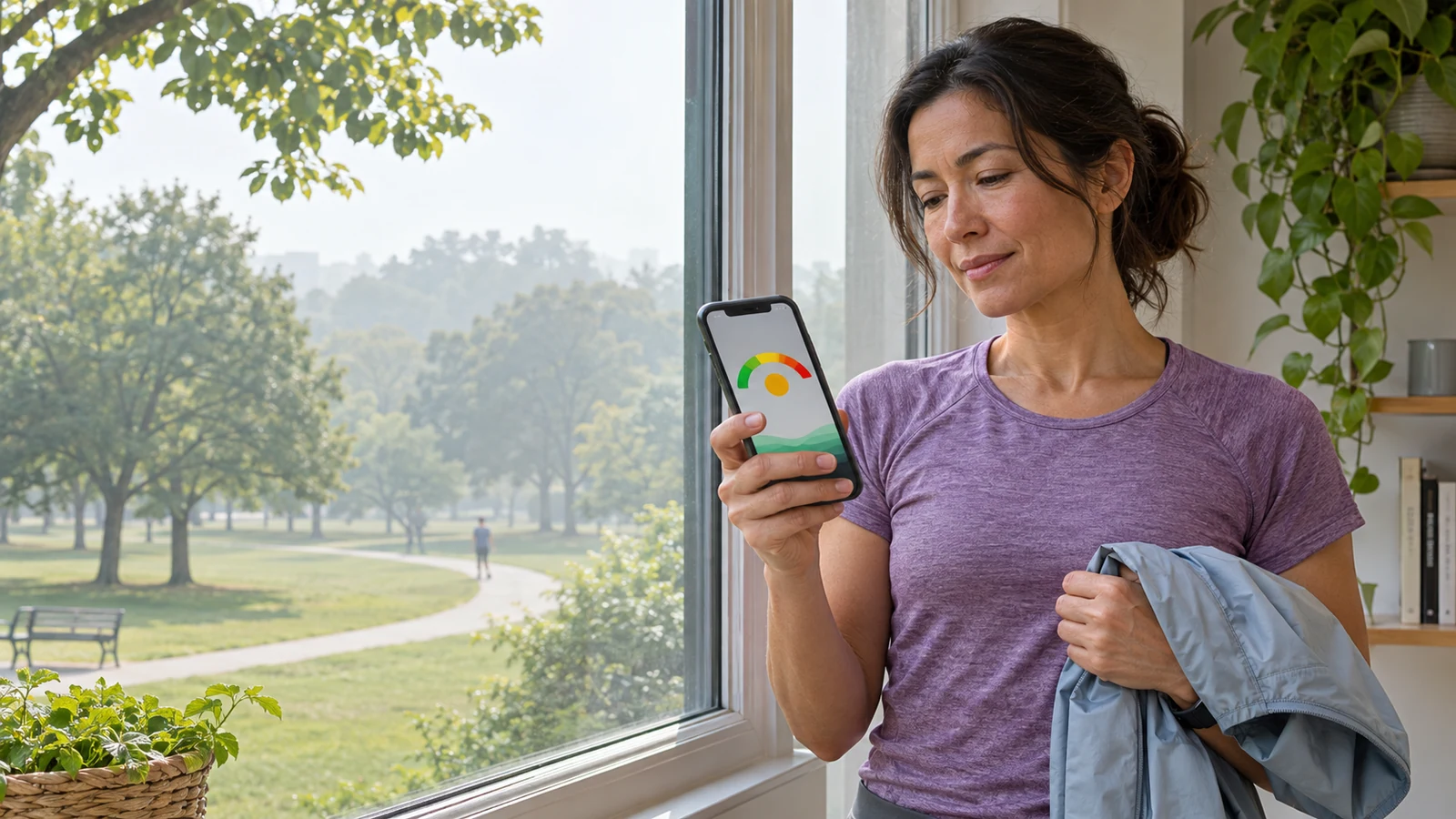
An air-quality alert does not automatically mean that everyone must stay inside all day. It is a signal to look at the pollutant, the forecast, the activity, and the people involved. On a day with higher pollution, some people may choose a different time, a less strenuous route, or an indoor alternative. Others may need to follow an existing clinician-provided plan or local public-health instructions. The goal is a proportionate adjustment—not panic, and not a promise that any single step removes all exposure. If symptoms are severe or rapidly worsening, prioritize urgent local medical guidance rather than an index or this article.
What the Air Quality Index is designed to do
The U.S. Environmental Protection Agency’s Air Quality Index (AQI) translates measurements of five major pollutants into a public-facing scale: ground-level ozone, particle pollution, carbon monoxide, sulfur dioxide, and nitrogen dioxide. It is meant to help people understand current or forecast outdoor conditions and the level of health concern. AirNow presents categories using both words and colors, from Good to Hazardous. The AQI is a communication tool, not a personal exposure monitor, diagnosis, or prediction of exactly how one individual will feel. Local authorities may use a different index or reporting convention, so check the official source for your location.
How to read the colors without treating them as a personal diagnosis
On the U.S. scale, green (0–50) is labeled Good, yellow (51–100) Moderate, orange (101–150) Unhealthy for Sensitive Groups, red (151–200) Unhealthy, purple (201–300) Very Unhealthy, and maroon (301 and above) Hazardous. These are category boundaries, not sharp biological switches: risk does not suddenly appear at one exact number for every person. AirNow says people in sensitive groups may experience effects in the orange range, while the general public is less likely to be affected; at higher levels, concern broadens. Read the category message and the pollutant-specific activity advice, not color alone. Do not use these U.S. values as a substitute for a local government’s scale.
Why today’s number can change during the day
A daily forecast and a current reading answer different questions. A forecast estimates conditions for a coming period and can help with scheduling. AirNow’s NowCast uses recent hourly monitor readings to estimate current ozone or particle pollution; it can change as new data arrive, especially when conditions shift quickly. A morning forecast may not describe the afternoon, and a reading from another neighborhood may not match the route you plan to use. Check the timestamp, location, pollutant, and whether the information is a forecast or a current estimate. Recheck on an unusually smoky or hazy day rather than relying on a saved screenshot.
Know which pollutant is driving the alert
The pollutant matters because different pollutants behave differently. Ground-level ozone often rises in sunny conditions and may vary by time of day; fine particles can come from smoke, traffic, dust, or other sources and may remain elevated for a different pattern. An AQI display may report the highest relevant pollutant, so two nearby places can have different readings. CDC notes that fine particles may be small enough to reach deep into the lungs, while ozone can irritate airways. A high number does not reveal the precise source or establish that a symptom was caused by pollution. Local alerts, fire information, and official explanations can add context, but they still do not diagnose an individual.
Who may want to plan more carefully
Some groups are more likely to be affected by unhealthy air, but the exact advice depends on the pollutant, health history, and local guidance. CDC identifies people with asthma or COPD, heart disease, diabetes, older adults, and babies and children among groups who may be more sensitive to particle pollution. CDC travel guidance for Thailand also advises people at increased risk—including children, older adults, pregnant travelers, and people with cardiovascular or respiratory conditions—to take precautions when pollution is high. These lists are prompts to plan, not a complete risk calculator. If a clinician has given you an action plan, use that plan and ask the care team how it relates to local alerts.
Turn a forecast into a practical activity plan
Start with the activity you actually planned. A short, easy walk is different from a long run, hill workout, outdoor job, or a child’s all-day sports event. When the forecast is worse, possible adjustments include shortening the session, reducing intensity, choosing a route away from busy roads, moving it to a time when the official forecast is better, or doing an indoor alternative. EPA and CDC guidance commonly emphasizes reducing prolonged or strenuous outdoor exertion when conditions are unhealthy, especially for people more likely to be affected. These are general options, not individual medical instructions. Follow emergency alerts, school or workplace policies, and clinician guidance when those are more specific.
When moving an activity indoors may help
An indoor option can preserve a routine when outdoor pollution is elevated, but indoor air is not automatically clean. During wildfire smoke, U.S. CDC advice includes closing windows and doors when practical, using an appropriate central-system filter or portable air cleaner if available, and reducing indoor particle sources such as smoking or burning candles. Conditions differ by building, climate, and equipment. Do not block ventilation or alter a heating or cooling system in a way that creates another hazard. If the home is extremely hot, lacks safe cooling, or has poor ventilation, seek local public-health or emergency-management advice about safer places to spend time. No consumer device can guarantee a pollutant-free room.
Wildfire smoke calls for a different level of attention
Wildfire smoke deserves special attention because smoke may travel far from the fire and conditions can persist or shift after flames are no longer nearby. CDC advises people to keep checking local air-quality information and, during smoke events, reduce exposure by staying in cleaner indoor air when possible. If outdoor activity can be postponed or moved, that may reduce time in smoke. People who must work outside may have fewer choices and should follow occupational safety procedures and local authorities. Visible haze is not a reliable measure of all pollutants, and clear-looking air is not proof that pollution is absent. Use a trusted monitor or public alert rather than relying only on smell or appearance.
What respirators can—and cannot—do
A well-fitting NIOSH-approved particulate respirator, such as an N95, may reduce inhalation of particles in some situations, including wildfire smoke. It is not a universal solution: fit matters, it may be uncomfortable or difficult for some people to wear, and a particulate respirator does not remove every gas or vapor. Ordinary loose face coverings are not designed to provide the same particle filtration and seal. CDC says to move to cleaner air and remove the respirator if you have difficulty breathing, become dizzy, or develop troubling symptoms while wearing it. People with heart or lung conditions, children, and anyone who is unsure about safe use should follow current local public-health advice and ask a qualified professional when needed.
Outdoor workers and people with limited choices
Outdoor workers, delivery staff, caregivers, athletes, and people without reliable air conditioning may not be able to simply choose to stay indoors. A useful plan may involve checking work or school notifications, identifying a nearby cleaner-air location, scheduling breaks where feasible, and asking an employer or local agency what protections are available. CDC particle-pollution guidance recommends more frequent breaks for outdoor workers and planning activities around forecasts. These general measures cannot replace workplace rules or a site-specific safety plan. If you face repeated exposure, document when and where alerts occur and raise it with the appropriate supervisor, occupational-health service, union, or public-health authority. Access and working conditions shape which options are realistic.
Notice symptoms without trying to diagnose them
Pollution can irritate the eyes and airways, and CDC lists coughing, chest tightness, or feeling short of breath among possible effects of particle pollution. Such symptoms can also come from many other causes, and a number on an app cannot determine what is happening. Move away from an exposure when practical and use a clinician-provided action plan if you have one. Seek urgent or emergency care through local services for severe breathing difficulty, chest pain, fainting, confusion, or another emergency warning sign. Do not wait for an AQI to rise or fall before acting on serious symptoms. If milder symptoms repeat around certain conditions, keep a brief record and discuss the pattern with a qualified health professional.
Make a simple plan before a high-pollution day
A simple high-pollution-day plan can be prepared in a few minutes. Choose one official source for forecasts, check notifications from local health or emergency agencies, and decide in advance which indoor or lower-exertion alternative is realistic. If someone has a prescribed respiratory action plan, keep it accessible and confirm that medicines or equipment are available as directed; this article does not tell anyone to change a dose. Families can agree on who checks school or sports updates and how to contact one another if plans change. Workers can ask about break locations and relevant workplace protections. Revisit the plan when the season, residence, or health circumstances change, rather than assuming one strategy fits every alert.
Use local information, especially outside the United States
The AQI described here is the United States system. In Thailand, CDC reports that air quality varies by province and season, and fine particulate matter can be elevated in some areas; it advises monitoring local conditions and public-health advisories. Follow Thailand’s official Pollution Control Department, provincial health office, or other designated government reporting source for local values and instructions. The same principle applies elsewhere: prefer the public authority that reports your local pollutant measurements, understand its scale, and read any accompanying health message. International maps and commercial apps can be useful, but providers may use different monitors, estimates, or calculation methods. Check the source and time before making a decision.
Keep wellness programs separate from air-quality evidence
The optional program links on this page are existing commercial wellness resources. Their descriptions do not establish that a program prevents air-pollution effects, changes an AQI, or treats asthma, COPD, heart disease, sleep apnea, or another condition. The medical information in this article comes from the public health sources listed below, not from a product review. Readers who explore those links should consider them separately from decisions about pollution exposure, respirators, treatment, or urgent symptoms. Commercial resources cannot replace emergency services, workplace protections, or advice from a qualified healthcare professional. This distinction helps keep editorial evidence separate from promotion.
The takeaway: small adjustments can preserve useful routines
The practical takeaway is to check a current, local forecast; identify which pollutant and time period it describes; and adjust the duration, intensity, timing, or location of an activity when official guidance calls for it. Extra planning may matter for people more sensitive to pollution and for those whose work or care responsibilities require time outdoors. AQI categories help communicate population-level concern but cannot predict an individual response. AI tools assisted with drafting and organization; Mr.Hotsia reviewed sources and clarity only, has no medical credentials, and no clinician reviewed this article. This is general health education, not diagnosis or personal medical advice. Do not change medicines or treatment because of this article; use local emergency guidance for severe symptoms.
Sources and further reading
Medical information was checked against these public health sources on November 17, 2026.
- AirNow / U.S. EPA — AQI Basics and category values ↗
- AirNow / U.S. EPA — Using the Air Quality Index, forecasts, and NowCast ↗
- CDC — Air Pollutants: Ozone and Particle Pollution ↗
- CDC — Particle Pollution Tips ↗
- CDC — Thailand: Air Quality and Traveler Health Advice ↗
- CDC — Safety Guidelines for Wildfires and Wildfire Smoke ↗
- CDC/NIOSH — Community Respirators and Masks ↗
This article is general health education, not a diagnosis or personal medical advice. Do not change treatment or supplements based on this article. Discuss individual results with a qualified healthcare professional.