Everyday health · Household product safety
Cleaning vs. Disinfecting at Home: Read the Label, Skip the Mixing
Cleaning and disinfecting are different jobs. Understand the distinction, check the product and surface instructions, and make a practical household plan without trying to create a sterile home.
AI assisted with drafting, organization, and the original editorial image. Mr.Hotsia reviewed sourcing and clarity only; no clinical review or medical qualifications are implied.
Start with the task, not the strongest bottle
A cupboard full of cleaning products can make an ordinary household task feel more complicated than it needs to be. One bottle promises a sparkling finish; another mentions germs; a third has directions in tiny print. The useful starting question is not which one sounds strongest, but what job you are trying to do. Removing visible dirt and using a disinfectant are related but different tasks. This guide explains general product-safety principles for adults at home. It does not provide a chemical recipe, an infection-control protocol for a particular illness, or a promise that a home can be made sterile.
Cleaning, disinfecting, and sanitizing are not synonyms
MedlinePlus distinguishes cleaning, which removes dirt and germs from a surface, from disinfecting, which uses chemicals to kill germs and does not necessarily remove dirt. Sanitizing means reducing germs to a level considered safe under relevant public-health standards. These terms describe different objectives, not a ladder on which every household task must reach the highest rung. Before following advice, check which meaning is intended. A helpful planning question is: “Am I removing a spill, following a surface-care instruction, or carrying out a specific disinfection task?” That question organizes the job; it does not identify an infection or assess anyone’s personal risk.
Routine cleaning is often enough
CDC says regular cleaning is enough in most home situations. Additional disinfection is relevant when someone is sick or is at higher risk because of a weakened immune system. Its guidance emphasizes frequently touched surfaces, visible dirt, and cleaning before disinfecting because dirt can interfere with the chemicals. This is general guidance, not a tailored plan for a medically vulnerable household. If a healthcare team has provided specific instructions, use that plan and ask about uncertainties. A generic article cannot decide what a particular infection, immune condition, or care situation requires, and more products are not automatically a better plan.
A surface sanitizer is not a hand sanitizer
EPA’s terminology for regulated surface products adds a useful distinction: surface sanitizers have claims against bacteria, while disinfectants have claims against bacteria and viruses. This does not mean every disinfectant works against every organism. EPA also distinguishes these products from hand sanitizers, which are regulated by the FDA in the United States. Do not transfer a surface-product instruction to your hands simply because the word sanitizer appears on both labels. Regulatory terms can differ between countries. The practical lesson is to identify the intended use on the actual container, rather than borrow instructions from a similar-sounding product online.
Check the specific claim, not just the brand
EPA explains that a registered disinfectant’s label specifies the microorganisms and uses supported by its registration. In the United States, the registration number identifies the product more reliably than a brand name, because related products can be sold under different names. Registration is not an endorsement over competing products, nor a worldwide certificate for every possible use. A photograph of a familiar logo is therefore not enough to select directions. Check the container you have, its intended surface, and its current instructions. If the text is missing or unreadable, do not fill the gap with a guess about a similar bottle.
Contact time belongs to the product label
Contact time is the period a disinfectant must remain on the surface to work as directed. EPA says the surface should stay visibly wet for the entire stated time. There is no single number that this article can safely assign to every product, surface, or organism. Read the relevant directions before applying anything, rather than discovering the timing halfway through the job. A timer can be an organizational aid after you have checked the label; it cannot supply a missing instruction. An immediate wipe-off and a longer application are not interchangeable merely because they use the same brand name.
Read the whole sequence before starting
EPA’s six-step disinfectant guide brings several instructions together: check suitability, read directions and precautions, pre-clean when required, follow contact time, and store products safely. Use the protective equipment specified for the product and task. A useful preparation habit is to read the whole sequence before opening the bottle, so you know what must happen before, during, and after application. For example, set out only the equipment the directions call for and confirm that you can follow the sequence. This is a planning example, not a universal method that overrides a label or a manufacturer’s surface-care instructions.
Never combine products to make them stronger
CDC advises never mixing cleaning products or chemicals, ensuring good ventilation, and following label precautions, including any required gloves or eye protection. Household surface products should not be swallowed, deliberately inhaled, injected, or applied to the body. Do not turn an online cleaning tip into a personal experiment with exposure. For a practical setup, keep other containers closed and avoid improvising a stronger mixture when a task seems difficult. If the product’s instructions cannot be followed in the available space, stop and obtain appropriate guidance rather than trying to compensate with extra chemical, a stronger smell, or another product.
Safety mistakes are worth taking seriously
A CDC report published in 2020 documented unsafe cleaning practices during the early COVID-19 pandemic, including applying household products to skin and using bleach on food. It was an opt-in survey, not a current estimate of how all households behave, and it does not establish that a particular product caused an individual’s symptoms. Its relevance here is narrower: people can misunderstand familiar household chemicals. The report is not used to revive an old pandemic cleaning schedule. Current product directions and current public-health guidance matter more than a remembered social-media routine from an earlier emergency.
Keep the product identifiable and inaccessible to children
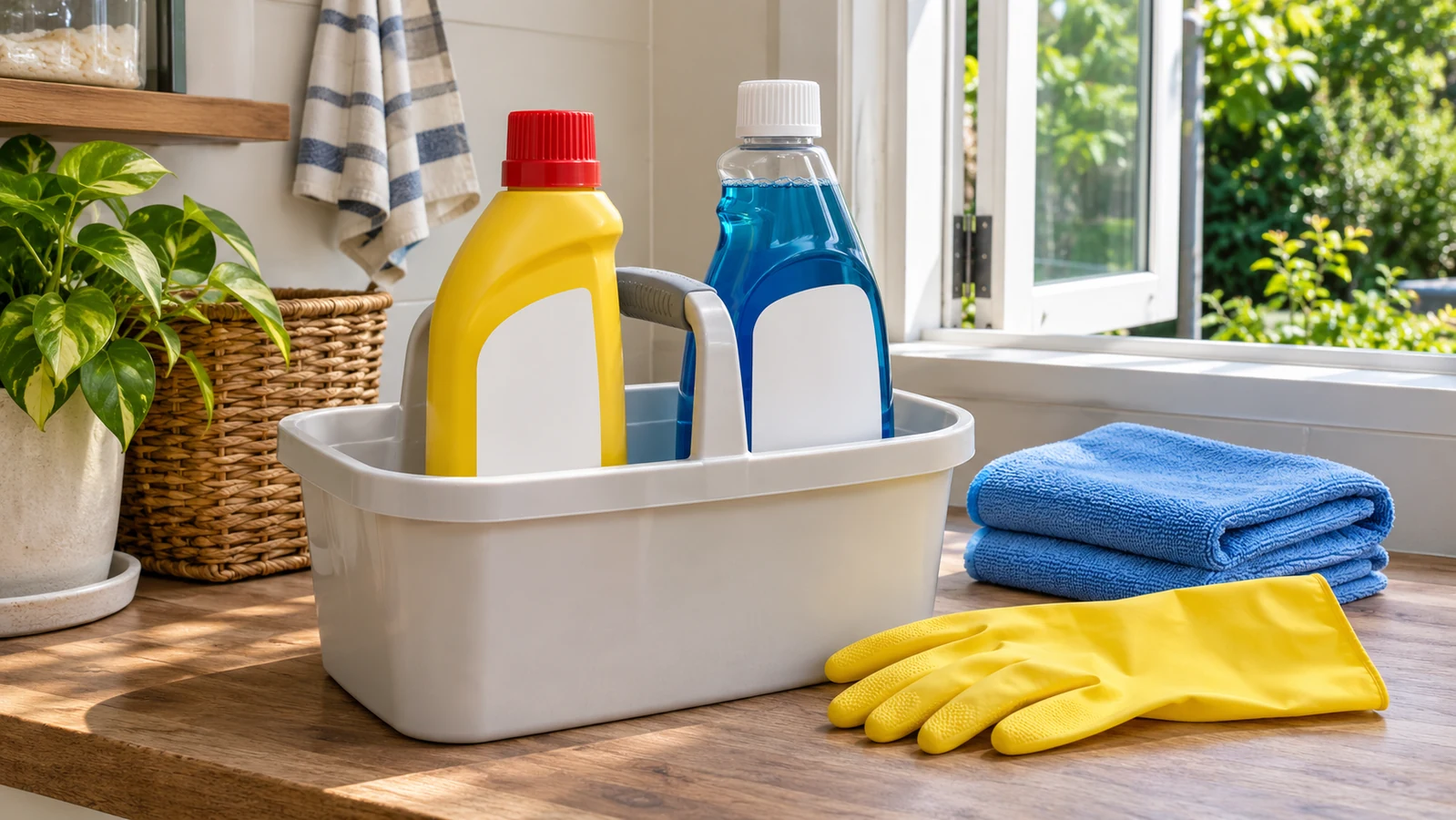
MedlinePlus recommends keeping products in their original containers, following label warnings, and storing them out of children’s reach. Retaining the container also keeps the instructions and product identity together. As an organizational example, a household could decide that an unlabeled bottle is not used until its identity and safe handling are resolved; a handwritten guess is not a substitute for the original information. Avoid treating storage as an afterthought at the end of a busy job. The illustration for this article shows closed, generic containers only; it is not a recommendation for a particular brand or storage arrangement.
One room can contain several different surfaces
Think of a room as several materials rather than one cleaning category. A kitchen might include a worktop, a painted cabinet, an appliance display, and an item that touches food. A living room may contain upholstery, a remote control, and a delicate finish. These are examples of why a product label and an item manufacturer’s instructions both matter; this article does not declare one product suitable for all of them. Before starting, identify the object and the instruction that applies to it. If they do not clearly match, seek clarification instead of assuming that a room name on an advertisement answers the question.
Make a small, usable household checklist
A short checklist can make the work easier to organize without turning it into a demand for constant disinfection. For example, write the task, the item, the instruction you are following, and what needs to be put away afterward. Keep the list about actions, not an invented cleanliness score. It might simply say to check the care instructions for a particular surface before selecting a product. This is an editorial planning suggestion, not a tested infection-prevention intervention. You do not need a special app, a new cleaning set, or an elaborate tracking system to read a label and arrange an ordinary household task.
Agree on what has already been used
In a shared home, communication can prevent uncertainty about what someone else has just used. An illustrative conversation could be: “I used this product on that surface and followed these directions; please check before using anything else.” Keep the actual container available for identification, then return it to appropriate storage. A shared note should not invent a new mixing sequence or override warnings. If paid cleaning or care workers are involved, ask how instructions and product information are communicated through their established procedures. This article is not a workplace chemical-safety assessment, a substitute for training, or legal advice about an employer’s responsibilities.
An exposure needs product-specific help
If a product exposure occurs, use the container’s safety information and contact an appropriate local poison-information service or healthcare professional for product-specific advice. An emergency requires local emergency assistance, not another cleaning experiment or a search for a home antidote. Have the product information available when seeking help, if it is safe to do so. This guide cannot assess an exposure, identify the cause of breathing or skin symptoms, or provide first-aid instructions for an unknown chemical. Do not assume discomfort is harmless because the product is sold for household use, and do not change an existing medical plan on the basis of this article.
Keep commercial reading separate from cleaning evidence
The site’s existing pages for Banishing Bronchitis, The Psoriasis Strategy, and Overthrowing Anxiety are optional commercial reading in the wider areas of respiratory, skin, and emotional wellbeing. Those subjects can be relevant to readers thinking about comfort and manageable household routines, but the program pages are not evidence for cleaning or disinfection. The three commercial links are separate from the official sources below. They do not establish that a program prevents infection, treats chemical exposure, or makes a cleaning product suitable. No purchase is needed to use public-health guidance, read a product label, or seek appropriate professional advice.
The takeaway and general-information disclaimer
The useful distinction is simple: choose the task first, identify the actual product and surface, and follow the applicable directions without mixing chemicals or chasing a sterile-home ideal. Where instructions are unclear or a household needs a specific medical plan, ask the relevant professional rather than improvise. This article is general health education, not diagnosis, individualized treatment, chemical first aid, or an infection-control prescription. AI assisted with drafting, organization, and the original editorial image. Mr.Hotsia reviewed sourcing and clarity only; no clinical review or medical qualifications are implied. The image and planning examples are illustrative, not safety certification or a guarantee of infection prevention.
Sources and further reading
Medical information was checked against these public health sources on November 20, 2026.
- CDC — When and How to Clean and Disinfect Your Home ↗
- MedlinePlus — Cleaning, Disinfecting, and Sanitizing ↗
- EPA — Difference between disinfecting, sanitizing, and cleaning products ↗
- EPA — Selected EPA-Registered Disinfectants and Directions for Use ↗
- EPA — Six Steps for Safe and Effective Disinfectant Use (PDF) ↗
- CDC MMWR — Household cleaning and disinfection knowledge and practices, May 2020 ↗
This article is general health education, not a diagnosis or personal medical advice. Do not change treatment or supplements based on this article. Discuss individual results with a qualified healthcare professional.