Everyday hygiene · Reusable drinkware
Reusable Water Bottles: Clean the Lid, Straw, and Seals
A bottle is more than its main container. Build a practical routine around the parts your model allows you to remove, suitable washing, thorough rinsing, and complete drying.
AI assisted with drafting, organization, and the original editorial image. Mr.Hotsia reviewed sourcing and clarity only; no clinical review or medical qualifications are implied.
Think about the whole bottle, not only the water inside
A reusable water bottle can become part of everyday life so easily that cleaning is reduced to a quick refill. Yet the main container is only one part of the object you use. A lid, drinking opening, straw, and sealing ring may each need attention. This guide is about ordinary drinkware care, not a promise that a bottle can be made sterile or a way to identify an illness from its appearance. The useful starting point is to understand your particular bottle and its removable parts. A simple, repeatable routine is more helpful than assuming that clear water means the entire assembly is clean.
Check the instructions for the bottle and its particular lid
Find the care information for both the container and the lid before choosing a method. Materials, coatings, and closure designs differ, even within a brand. Klean Kanteen’s FAQ, for example, separates instructions for different cap designs and describes parts that should not be forced out. Its guidance is useful as a manufacturer example, not a rule for every reusable bottle. An editorial planning suggestion is to keep the relevant care link or leaflet somewhere easy to find. If you later replace the lid, check its instructions too rather than assume that the original bottle’s instructions describe the new mechanism.
Make routine washing part of using the bottle
Purdue Extension recommends washing a water bottle after each use, or daily when it is being refilled throughout the day. Its guidance includes dish soap, cleaning the separate pieces, rinsing, and drying before reassembly. That recommendation gives routine washing a place in the day instead of leaving it until a bottle looks unpleasant. As a practical example, you might add the bottle to the items you wash after returning home. This is an organizational suggestion, not a claim that every bottle, drink, person, or setting has the same requirements. Follow any additional care directions supplied for your particular product.
Start with clean hands and a clear place for the parts
Clean hands belong in the routine as well. CDC explains that germs can spread when food or drinks are prepared with unwashed hands or when contaminated surfaces are touched. Its handwashing steps include soap, clean running water, scrubbing for at least twenty seconds, rinsing, and drying. This is general hand-hygiene guidance, not a bottle-specific decontamination protocol. Before handling the parts you have washed, think about where you will put them. A clear space makes it easier to keep track of a lid or seal and avoids having to search through unrelated utensils while you are trying to reassemble the bottle.
Separate only the pieces intended to come apart
Remove a lid, straw, or ring only in the way the manufacturer intends. A piece that can physically be pulled out is not necessarily a piece that should be removed during routine care. Klean Kanteen’s Flip Seal Sport Cap information, for instance, distinguishes a sealing gasket intended for removal from a vent gasket whose removal is not recommended, and warns against forcing out its spout. The important lesson is about checking the exact design, not copying that cap’s instructions onto another bottle. If a part resists or the diagram is unclear, stop trying to improvise the disassembly and consult the appropriate care information.
Use an appropriate brush rather than relying on a quick rinse
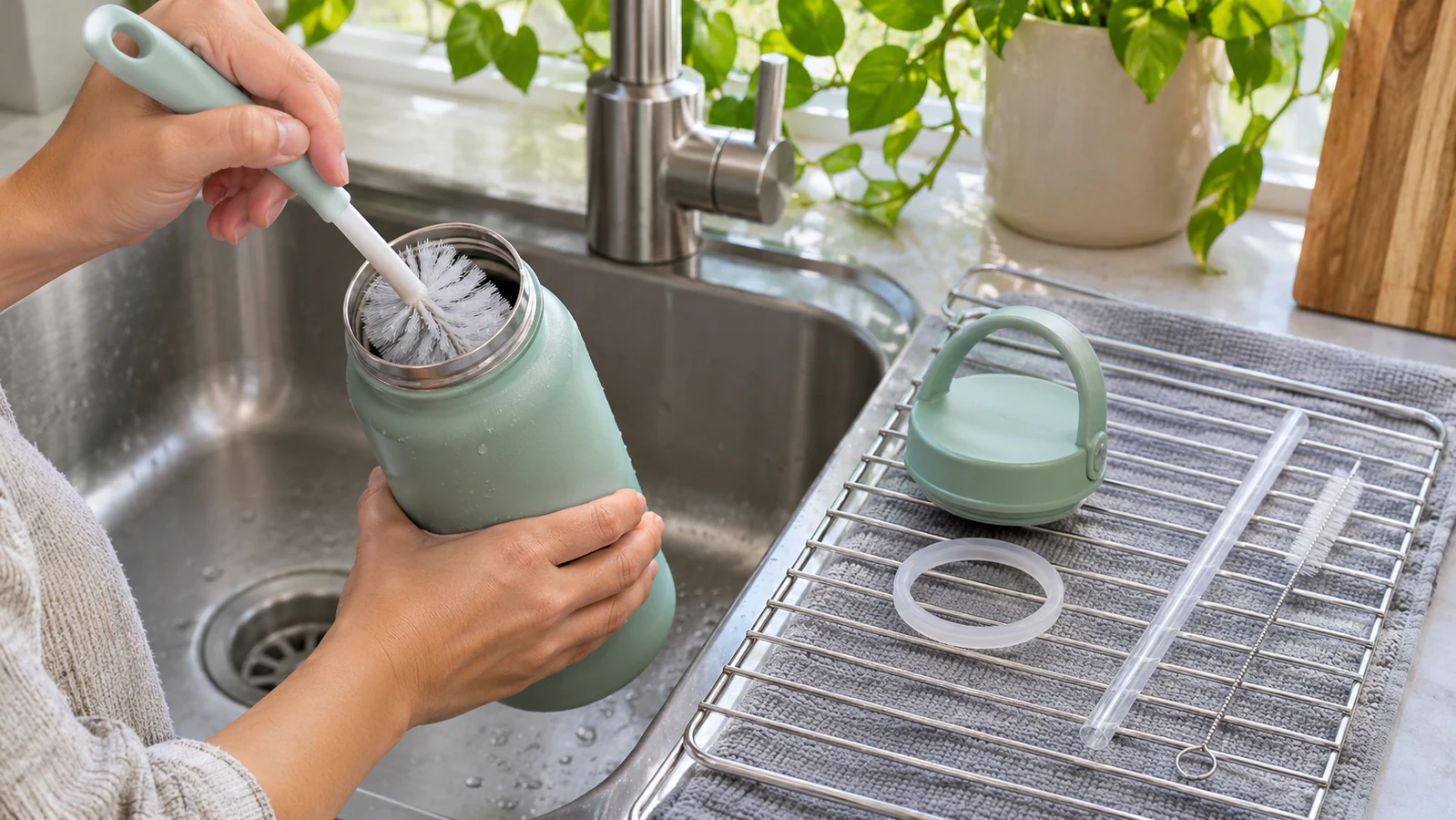
For handwashing, use the method and cleaning tools suitable for the model. Purdue’s guidance describes using a bottle brush to reach the inside and the small spaces in separate pieces. A planning question is whether your brush actually fits the opening and reaches the areas you need to clean without forcing it. A quick swirl may be convenient, but it does not give you the same opportunity to inspect and clean the separate parts. This article does not prescribe an abrasive tool, a boiling-water treatment, or a universal soaking time. Product directions matter more than an attractive cleaning demonstration on a social-media feed.
Give reusable straws their own cleaning step
If you use a reusable straw, remember that it is a separate item rather than an accessory that gets cleaned automatically with the bottle. Purdue’s advice for metal straws is to wash after use with dish soap and water, using a thin brush inside, then let the straw dry before storage. That material-specific advice should not be expanded into permission to force a brush through every flexible valve or unusual drinking mechanism. Check the instructions for those designs. As an organizational example, keep the suitable straw brush with your bottle-care tools so the straw is not repeatedly overlooked when the main container is washed.
A dishwasher is an option only when the parts permit it
Use a dishwasher only for components whose instructions allow it. The relevant question is not simply whether a bottle appears sturdy enough, but whether that exact container and lid assembly are approved for the method. Hydro Flask’s Flip Sip Cap guide permits either dishwashing or handwashing with warm soapy water for that cap, while its assembly directions are specific to its own parts. This is not evidence that every insulated bottle, lid, coating, or seal tolerates the same treatment. If the care information gives a rack position or other limitation, follow it. Avoid substituting a guess about the material for the actual product instructions.
Rinse, then allow the pieces to dry completely
After washing, rinse the pieces and give them time to dry. Purdue explicitly advises complete drying before reassembly, and the Hydro Flask guide likewise begins reassembly with dry components. Plan for this step instead of treating washing as finished the moment the bottle leaves the sink. For example, leave enough space for the open container and permitted removable pieces while they dry, rather than closing everything immediately to clear the counter. The illustration here shows a simplified arrangement, not a required drying layout. Your bottle’s shape, available space, and care directions may call for a different practical arrangement.
Cleaning and disinfecting are different jobs
CDC distinguishes cleaning, sanitizing, and disinfecting rather than using them as interchangeable words. In its household guidance, cleaning uses water, soap, and scrubbing to remove dirt and germs, while sanitizing and disinfecting are separate processes. This distinction matters when reading a bottle-care tip that promises to disinfect without explaining the method or whether it is suitable for drinkware. CDC’s page concerns household surfaces; it is cited here to explain terminology, not to authorize pouring a surface product into a drinking bottle. An ordinary care routine should not be described as sterilization or as a guarantee against infection.
Do not turn a general cleaning recipe into a universal bottle rule
Do not combine cleaning products or copy a chemical recipe from an unrelated household task into a bottle. CDC advises following product labels and warns against mixing cleaning chemicals. Compatibility also matters: Hydro Flask’s specific Flip Sip Cap instructions say to avoid cleaners containing bleach or chlorine. That is a good example of why a generic recommendation and a product-specific restriction cannot simply be blended. This article deliberately does not provide a disinfectant dilution or an improvised deep-cleaning formula. If the situation calls for more than routine washing, use instructions appropriate to the exact food-contact product and seek clarification when they are missing.
A manufacturer example shows why assembly instructions matter
Reassembly deserves the same attention as taking things apart. In the Hydro Flask example, the guide describes aligning the gasket and seating it in its channel before replacing another component. Those instructions apply to the named cap, not to the simplified bottle in our illustration. The broader planning point is to check the relevant diagram before putting pieces back, especially if more than one similar-looking ring or lid is on the counter. Do not present a guessed arrangement as a successful repair. When a part cannot be fitted as directed, contact the manufacturer instead of assuming that a lid which closes is necessarily correctly assembled.
When something is unclear, ask about the exact model
Useful questions for a manufacturer are concrete: Which parts are intended to be removed? Which are dishwasher-safe? What cleaning method applies to this lid? Is the part I have the correct replacement for this model? These are editorial examples of questions, not promises about what customer service will offer. Include the model name if you know it, without sending unnecessary personal information. A photo of an unlabelled bottle may not establish its material or internal construction. General online advice cannot certify that an unfamiliar component is safe, identify every type of residue, or determine whether a damaged item can be restored.
Make the routine easier without buying a whole new system
A workable routine does not require buying an entire new collection of products. Begin by checking the instructions for what you already own, identifying the parts you actually use, and allowing time to wash and dry them. You might keep the correct brushes together, set aside a consistent drying place, or save the assembly diagram for later. These are practical organization suggestions rather than tested health interventions. If choosing another bottle eventually becomes necessary, consider whether its care directions are clear and whether you can manage the required cleaning. This page does not rank brands or claim that a complicated lid is inherently better than a simple one.
Optional commercial reading is separate from bottle-care evidence
The three optional commercial links on this page lead to Weight Loss Breeze, The Blood Pressure Program, and The Oxidized Cholesterol Strategy, existing books in the site’s wider nutrition and everyday-wellbeing catalog. They are not evidence for bottle cleaning, a recommendation to change fluid intake, or a substitute for product-care instructions. Purchasing a program is not necessary to wash drinkware. The Purdue, CDC, and manufacturer references below have separate roles: everyday care guidance, general hygiene principles, and model-specific examples. Their inclusion does not imply endorsement of the commercial books, and this article does not evaluate those programs as treatments or make claims about their outcomes.
The takeaway and general-information disclaimer
The main idea is to treat the bottle as an assembly: check the exact instructions, wash the permitted pieces with suitable tools, rinse, dry, and put them back as directed. Do not let a convenient refill replace routine care, or turn a cleaning tip into a claim of sterility. This article provides general household health education, not diagnosis, personalized medical advice, treatment, or a guarantee that a particular item is safe. For individual health concerns, consult a qualified healthcare professional. AI assisted with drafting, organization, and the original editorial image. Mr.Hotsia reviewed sourcing and clarity only; no clinical review or medical qualifications are implied.
Sources and further reading
Medical information was checked against these public health sources on November 21, 2026.
- Purdue Extension — Cleaning Reusables: water bottles and metal straws (2021) ↗
- CDC — About Handwashing ↗
- CDC — When and How to Clean and Disinfect Your Home (general terminology and chemical-safety context, not bottle-specific directions) ↗
- Klean Kanteen — FAQ: Flip Seal Sport Cap (manufacturer-specific parts and care example; not an endorsement) ↗
- Hydro Flask — How to Clean Your Flip Sip Cap (July 15, 2026; manufacturer-specific example, not an endorsement) ↗
This article is general health education, not a diagnosis or personal medical advice. Do not change treatment or supplements based on this article. Discuss individual results with a qualified healthcare professional.