Nutrition · Food safety away from home
Packing a Picnic Cooler: Keep Cold Food Safe on a Day Out
Plan the cold sources, separate foods, check temperature, and organize serving before leaving home. A cooler is part of a food-safety plan—not a guarantee that lunch stays safe indefinitely.
AI assisted with drafting, organization, and the original editorial image. Mr.Hotsia reviewed sourcing and clarity only; no clinical review or medical qualifications are implied.
Plan the whole journey, not just the picnic
A day out can involve much more than the drive to a picnic table. There may be an errand on the way, a walk before lunch, and another stop before returning home. Food safety needs to cover that whole journey. A cooler can help maintain cold conditions, but its name, size, or appearance does not establish how long your particular meal will stay safe. This guide focuses on planning cold food for an ordinary day trip, not diagnosing food poisoning or prescribing a diet. The suggestions for organizing containers and sharing jobs are practical examples, not a tested guarantee for every cooler, climate, or journey.
Choose a menu that fits the facilities
Begin by asking what facilities will actually be available: refrigeration, a clean place to eat, handwashing water, and somewhere shaded to keep supplies. Nebraska Extension advises choosing shelf-stable foods when possible and bringing only the amount of perishable food that can be kept safely cold. That is a useful reason to simplify a menu when cooling is limited. Shelf-stable means the product can be stored as its label directs without refrigeration before opening; it does not mean every opened package or prepared dish can sit out indefinitely. Check storage directions rather than infer them from an ingredient’s reputation as a healthy food.
Know which foods need reliable cooling
Nebraska Extension lists foods such as dairy products, eggs, cooked beans, cut fruit, and prepared salads among items needing cold storage outdoors. A vegetarian meal therefore does not automatically remove the need for cooling. Consider the prepared food and its storage instructions, not just whether meat appears on the menu. As a planning example, write down the items that need a cold space before choosing the bag or cooler. This can reveal a mismatch between the meal you intended to bring and the space available for both food and cold sources. It is an organizational check, not a microbiological assessment.
Start with properly prepared, chilled food
CDC emphasizes clean hands and surfaces, separation of raw foods, proper cooking, and prompt refrigeration. Its advice includes placing warm food in several clean, shallow containers for refrigeration so it cools more quickly. Prepare and chill food safely before treating a cooler as its travel storage. Do not assume that adding a large warm dish beside chilled sandwiches creates the same starting conditions as packing already chilled food. This article does not supply a cooling schedule for bulk catering. If you are preparing food for a business or an organized event, follow the relevant food-safety requirements rather than substitute a household checklist.
Pack cold sources rather than relying on insulation
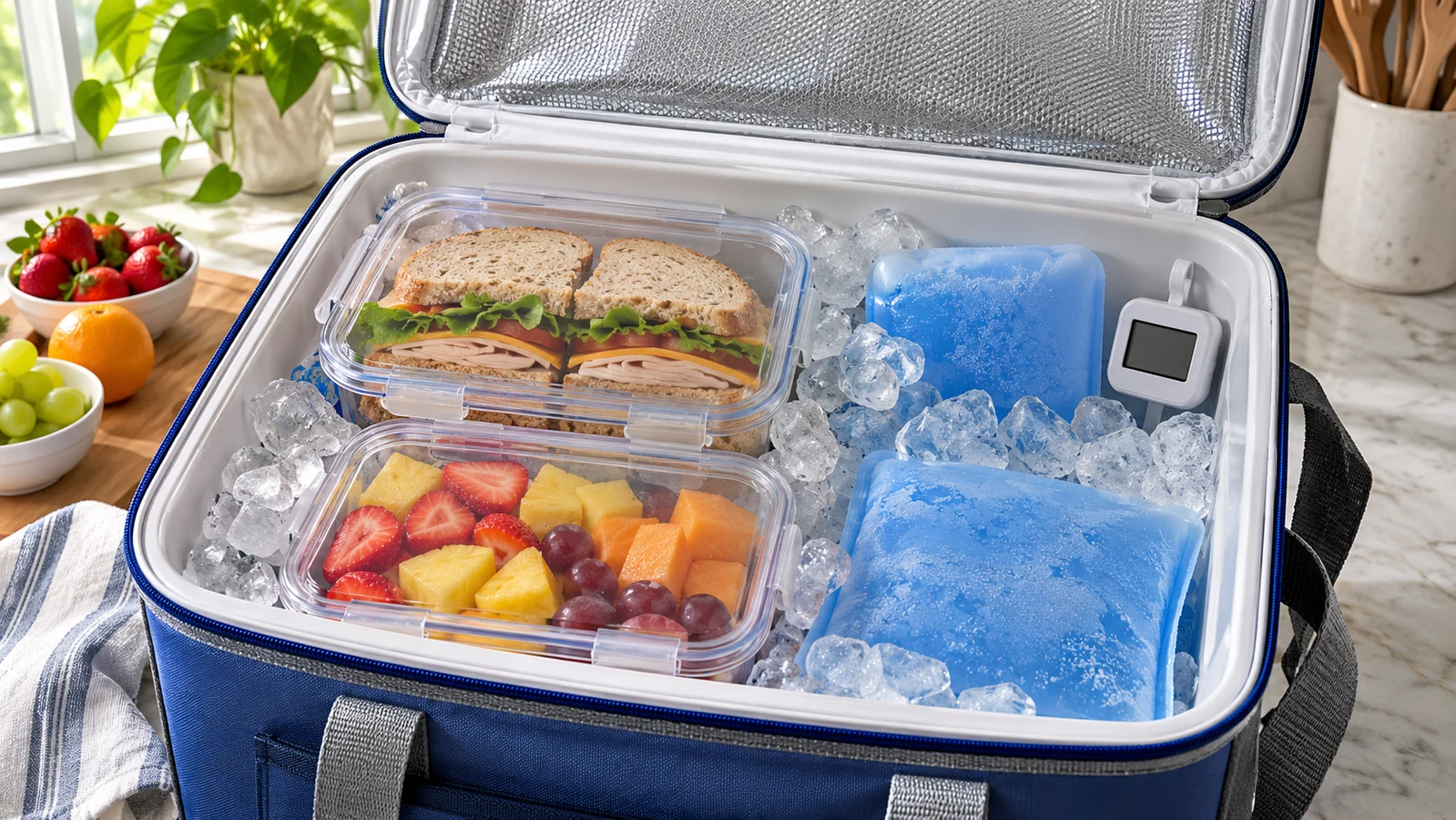
FoodSafety.gov recommends ice, frozen gel packs, or frozen water bottles as cold sources and explains that a fuller cooler retains cold better than a partly empty one; extra space can be filled with ice. This does not provide a universal number of packs or hours for every container. Before departure, consider whether the planned food leaves room for the cooling materials it needs. Follow the cooler manufacturer’s instructions too. An expensive insulated box without an adequate cold source is not the same setup as a packed, chilled cooler. The illustration shows a packing arrangement only, not a laboratory test of its performance.
Use temperature information instead of touch
FoodSafety.gov recommends an appliance thermometer in the cooler and a cold-storage target of 40°F, approximately 4°C, or below. That gives more useful information than judging the handle, outside wall, or one container by touch. An appliance thermometer monitors the storage environment; a food thermometer used to check cooking has a different task. Read the instructions for the device you use and keep it clean. The important distinction is between measuring relevant conditions and feeling reassured by the word insulated. Neither a photograph of ice nor a single general article establishes the temperature history of an individual meal.
Keep raw food and ready-to-eat food separate
FDA advises securely wrapping raw meat, poultry, and seafood so their juices do not contaminate cooked or ready-to-eat foods. It also warns against reusing plates or utensils that held raw foods for serving unless properly washed first. Think about the opening and serving sequence as well as the trip itself. A container that is convenient to carry still needs to keep its contents separated from other food. If you are only taking ready-to-eat items, you need not add raw ingredients to make a complete picnic. The packing example is not a recommendation to handle raw food where suitable cleaning facilities are unavailable.
Make the drinks easy to reach without warming lunch
FDA suggests considering separate coolers for drinks and perishable food because the drinks cooler may be opened repeatedly. For the food cooler, minimize unnecessary opening. You might group food by the order in which you plan to serve it so finding one item does not require leaving the lid open while everything is rearranged. That grouping is an editorial planning suggestion; it is not a substitute for cold sources or temperature checks. If you have only one cooler, acknowledge that constraint when planning the amount of food and the way people will use it rather than assume a second container is mandatory.
Arrange a clean place to serve
CDC recommends washing hands with soap and water for at least 20 seconds before eating and during food preparation, and keeping utensils and work surfaces clean. Nebraska Extension also encourages planning cleaning supplies when running water is limited. Before leaving, identify where handwashing can happen and what you need to bring. Do not let a neat-looking picnic table decide whether serving utensils are clean. As an organizational example, keep the clean utensils together until needed and agree where used ones will go. This does not replace product directions for any cleaning supplies or provide an infection-control plan for a particular illness.
Keep track of time outside temperature control
CDC advises not leaving perishable food out for more than two hours, or one hour when exposed to temperatures above 90°F, about 32°C. These are limits, not a goal for how long lunch should remain on display. Keep cold food under appropriate temperature control until serving, and take out only the amount needed at a time. Consider the whole period outside controlled storage, including preparation for serving and packing away. A convenient planning note might record when food was taken out; it cannot reconstruct an unknown temperature history. Do not use the clock alone to override evidence that cold storage was inadequate.
Do not automatically repack every leftover
FoodSafety.gov cautions that food left outside too long may not be safe to repack for later and advises discarding it when safety is uncertain. Plan portions and the return journey before the meal, rather than deciding that everything remaining must come home. A closed container does not by itself establish that its contents stayed safely cold. This is different from saying that every leftover must always be discarded: the relevant storage conditions and handling history matter. When that history is unclear, do not invent certainty to avoid waste. Planning a smaller quantity next time is more useful than making a safety claim about an uncertain dish.
A lunch bag is a smaller version of the same challenge
For packed lunches, FoodSafety.gov recommends an insulated bag with two cold sources and advises refrigeration on arrival when available. Its school-lunch guidance also describes placing a lunch bag in the refrigerator with the lid open to allow cold air to circulate. These are useful distinctions between transport and storage at the destination. A bag that helped on the commute is not a reason to ignore an available refrigerator. For a day trip without one, the cooling plan must cover the actual conditions instead. Do not transfer the two-source lunch-bag example into a guarantee for a much larger cooler or a longer outing.
Share the plan when several people bring food
When friends bring different dishes, ask each person how their food will be transported and kept cold before serving. FoodSafety.gov’s events guidance highlights that shared gatherings involve food prepared in different places by different people. A simple agreement can make responsibilities clearer: who brings the cold sources, who checks the cooler, and where food stays until needed. These are planning roles, not professional food-safety certification. Nobody needs to disclose a medical condition to explain that their dish requires refrigeration. Keep product labels available when useful, and do not turn a casual group message into an assurance that every item has been assessed.
Use a short departure checklist
A departure checklist can stay short: the food needing refrigeration, adequate cold sources, a thermometer suitable for the cooler, closed containers, clean serving equipment, and a realistic handwashing plan. Add the expected journey and meal times as reminders to check the plan, not as a promised safe duration. If one part is missing, reconsider the menu or the destination facilities before setting off. This checklist combines the guidance above with organizational examples; it has not been validated as a scoring tool. Completing every line does not certify a meal, and buying a particular brand is not required to ask better planning questions.
Optional nutrition reading is separate from safety evidence
The site’s existing Weight Loss Breeze, The Blood Pressure Program, and The Oxidized Cholesterol Strategy pages are optional commercial reading connected with the broader subject of everyday food choices. They are not sources for cooler temperatures, food handling, or the safety limits discussed here. The three links are separate from the public-health and university references below. No purchase is needed to follow food-safety guidance, and a program cannot assess whether your picnic food is safe. This guide does not endorse program treatment claims, recommend weight loss for an individual, or suggest changing prescribed treatment or a clinician-directed eating plan.
The takeaway and general-information disclaimer
The practical sequence is to choose food that fits the available facilities, prepare and chill it safely, pack adequate cold sources, monitor storage conditions, keep foods separated, and organize serving and the trip home. Simplifying the menu can be more realistic than relying on an unverified cooling promise. This is general food-safety education, not diagnosis, individualized medical or nutrition advice, treatment for food poisoning, or a substitute for local food-service regulations. AI assisted with drafting, organization, and the original editorial image. Mr.Hotsia reviewed sourcing and clarity only; no clinical review or medical qualifications are implied. The pictured arrangement is fictional and does not certify food temperature or safety.
Sources and further reading
Medical information was checked against these public health sources on November 20, 2026.
This article is general health education, not a diagnosis or personal medical advice. Do not change treatment or supplements based on this article. Discuss individual results with a qualified healthcare professional.