Everyday food safety · Reusable grocery bags
Reusable Grocery Bags: Separate, Clean, and Dry Before the Next Shop
A reusable bag needs a routine as well as a place by the door. Keep raw foods separate, check for leaks, follow material-specific care instructions, and let bags dry before putting them away.
AI assisted with drafting, organization, and the original editorial image. Mr.Hotsia reviewed sourcing and clarity only; no clinical review or medical qualifications are implied.
Think about the journey, not just the bag
Reusable grocery bags are easy to remember when leaving home and easy to forget once the shopping is unpacked. They may be folded, stacked, or returned to a car without another thought. A more useful approach follows the whole journey: what goes into each bag, whether anything leaks, how the material can be cleaned, and whether it is dry before storage. Health Canada explains that bags and bins can collect bacteria from foods and transfer contamination to other items. This guide turns that basic concern into an ordinary household routine, not a reason to fear every shopping trip or buy specialized equipment.
Keep raw foods separate from ready-to-eat foods
The CDC places separation alongside cleaning, cooking, and chilling in its food-safety framework. During shopping, raw meat, poultry, seafood, and their juices should be kept away from other foods. Think especially about items that will be eaten without cooking, such as bread or prepared food. A shopping bag is not a reason to combine everything into one compartment simply because each item has packaging. The practical aim is to keep different tasks and food types apart. This article does not assess a particular package or tell you whether a food exposed to a leak is safe to eat.
Give bags a clear role
Food Standards Scotland recommends keeping dedicated bags for raw foods rather than using those same bags for ready-to-eat foods. It also notes that a bag can look clean while still carrying bacteria after raw meat has been inside. A household example is to assign one recognizable bag to raw-food purchases and another to foods that will not be cooked. The distinction should be understandable to everyone doing the shopping. It is an organization aid, not a guarantee: designating a bag does not remove the need to check it, follow appropriate care instructions, or keep leaking packages contained.
Make separation easier at the checkout
Food Standards Scotland suggests separating raw and ready-to-eat foods on the checkout conveyor, making separation easier when packing. This is a small opportunity to organize before bags become full. As an editorial example, put the dedicated raw-food bag where the person packing can identify it, rather than explain the system only after everything is mixed. A color, a simple mark, or a consistent place in the trolley may help. No particular color has a universal food-safety meaning. Choose a cue that works for your household rather than treat the appearance of the bag as evidence about its contents.
Check for spills after unpacking
After unloading, pause before folding bags away. Food Standards Scotland advises checking after each use for spills, including meat juices or soil. Health Canada says a bag affected by leaking food juices should be thoroughly washed before reuse. Those recommendations make the unpacking stage a useful reminder. Look inside the bag and notice the material and condition, rather than wait for a particular smell. An editorial planning example is to keep bags needing attention separate from the clean ones. This does not create a home test for bacteria or establish that a bag without visible marks is hygienically safe.
Read the care instructions before washing
Bag materials differ, so start with the care label or the manufacturer’s directions. Québec’s public guidance specifically tells readers to consult care instructions and notes that fabric bags can be machine washed. Health Canada also describes frequent machine washing of cloth bags and hand washing for appropriate bags that cannot be machine washed. Do not assume a fabric-looking outer layer means that an insulated lining, insert, or fastener tolerates the same treatment. If the instructions are missing, look for reliable product guidance rather than improvise a chemical or heat treatment. This article does not prescribe a universal wash temperature for every material.
Do not assume every plastic-lined bag can be rescued
Public guidance is not identical for every kind of bag. Food Standards Scotland says plastic-based reusable bags with spillage, soiling, or damage should ideally be disposed of, while distinguishing washable cotton fabric bags. Health Canada describes washing reusable bags and bins, but that does not establish that every damaged or contaminated product can be restored. Read these sources with their material-specific scope in mind. A useful question is whether your particular bag can be cleaned as directed and remains suitable for use. Do not turn general washing advice into a promise that any bag can always be rescued.
Drying is a separate step
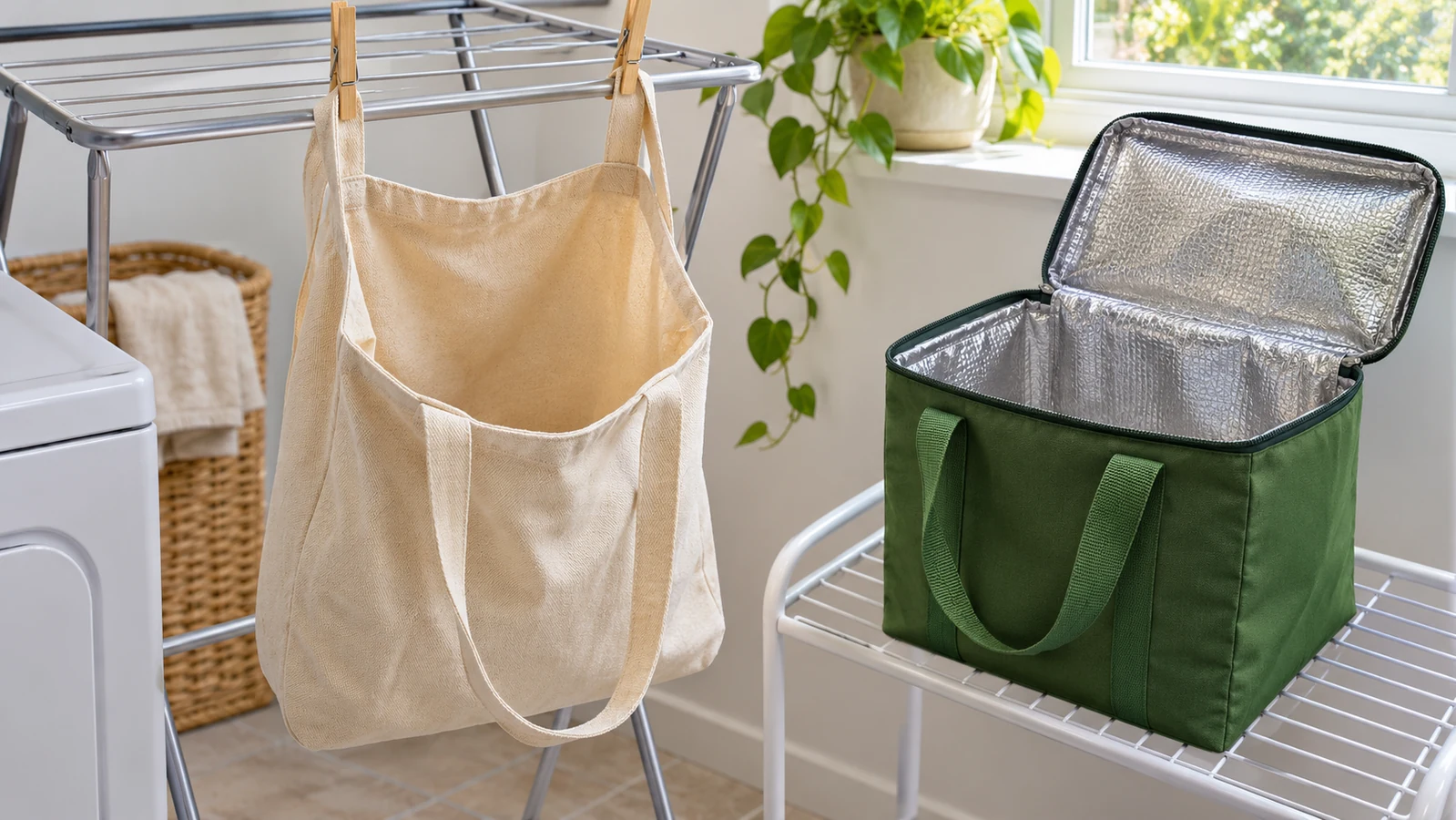
Washing and putting away are not the same step. Québec advises drying bags inside out, or drying the interior with a clean, dry cloth; Health Canada also includes drying after washing. Plan for this stage before stuffing a washed bag into another bag. An editorial example is to leave enough space for the interior to be accessible while it dries, following the product’s instructions. The image accompanying this article illustrates empty bags being aired, not an approved drying method for every construction. It cannot show that a bag is free of contamination or replace its care directions.
Give clean bags a practical storage place
Once bags have been appropriately cleaned and dried, choose a storage arrangement you can maintain. For example, keep the bags that are ready for shopping in one place and those awaiting care somewhere distinct. This is an editorial organization suggestion, not a formally tested intervention or an official storage-location rule. The purpose is to avoid losing track of which bag still needs attention. A neat pile is not proof that cleaning happened, and a decorative basket adds no special protection. Focus on a system that helps you remember the previous contents, the care instructions, and whether the bag is ready to use.
Keep non-food errands in the picture
A grocery bag sometimes becomes a general-purpose carrier for shoes, sports gear, tools, or other errands. Health Canada recommends thoroughly washing bags or bins before using them for groceries if they have carried non-food items. An editorial example is to keep a separate errand bag so that a busy morning does not require reconstructing every recent use. If another household member borrows a bag, ask what it carried before returning it to the grocery supply. The point is not to label all non-food objects dangerous; it is to avoid assuming that a familiar bag has always been used in the same way.
Remember the surfaces underneath the bags
The bag’s journey also includes the place where it is set down. Health Canada advises cleaning and, where appropriate, sanitizing areas such as counters and tables on which bags or bins were placed. This article does not give a chemical recipe or claim every surface needs the same treatment. Follow suitable product directions and guidance for the surface. A practical planning example is to unpack in an area that is easy to clean instead of scattering bags across several food-preparation spaces. Keep surface care separate from deciding how to wash the bag itself; materials and intended uses may differ.
A clean bag is not a refrigerator
Cleanliness does not replace temperature control. Health Canada’s broader food-safety guidance recommends buying chilled or frozen foods near the end of the shop. The CDC emphasizes prompt refrigeration of perishable food. A clean tote, or even an insulated carrier, does not by itself prove that food remained at a safe temperature. Plan the trip and unpack foods needing refrigeration promptly rather than treat bag cleaning as the entire safety plan. This article does not determine the safety of groceries left in a vehicle or provide a personalized time allowance for travel. Consult the linked official guidance for temperature-related decisions.
Build a routine other people can follow
A routine is easier to share when it uses clear actions rather than vague instructions to be careful. An editorial example has four moments: choose bags by role before leaving, keep foods separated while packing, check bags while unpacking, and complete the appropriate care and drying before storage. Explain the system to anyone who shares the shopping. If a bag is unsuitable or instructions are unclear, leave it out of the next shop while you resolve that question. These are reminders for organizing tasks, not a certification scheme, a scoring system, or proof that a shopping trip carries no risk.
Know what this guide cannot tell you
This is household education, not guidance for a restaurant’s food-safety plan or a substitute for local requirements. The linked Canadian and Scottish sources reflect their own settings; their regulatory statements should not be automatically applied elsewhere. This article does not diagnose foodborne illness, advise treatment, assess symptoms, or decide whether a specific exposed food should be eaten. It also does not rank brands or claim that a reusable bag is inherently safe or unsafe. For product-specific care questions, consult the manufacturer. For an official food warning, follow the responsible authority rather than rely on a general bag-care checklist.
Optional commercial reading is separate from food-safety evidence
The three optional commercial links are existing books in this site’s broader food and everyday-wellbeing catalog: Weight Loss Breeze, The Blood Pressure Program, and The Oxidized Cholesterol Strategy. They are separate reading choices, not evidence for grocery-bag hygiene or endorsements by the agencies cited here. You do not need to buy a program to use reusable bags or read the public guidance. This article does not evaluate those programs as treatments, promise a health benefit from purchasing them, or recommend changing medicines or an individual diet. Keep commercial reading clearly separate from the food-handling recommendations and source links.
A manageable reset and general-information disclaimer
A manageable reset is to keep raw and ready-to-eat foods apart, notice spills and damage, follow material-specific care instructions, and complete drying before returning bags to service. Remember that food temperature, packaging, hands, and surfaces still matter. No single bag or routine guarantees protection against illness. This article provides general information rather than diagnosis, individualized medical advice, professional food-service certification, or a determination about a particular food. AI assisted with drafting, organization, and the original editorial image. Mr.Hotsia reviewed sourcing and clarity only; no clinical review, medical qualifications, or approval by the cited agencies is implied.
Sources and further reading
Medical information was checked against these public health sources on November 21, 2026.
- Health Canada — Reusable grocery bags and bins: separation, washing, drying and surfaces ↗
- Gouvernement du Québec — Reusable bags and containers: cleaning and care labels ↗
- Food Standards Scotland — Reusable bags and containers: dedicated bags and material-specific limits ↗
- Health Canada — Food safety and you: shopping guidance ↗
- CDC — Preventing Food Poisoning: clean, separate, cook and chill ↗
This article is general health education, not a diagnosis or personal medical advice. Do not change treatment or supplements based on this article. Discuss individual results with a qualified healthcare professional.