Everyday prevention · Kitchen hygiene
Kitchen Cutting Boards: Separate Tasks, Clean, and Replace Worn Surfaces
A board’s job and condition matter more than its color. Plan separate equipment for raw and ready-to-eat food, clean between tasks, follow care instructions, and notice wear that makes cleaning difficult.
AI assisted with drafting, organization, and the original editorial image. Mr.Hotsia’s review credit is limited to sourcing and clarity; no clinical review or medical qualifications are implied.
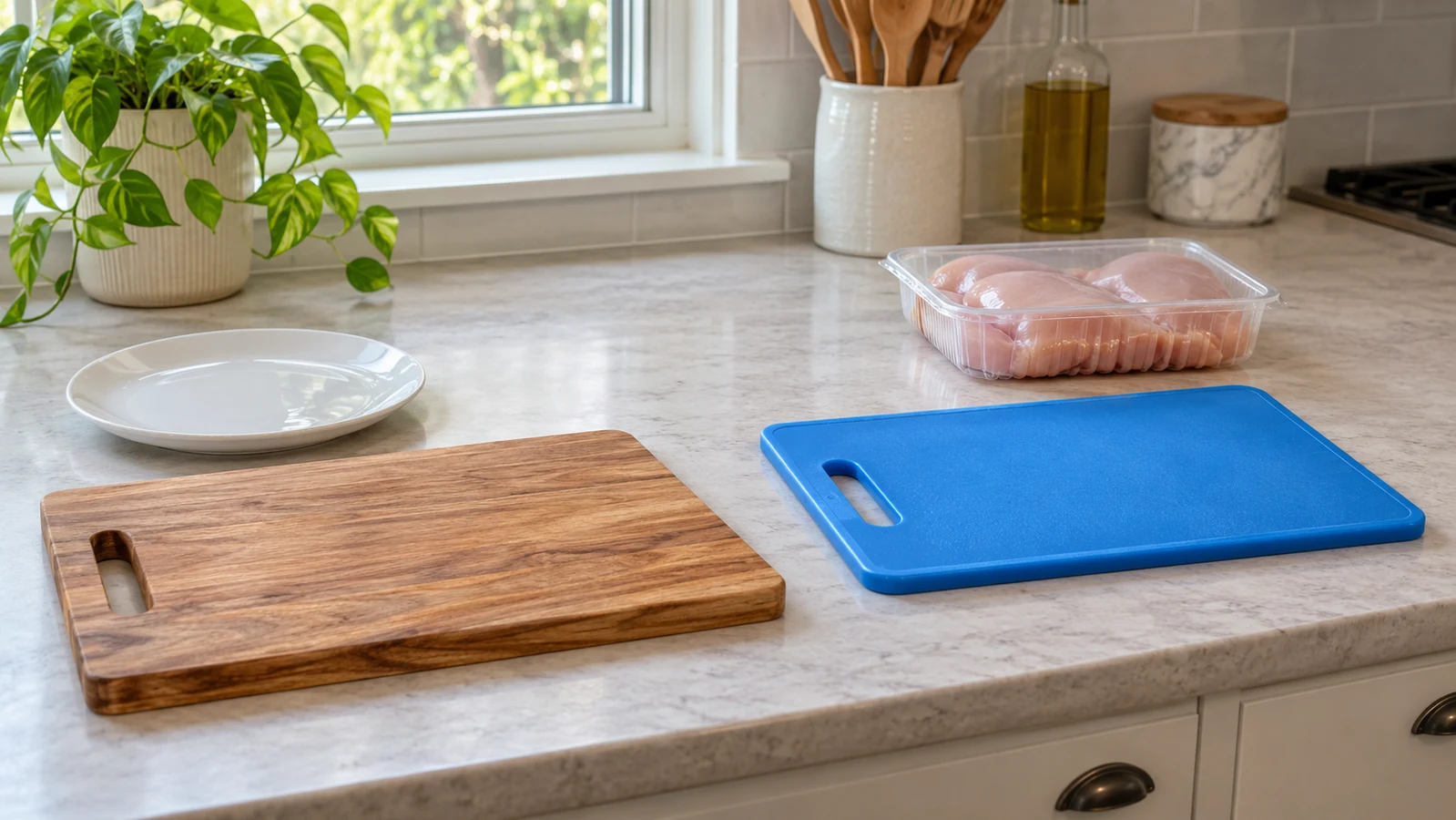
Start with the next food that will touch the board
Before preparing a meal, ask what will touch the cutting board now and what will touch it next. Chopping raw chicken and slicing food that will be eaten without further cooking are different jobs. A useful kitchen routine makes that distinction visible before the work begins. This guide focuses on boards, the tools around them, and the transition between tasks. It is not a ranking of brands or a test that certifies a home kitchen. The aim is a practical arrangement that people sharing the kitchen can understand, rather than buying an impressive-looking board and assuming the rest takes care of itself.
What cross-contamination means in an ordinary kitchen
Cross-contamination is the transfer of contamination from one place or food to another. Health Canada’s Food safety and you guidance recommends one board for produce and another for raw meat, poultry, fish, and seafood. The point is separation of tasks, not a special protective property of a particular color. An editorial example is to decide where salad preparation will happen before opening a raw-meat package. That small planning step gives the household a clear question to answer: which equipment is for food that will go straight to the table, and which equipment is reserved for the raw-food task?
Ready-to-eat does not mean only packaged snacks
The Food Standards Agency’s ready-to-eat guidance describes food that will not be cooked or reheated before serving. Its examples include salads, sandwiches, cheese, and food cooked in advance to be served cold. This matters because a later cooking step should not be assumed to correct a preparation mistake. An editorial way to map a meal is to separate the ingredients by what happens next, rather than by whether they look fresh, cooked, or packaged. A cooked item can still need clean preparation equipment. The agency’s document is written for food businesses; here, its separation principle is explained without presenting business procedures as universal household law.
Give separate equipment a clear job
Separate boards make the division easier to maintain. Health Canada specifically recommends separating produce boards from boards used for raw animal foods, while the FSA recommends separate boards and utensils for ready-to-eat food where possible. Choose an arrangement that the actual kitchen users can follow. An editorial example is a simple household note identifying each board’s job and where it belongs after cleaning. Do not rely on an unspoken rule that only one person knows. Separation should remain a working practice each time food is prepared, not merely a promise made when a new board is unpacked.
Make the household system easy to understand
Color can be a reminder, but a blue or green board has no useful meaning if everyone interprets it differently. As an editorial organization example, agree on the purpose of each board and show a visitor or family member where the clean equipment is kept. This article does not prescribe a universal color code or claim that one is legally required in every home. If a label or care card came with the board, keep it available. The practical goal is less uncertainty during a busy meal: someone should not have to guess whether the board beside the sink is clean, used, or waiting to be washed.
Think beyond the board to the knife and plate
A separate board is only one part of the route food takes through the kitchen. Health Canada says plates and utensils used for raw food should be washed thoroughly with soap before reuse. Think about the knife, serving plate, and container as well as the board. An editorial example is to put out a clean plate for finished ingredients before preparation starts, rather than returning them to a plate used earlier for raw food. This is a workflow example, not an assurance that any particular meal is contamination-free. Equipment can look familiar and still need cleaning before its next job.
Wash between foods, not only at the end
The FDA’s surface-safety guidance says to wash boards, utensils, dishes, and counters with hot, soapy water after preparing each food item and before moving to the next. That makes cleaning a transition, not only the final chore after dinner. A practical editorial question is whether there is enough clear sink space to wash the board when needed. If washing is always delayed because the sink is full, changing the order of kitchen chores may be more useful than buying another accessory. Follow the board’s care instructions and handle hot water safely; this guide does not specify a temperature for a home washing test.
Keep cleaning and sanitizing distinct
Cleaning and sanitizing are related but not interchangeable instructions. Health Canada advises using a kitchen sanitizer according to its directions, including the required rinsing, for food-contact equipment. Read the actual product label and confirm that it is suitable for the intended surface and use. This article does not reproduce a household bleach recipe or suggest mixing products. An editorial planning example is to keep the board’s care information and the chosen product’s instructions easy to find, rather than remembering only a fragment of advice. A quick wipe with an unidentified spray should not be treated as evidence that the whole process was followed.
Follow the particular board’s care instructions
Before putting a board in a dishwasher or applying a cleaning product, check the instructions for that specific item. The word wood, plastic, or bamboo alone does not provide the complete care directions for every construction and finish. As an editorial shopping question, ask whether the care information is available before buying a replacement. Consider whether the suggested routine fits the kitchen equipment you actually have. This guide does not declare all boards of one material dishwasher-safe, recommend sanding or chemical restoration, or claim that a home treatment returns an old board to a tested condition. Product-specific questions belong with the manufacturer.
Watch for wear rather than a universal birthday
Condition matters over time. The FDA advises replacing excessively worn boards, including wooden, plastic, and nonporous acrylic boards, because grooves and cracks can become difficult to clean. Its advice does not establish one replacement date for every household. An editorial reminder might be to inspect the surface while putting clean equipment away, when changes are easier to notice than in the middle of chopping. Look at the item you have, not just the purchase date. This article does not give a groove-depth measurement, diagnose contamination from a photograph, or promise that a surface without visible damage contains no microorganisms.
Do not turn color or material into a safety certificate
A premium price, attractive grain, or antibacterial-sounding product name should not replace a clear preparation and cleaning routine. This is an editorial purchasing principle, not a comparative laboratory finding about materials. Ask what the manufacturer actually says about use and care, and whether you can follow those directions consistently. The sources here support separating tasks, cleaning equipment, and replacing worn surfaces; they do not endorse a brand sold on this website. The illustration also does not compare materials experimentally. Its wooden and plastic boards are a visual way to show separate equipment, not a claim that either board has passed inspection.
Give washed produce a clean destination
Produce needs a clean destination after preparation. Health Canada’s produce-safety page recommends a separate clean plate or container for peeled or cut fruit and vegetables, alongside separate boards for produce and raw meat. An editorial meal-planning example is to have that container ready before cutting begins, so prepared ingredients are not set back onto equipment awaiting cleaning. Follow the food’s own handling instructions as well. This article does not treat every item described as a vegetable as interchangeable, recommend detergent on produce, or replace package directions. The board routine is one part of handling food, not the whole food-safety system.
Plan the transition before a busy meal
For a busy shared meal, a short editorial plan can help: identify the ready-to-eat ingredients, choose the equipment for each job, set out clean receiving dishes, and decide where used tools will go. Then pause between tasks to carry out the cleaning steps rather than merely moving the same tools to a different corner. This is a suggested organization method, not an officially validated checklist or a score predicting illness. Keep it understandable for the person actually cooking. A complicated system that nobody remembers is less useful than a clear arrangement supported by the public guidance and the products’ instructions.
Keep household guidance in its proper scope
The article is limited to everyday information about equipment and preparation. It does not diagnose food poisoning, recommend treatment after an exposure, or assess an individual’s medical risk. Questions about symptoms belong with an appropriate health professional. A commercial food business should follow the rules and approved procedures that apply locally rather than use this household article as its compliance manual. Guidance from Canada, the United States, and the UK has different contexts. Where care directions, food-contact product instructions, or local requirements are unclear, obtain the relevant information instead of improvising a universal solution from a general internet summary.
Optional commercial reading is not food-safety evidence
Readers interested in broader daily wellbeing can optionally explore Weight Loss Breeze, The Insomnia Program, and Overthrowing Anxiety through the three existing commercial book links on this page. Their connection is general routines and wellbeing, not cutting-board hygiene. They are not evidence for these food-handling recommendations, do not sanitize equipment, and are not presented as treatments for foodborne illness. No purchase is needed to use the public information cited below. The references and product links serve different purposes; neither the presence of a link nor this article implies endorsement of a commercial program by Health Canada, the FDA, or the FSA.
A practical starting point and general-information disclaimer
Begin with a clear division of jobs, clean the equipment between foods, follow the actual care instructions, and replace a board when wear makes effective cleaning difficult. These habits do not make any kitchen risk-free, and a clean-looking board is not a laboratory result. Use the direct public sources for the underlying recommendations and keep product-specific instructions available. This is general information, not personalized medical advice, diagnosis, treatment, or certification of a kitchen or product. AI assisted with drafting, organization, and the original editorial image. Mr.Hotsia’s review credit is limited to sourcing and clarity; no clinical review or medical qualifications are implied.
Sources and further reading
Medical information was checked against these public health sources on November 21, 2026.
- Health Canada — Food safety and you: separate boards and clean utensils ↗
- Health Canada — Produce safety: separate equipment and clean receiving containers ↗
- U.S. FDA — Cleaning: surface safety and replacement of worn boards (general equipment guidance only) ↗
- Food Standards Agency — Safe method: ready-to-eat food (PDF; business context, separation principles only) ↗
This article is general health education, not a diagnosis or personal medical advice. Do not change treatment or supplements based on this article. Discuss individual results with a qualified healthcare professional.