Everyday food safety · Refrigerator temperature
Refrigerator Thermometers: Check the Temperature, Not Just the Dial
A refrigerator setting is not always a temperature reading. Learn how to make appliance-thermometer checks understandable, keep a simple record, and recognize what a cold reading cannot prove about food safety.
AI assisted with drafting, organization, and the original editorial image. Mr.Hotsia’s review credit is limited to sourcing and clarity; no clinical review or medical qualifications are implied.
A setting and a reading answer different questions
A dial marked one through five may look reassuring without answering the question you actually have: how cold is the refrigerator? The FDA explains that many refrigerator controls do not display the actual temperature. A freestanding appliance thermometer can provide a reading that helps you monitor conditions and adjust the setting when necessary. This article focuses on that everyday distinction, rather than another list of leftover-storage times. It is a guide to making a household check understandable and repeatable, not a test that certifies every food in the refrigerator or predicts whether someone will become ill.
Start with the published temperature guidance
The CDC recommends keeping a refrigerator at 40°F or below and a freezer at 0°F or below. Health Canada expresses its guidance as 4°C or lower for the refrigerator and −18°C or lower for the freezer. Use the units in the guidance and on your device; do not confuse a positive refrigerator temperature with a negative freezer temperature. The familiar Celsius and Fahrenheit figures are rounded public-guidance equivalents, not an invitation to treat a dial number as degrees. If your appliance instructions use numbered settings, look up how those settings are adjusted rather than assign them invented temperatures.
Choose a device for the job
Choose a thermometer intended for the appliance and its temperature range. The FDA describes inexpensive freestanding appliance thermometers and recommends checking them often. This is not a comparison of brands, connected sensors, or premium monitoring systems. Before buying, consider whether you can read the display, understand its units, and find its instructions. A product description should explain its intended use instead of leaving you to guess from a photograph. A household planning example is to keep the model name with the refrigerator manual so that instructions remain available after the packaging has been recycled.
Read both sets of instructions
There are two instruction sets to consult: the refrigerator manual and the thermometer directions. Use them for placement, setup, response time, cleaning, batteries where relevant, and any manufacturer-described accuracy checks. This article does not invent one waiting period or calibration method for every design. An editorial example is to write down the page or section covering temperature adjustment before changing a control. If directions are unclear, ask the manufacturer rather than improvising a test. A careful question is more useful than assuming that two devices with similar-looking displays must be installed, cleaned, or interpreted in exactly the same way.
Make the reading accessible
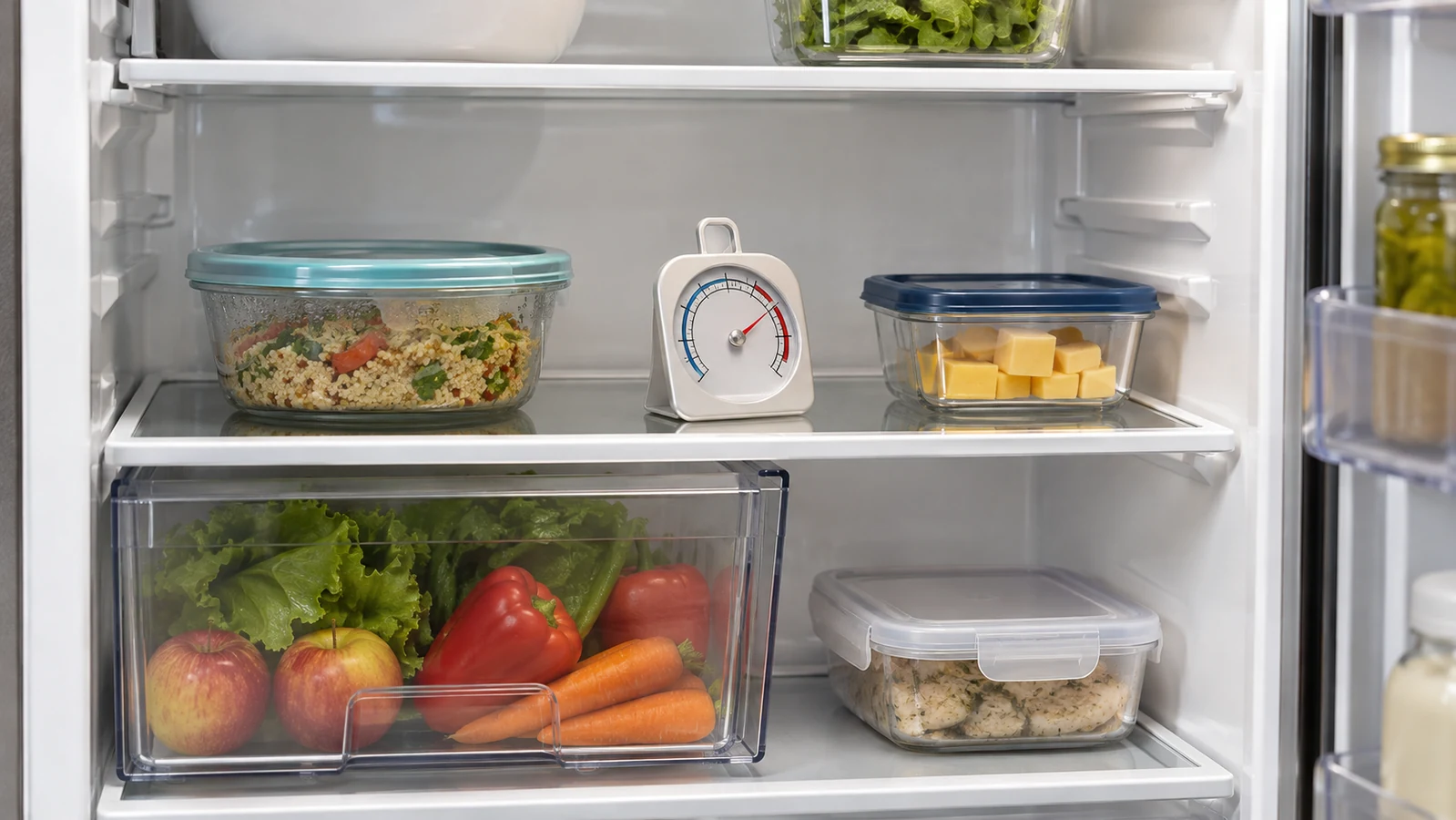
The FDA’s food-storage guidance recommends placing refrigerator and freezer thermometers toward the front in an easy-to-read location and checking them regularly, at least weekly. Combine that advice with the instructions for your particular equipment. Make the device accessible rather than burying it behind containers or leaving it somewhere it cannot be read. An editorial organization example is to identify its usual place when explaining the kitchen routine to another household member. The accompanying image is only a contextual illustration: it does not establish the correct location for every appliance or show a verified reading.
Write down the unit, not just the number
Record a unit whenever you record a temperature. A note that says only four can be confused with a control setting, a Celsius reading, or a count of something else. A simple household example is a line with the date, time, device location, reading, and unit. This is an editorial reminder format, not an official monitoring form or a requirement to create a detailed spreadsheet. Use words and print sizes everyone involved can understand. If the thermometer has more than one display mode, consult its directions so that a remembered reading is not mistaken for the current one.
Build a small record instead of relying on memory
A small record can help you describe what you observed without reconstructing it from memory. For example, note an ordinary check and separately note a check made after following the appliance instructions to change a setting. Include relevant context in plain language rather than filling the page with assumptions about the cause. The point is not to manufacture a diagnosis of appliance failure from a few numbers. Nor does a list of readings establish what happened during every unobserved interval. Treat the record as a communication aid when discussing the equipment with a manufacturer or qualified repair service.
Respond to a concerning reading without guessing
If a reading is outside the recommended range, do not simply rename it acceptable because the dial is in its usual position. Check that you are reading the intended unit and following the device directions, then use the refrigerator manual for appropriate adjustments and rechecking. Seek qualified service for equipment problems; this guide does not provide electrical repair instructions. Keep the equipment question separate from the food question. A new cold reading does not tell you how long food was previously warm. Use official time-and-temperature guidance for food decisions, and do not taste questionable food to investigate its safety.
Keep the surroundings in the picture
A thermometer is part of a storage arrangement, not a substitute for one. The FDA cautions against packing refrigerated foods so tightly that cold air cannot circulate. Health Canada also advises keeping raw meat, poultry, fish, and seafood in sealed containers or bags on the bottom shelf so their juices do not drip onto other foods. These are complementary precautions: a temperature display does not contain a leaking package or make room around an overcrowded shelf. As an editorial reminder, notice whether new shopping has obscured the thermometer while putting foods in their appropriate places.
Cold storage still has a time limit
Temperature and storage duration are separate questions. FoodSafety.gov publishes a cold-storage chart with refrigeration limits for different foods, alongside freezer guidance that distinguishes quality limits. A reading within the recommended range is not permission to keep every refrigerated item indefinitely. Use the chart for the particular food rather than transferring the limit for one item to a different one. A household organization example is to keep preparation or opening information where it can be found when consulting the guidance. This article deliberately does not reproduce a universal storage-time table or decide whether a specific container should be eaten.
A cold reading does not erase earlier handling
The CDC’s food-safety approach includes cleaning, separation, cooking, and chilling. A refrigerator check addresses only part of that picture. Prompt refrigeration still matters, and bringing food into a cold appliance does not rewrite its earlier handling. Think about the whole journey without turning a routine thermometer check into a reason to delay putting perishables away. For an uncertain exposure, consult the linked public guidance or the relevant food authority rather than use this article as a personalized assessment. In particular, a tidy shelf, a familiar package, and one reassuring number are not interchangeable evidence about food safety.
Do not confuse the appliance with the food
An appliance thermometer and a food thermometer serve different purposes. The CDC recommends a food thermometer to check that cooked foods reach the appropriate safe internal temperature, while its refrigeration guidance describes an appliance thermometer for checking the refrigerator. Do not treat an air-temperature display as a measurement of the center of a meal, or improvise a food probe from a device not intended for that use. Consult the correct equipment instructions and official guidance for the task. This distinction keeps a useful household tool in proportion: measuring one condition does not mean that every other necessary measurement has been made.
Make the routine shared and readable
Make the check easy to hand over. An editorial household example is a short note showing where the thermometer is, which unit is used, where instructions are kept, and whom to contact about an equipment problem. Avoid unexplained symbols or a private code only one person understands. Someone joining the routine should not have to guess whether a number is a target, a setting, or an observed reading. This is practical organization rather than a tested medical intervention. Choose a format that supports understanding, and do not describe a completed checklist as a guarantee of protection against illness.
Know when this guide stops
This guide concerns ordinary household organization, not a restaurant monitoring plan, commercial refrigeration certification, or storage requirements for medicines. It does not interpret symptoms, diagnose foodborne illness, prescribe treatment, or decide whether a particular exposed food is safe. Power interruptions and uncertain temperature histories require their own official guidance rather than a shortcut based on the latest display. For appliance-specific questions, use the manufacturer or qualified service support. For suspected illness, seek advice from a qualified health professional. Public sources cited here describe their own jurisdictions; their regulatory statements should not be automatically applied to another setting.
Optional commercial reading is not food-safety evidence
The three optional commercial reading links are existing pages in this site’s broader food and everyday-wellbeing catalog: Weight Loss Breeze, The Blood Pressure Program, and The Oxidized Cholesterol Strategy. They are not sources for refrigerator-temperature recommendations, appliance endorsements, or food-safety certification. No purchase is needed to read the public-agency guidance or perform an ordinary thermometer check. This article does not evaluate those programs as treatments, promise benefits from buying them, or recommend changing medicines or an individual diet. Keep the commercial links separate from the evidence and from any question requiring professional care.
A practical starting point and general-information disclaimer
A manageable starting point is to distinguish the setting from the reading, find the instructions, confirm the displayed unit, and make regular checks understandable to the people sharing the kitchen. Keep storage time, separation, cleaning, and proper cooking in view as well. No thermometer certifies that all food is safe. This article provides general information, not individualized medical advice, diagnosis, treatment, or an assessment of a particular food. AI assisted with drafting, organization, and the original editorial image. Mr.Hotsia’s review credit is limited to sourcing and clarity; no clinical review, medical qualifications, or approval by the cited agencies is implied.
Sources and further reading
Medical information was checked against these public health sources on November 21, 2026.
- FDA — Refrigerator Thermometers: actual temperatures, monitoring and air circulation ↗
- FDA — Are You Storing Food Safely? placement, checks and storage precautions ↗
- Health Canada — Safe food storage: cold temperatures and raw-food separation ↗
- CDC — Preventing Food Poisoning: appliance and food thermometers, clean, separate, cook and chill ↗
- FoodSafety.gov — Cold Food Storage Charts: food-specific refrigeration limits ↗
This article is general health education, not a diagnosis or personal medical advice. Do not change treatment or supplements based on this article. Discuss individual results with a qualified healthcare professional.