Everyday prevention · Oral hygiene
Toothbrush Care: Rinse, Air-Dry, Keep Separate, and Notice Wear
A useful toothbrush-care routine does not need a sterilizing gadget. Rinse after use, let the brush dry upright, avoid sharing, and check the bristles as well as the calendar.
AI assisted with drafting, organization, and the original editorial image. Mr.Hotsia’s review credit is limited to sourcing and clarity; no clinical review or medical qualifications are implied.
Start with the brush after brushing
The toothbrush-care routine begins when you finish brushing, not when you buy a replacement. The basic questions are straightforward: has the brush been rinsed, can it dry, is it kept separate from other people’s brushes, and are its bristles still in reasonable condition? These questions are more useful than treating an expensive holder as a guarantee of cleanliness. This article explains routine equipment care using public dental guidance. It does not assess anyone’s teeth, prescribe a treatment, or certify a particular brush. A manageable daily routine is the goal, rather than trying to turn an ordinary bathroom into a sterile laboratory.
Rinse away what is left behind
The American Dental Association recommends rinsing a toothbrush thoroughly after each use to remove remaining toothpaste and debris. FDI World Dental Federation gives the same basic advice in its toothbrushing guide. Make that step part of finishing the task, rather than putting a paste-covered brush away and planning to deal with it later. An editorial household example is to leave enough time in the morning routine to rinse and store the brush before rushing out. This is not a laboratory cleaning protocol or a recommendation to add detergent, household cleaner, or another substance to a toothbrush.
Let the brush air-dry upright
After rinsing, store the brush upright and allow it to air-dry. The ADA explains that keeping a moist brush in a closed container promotes microbial growth more than leaving it exposed to open air. FDI also recommends upright, air-drying storage. The practical distinction is between a place where the wet brush can dry and a container that keeps it enclosed. This guide does not specify an exact drying time for every bathroom or brush. As an editorial check, look at how the brush is actually stored after use, rather than assuming an attractive container automatically provides the right conditions.
Keep brush heads apart
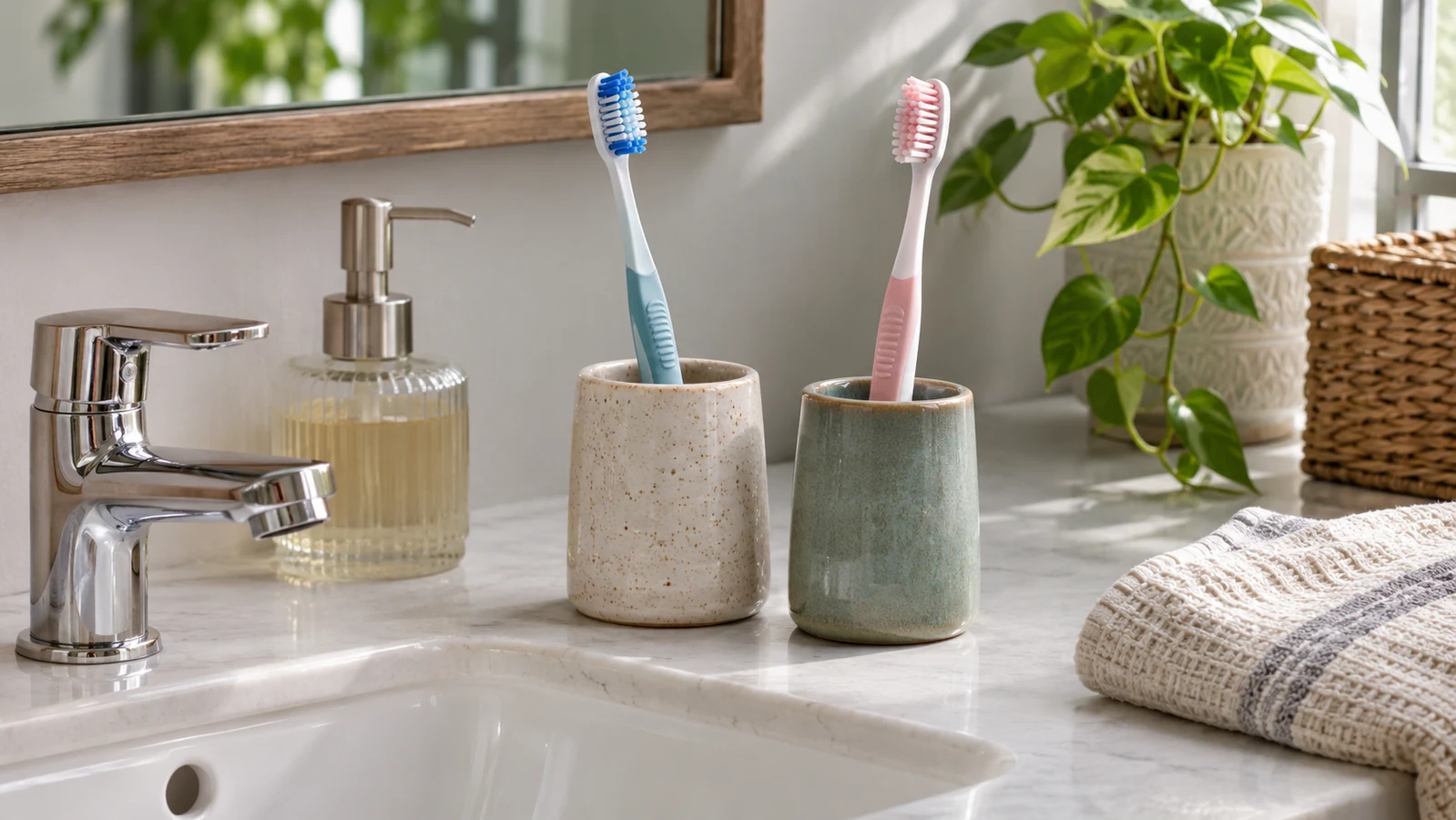
The ADA’s MouthHealthy consumer page advises separating brushes stored together so that they do not contact one another. Think about the brush heads, not merely whether the handles have different colors. An editorial organization example is to check the arrangement after everyone has put their brushes away, when a crowded holder may look different from an empty one. Separate holders are one possible arrangement, not a mandatory product purchase or the only acceptable design. The photograph illustrates separated brushes; it does not establish a minimum distance, test a holder, or certify that the surrounding surface is free of microorganisms.
Make ownership clear in a shared bathroom
Do not share toothbrushes. This recommendation appears in the ADA, FDI, and UCSF California Childcare Health Program guidance. In a shared bathroom, a clear ownership system can make that rule easier to follow. An editorial example is to choose a simple way for household members to identify their own brush without having to ask someone who is still asleep. Appearance alone may not be enough when several brushes look similar. A spare unused brush can also be considered when planning for guests. These are organization suggestions, not a claim that any labeling method or storage product prevents every possible mix-up.
Do not confuse a clean appearance with sterility
Finding microorganisms on a used toothbrush is not the same as demonstrating that the brush caused an illness. The ADA’s technical overview notes that brushes can harbor bacteria while also describing a lack of evidence that those bacteria cause adverse health effects. That distinction helps keep routine care proportionate. A brush should not be judged sterile because it looks clean, but neither should an alarming photograph be used to diagnose a health problem. This article does not estimate an individual infection risk or promise that rinsing eliminates every organism. The basic recommendations stand without turning everyday care into a claim of complete disinfection.
Check the bristles as well as the calendar
The ADA and FDI recommend replacing a brush approximately every three to four months, or sooner when the bristles are matted or frayed. The ADA links wear to reduced effectiveness. That makes the condition of the working end important, not just the date on a receipt. An editorial example is to notice the bristles while putting the brush away, instead of waiting for a calendar alert to authorize looking at it. This guide does not provide a measured threshold for wear, diagnose brushing technique from a photograph, or say that a brush becomes unsafe at a precise hour on its replacement date.
Use a reminder without ignoring visible wear
A reminder can help you remember when a brush was started. An editorial option is a note in an existing calendar or a date kept with the replacement supply, rather than creating a complicated tracking system. Keep that reminder separate from the condition check: visibly frayed bristles should not be ignored because the planned date has not arrived. Equally, a reminder is not evidence that all brushes have identical lifespans. The public guidance gives a practical replacement interval with an earlier-change condition, not a guarantee of a fixed number of brushing sessions for every person or product.
Heat is not a shortcut to better care
Do not use a microwave or dishwasher as a shortcut to routine toothbrush care. The ADA discourages those methods because high heat can damage the brush; the UCSF family factsheet also advises against them. A damaged tool is not made more useful by the intention to clean it thoroughly. This article does not suggest an alternative heating time, a boiling procedure, or an experiment to find how much heat a brush tolerates. If you are unsure about cleaning a particular item, consult the manufacturer’s directions or ask a dental professional instead of borrowing a method intended for a different household object.
Avoid inventing a soaking recipe
Routine care should not become an improvised chemical project. The UCSF factsheet says soaking brushes in disinfectant solutions or mouthwash is unnecessary and notes that reused or shared solutions can introduce cross-contamination concerns. The ADA describes the evidence about sanitizing as limited. Those points do not justify inventing a concentration, contact time, or mixture at home. This guide provides no soaking recipe and does not recommend a sanitizing device. If a dentist has given you specific instructions for your circumstances, ask them to clarify the product and steps rather than replacing that advice with a general article.
Check the instructions for powered equipment
A powered brush adds a handle, charging equipment, and a detachable head to the care questions. Treat the instructions for that exact model as the source for cleaning its components. An editorial planning example is to keep the care leaflet or manufacturer’s instructions accessible, so the person cleaning the bathroom does not have to guess what may be rinsed, detached, or immersed. This is not a claim that every powered brush has the same construction. The article does not instruct readers to open electrical parts, submerge a handle, or apply a method from one brand’s manual to another product.
Plan storage when staying away from home
When staying somewhere else, think about where the brush can stand after use rather than only how it fits in a bag. This is an editorial application of the upright, air-drying and nonsharing principles, not a separate official travel protocol. A compact bathroom may need a different arrangement from the one at home. Do not assume a shared cup belongs to you alone, or that a closed travel case is automatically the best place for a wet brush throughout the stay. For product-specific packing and cover instructions, consult the item’s directions. No travel accessory is evaluated or endorsed here.
Know when a general care article is not enough
Routine brush care is not the same as advice after illness, accidental sharing, a medical procedure, or a condition that changes someone’s care needs. This article deliberately does not provide rules for those situations. Ask an appropriate dental or health professional for instructions suited to the circumstances. Likewise, a childcare service should follow its current local policy and professional guidance rather than use this household article as a complete infection-control manual. The UCSF source is a family and childcare resource; only its general equipment-care recommendations are used here, not a claim that all settings have identical requirements.
Keep the routine simple and usable
A short editorial routine can remain understandable: rinse the brush after use, put it upright where it can air-dry, keep its head apart from other brushes, and notice whether the bristles are wearing out. Then use a simple reminder to support replacement rather than to override what you can see. This is not an officially validated checklist, a score for oral health, or a promise that completing four steps prevents disease. If a household system is hard to remember, simplify the arrangement and explain it to the people who use it. The routine should support everyday care without unnecessary gadget purchases.
Optional commercial reading has a different purpose
For readers exploring related but separate wellbeing topics, three existing commercial program pages are linked: TMJ No More, The Acid Reflux Strategy, and The Insomnia Program. Their connections are jaw-related reading, reflux-related reading, and nighttime routines, respectively, not evidence for toothbrush storage. These books are not presented as a way to disinfect a brush, treat a dental condition through brush care, or replace a professional assessment. No purchase is needed to follow the free public guidance cited here. The commercial links and the dental references serve different purposes; the ADA, FDI, and UCSF do not endorse these programs through this article.
A short starting point and general-information disclaimer
Start with ordinary care that you can repeat: rinse, allow upright air-drying, avoid sharing, keep heads separated, and check wear alongside the approximate replacement interval. Follow the instructions for your particular equipment and ask for individual advice when general guidance does not answer the question. This article offers general information, not personalized medical or dental advice, diagnosis, treatment, or product certification. It does not promise a sterile brush or a disease-free mouth. AI assisted with drafting, organization, and the original editorial image. Mr.Hotsia’s review credit is limited to sourcing and clarity; no clinical review or medical qualifications are implied.
Sources and further reading
Medical information was checked against these public health sources on November 21, 2026.
- American Dental Association — Toothbrushes: routine care, wear and evidence limits ↗
- ADA MouthHealthy — Toothbrushes: separate storage and replacement ↗
- FDI World Dental Federation — Consensus on Toothbrushing visual guide (PDF; storage and routine replacement only) ↗
- UCSF California Childcare Health Program — Toothbrush Care is Important (general equipment-care recommendations only) ↗
This article is general health education, not a diagnosis or personal medical advice. Do not change treatment or supplements based on this article. Discuss individual results with a qualified healthcare professional.