Everyday prevention and home safety
Smoke Alarms at Home: Test the Device, Check Its Age, Keep a Plan
A smoke alarm needs more than a place on the ceiling. Learn how testing, device age, model-specific battery instructions, accessible alerts, and a household escape plan fit together.
AI assisted with drafting, organization, and the original equipment illustration. Mr.Hotsia reviewed sourcing and clarity only; no clinical review or medical qualifications are implied.
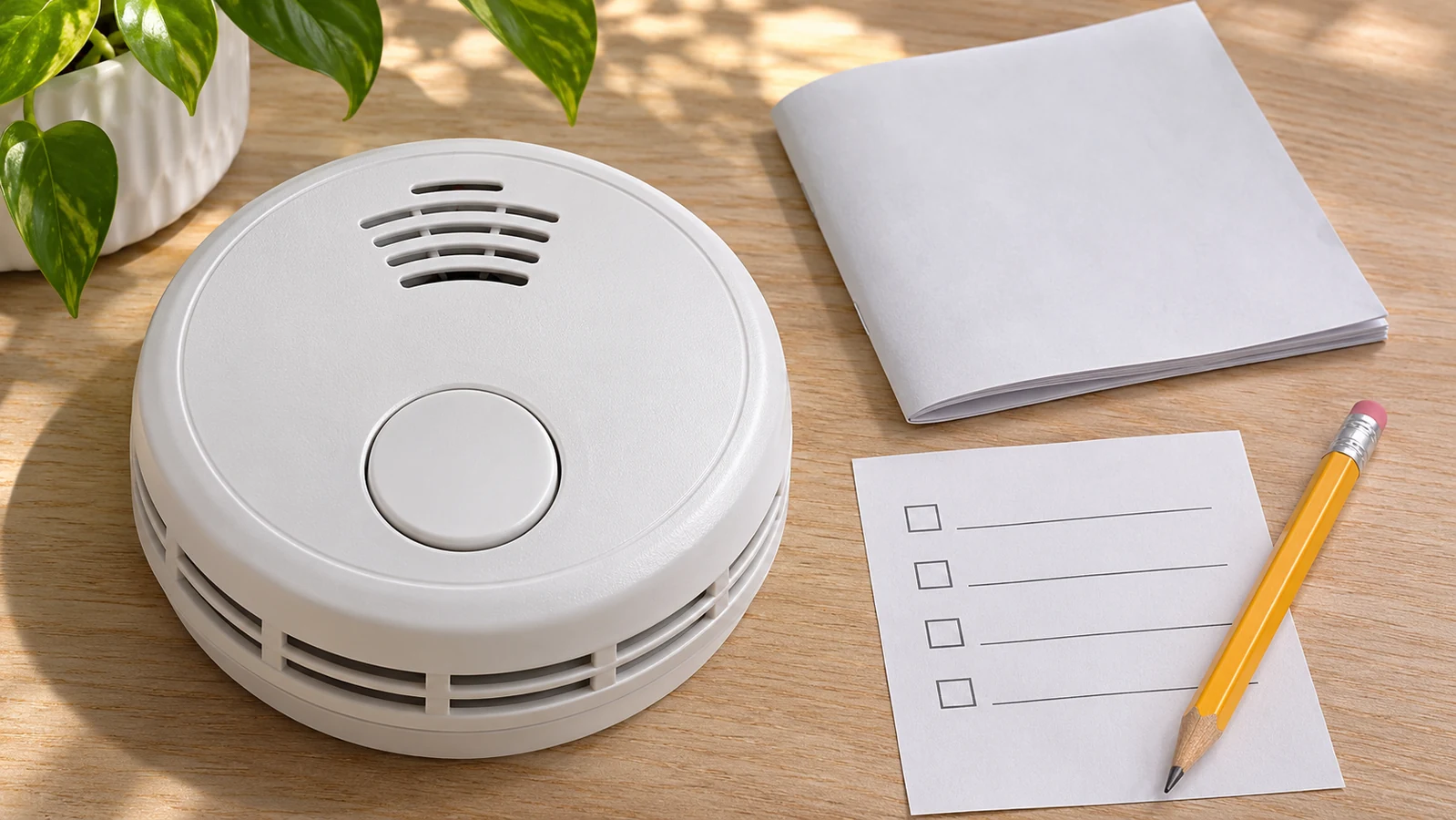
A visible alarm is only the starting point
Seeing a smoke alarm in the hallway can be reassuring, but its presence alone does not tell you when it was last tested, how old it is, or what the household would do if it sounded. A useful home-safety routine brings those questions together. This article is for ordinary preparation before an emergency, not troubleshooting during a fire. It summarizes public guidance from the U.S. Fire Administration, the American Red Cross, and the Texas Department of Insurance. Local requirements and individual products can differ. Use the instructions for the actual device and obtain qualified local help where the arrangement is uncertain.
Use the test button, not a home-made fire
The American Red Cross recommends testing smoke alarms with the test button at least monthly. It specifically describes that method as safer than using matches, lighters, cigarettes, or another controlled fire to test an alarm. That is an important distinction: preparation should not create a new ignition source. An editorial application is to read the model’s testing instructions in advance and choose a suitable time for the household. Do not light something beneath a device to imitate a video. This article does not describe an aerosol test procedure or certify that a device has passed an inspection from a written account of a button press.
Know which power arrangement you have
USFA distinguishes replaceable-battery alarms, long-life sealed-battery alarms, and hardwired alarms with backup power. Its guidance calls for monthly testing, while maintenance and replacement depend on the type and the manufacturer’s instructions. For a conventional nine-volt model, it advises replacing the battery at least annually; a sealed long-life battery is a different arrangement. Do not assume that every device has a battery compartment you should open. In an editorial example, someone finds two different models in the same home. Recording both model numbers is more useful than applying the instructions for one to the other without checking.
Read the device date rather than guessing
The Texas Department of Insurance advises replacing smoke alarms at least every ten years and points readers to the label showing when a unit was made. USFA likewise emphasizes the manufacture date when explaining alarm age. That is not necessarily the day you moved in or noticed the device. An original planning example is looking up the documentation while making a household inventory, rather than deciding that a clean-looking cover must be recent. If the date cannot be established, ask the manufacturer or appropriate fire-safety professional about replacement. Avoid turning the absence of a purchase receipt into a guess about the sensor’s age.
Do not confuse a battery change with a new alarm
A new battery does not make an old alarm a newly manufactured device. This is a practical distinction between two maintenance tasks, not a new technical rule: battery power and the age of the alarm are separate questions in the source guidance. When reviewing a device, keep a place for each on your checklist. An editorial example is a note that says battery changed but leaves device age unknown. That note is still incomplete rather than proof that everything has been renewed. If replacement is needed, choose an appropriate unit and installation process; do not attempt to refurbish an alarm’s internal sensor.
Check coverage without improvising electrical work
USFA recommends alarms inside and outside sleeping areas and on every level of the home, and recommends interconnection so that one sounding causes the others to sound. It also states that only qualified electricians should install hardwired smoke alarms. Use those broad principles to identify questions, not as a substitute for product placement instructions, local requirements, or a building assessment. This article provides no wiring diagram or universal mounting measurement. If you are unsure about the arrangement, ask local fire-safety personnel or a qualified installer. An unfamiliar connector is not an invitation to experiment with the home’s electrical system.
Treat nuisance alarms as a problem to resolve
USFA and the Red Cross warn against removing a battery or disabling a smoke alarm because cooking or steam causes nuisance activation. The Red Cross points to the hush feature and appropriate placement as issues to consider. Read the model’s instructions and seek help with persistent problems rather than making the home permanently quieter by removing protection. This paragraph concerns a known nuisance situation, not permission to assume an unexplained alarm is harmless. If there may be a fire, act on the warning and the household’s emergency arrangements. Do not remain inside to diagnose a device when conditions are unsafe.
Keep dust care specific to the device
Texas fire-safety guidance notes that dust and cobwebs interfere with smoke detection and describes vacuuming as part of care. The Red Cross also discusses dust removal. Follow the actual manufacturer’s cleaning directions rather than inventing a spray, soaking method, or internal repair. An editorial preparation step is to locate the manual and identify which care tasks it permits. This article does not instruct readers to dismantle a unit, use household chemicals on its sensor, or climb onto unstable furniture. If access is difficult, arrange suitable help. A maintenance task should not create a separate fall or electrical hazard.
Ask whether everyone can receive the warning
The Texas guidance describes alert features such as strobe lights and bed shakers for people who are hard of hearing. The practical question is whether everyone can receive the warning, not merely whether somebody standing beside the device hears a test. This article does not prescribe a particular alert system or decide what a person needs. Ask a qualified fire-safety professional about compatible options and applicable local requirements. In a fictional household discussion, a resident can explain that an audible-only alert may not meet their needs without being required to disclose a full medical history to everyone else in the building.
Connect the warning to an escape plan
USFA’s home escape guidance connects working alarms with planning and practice. It calls for knowing ways out, an outside meeting place, and remaining outside once you have escaped. A warning device is therefore one part of preparation, not the entire response. Review the official guidance and the arrangements appropriate to your building before an emergency. In a multiunit property, ask about its specific emergency procedures rather than assuming a diagram for a detached house transfers unchanged. This article is not a complete evacuation plan and cannot determine a safe route through a building it has not assessed.
Give the plan practical details
An editorial planning discussion can identify who may need help, how visitors will learn the arrangements, and where people will meet. Keep the plan realistic for the people present rather than imagining everyone can move in the same way, and obtain appropriate local fire-safety guidance about assistance needs. During an actual fire, get out, stay out, and contact the local emergency service from safety; do not go back inside for possessions. The purpose of preparation is to support a prompt response, not to turn an emergency into a search for a checklist or a debate about maintenance history.
Keep a small maintenance record
A small maintenance record can make routine responsibilities clearer. As an original example, list the device location, model, manufacture or replacement date, last test, and the next action stated in its instructions. Mark unknown information as unknown rather than filling it with a plausible date. This is an organizational suggestion, not a legally required inspection form or a certificate of compliance. A tidy record cannot compensate for a failed test or a missing device. Use it to keep track of action, not to reassure yourself that paperwork alone means the equipment or the household is fully prepared.
Make responsibilities explicit in a shared home
In a shared home or rental, clarify who will report a problem and who will arrange the permitted work. An editorial example is sending the property contact a specific description: which device, what happened during the instructed test, and what documentation is available. This is not legal advice about landlord and tenant obligations, which depend on the setting. Do not assume a responsibility has been accepted merely because a message was sent. Keep follow-up practical, and use appropriate local advice if the arrangement remains unresolved. This article does not authorize bypassing, disconnecting, or modifying a building’s alarm system.
Know the limits of a checklist
A checklist is useful for noticing missing information, but it cannot inspect hidden wiring, assess every placement issue, or guarantee that an alarm will warn everyone in every fire. The sources provide general guidance, and the manual and qualified local assessment supply details that a broad article cannot. If a unit does not respond as its instructions say it should, do not record the check as successful. Seek the appropriate replacement or service guidance. During a suspected fire, prioritize the emergency response rather than continuing a maintenance exercise. No photograph, app notification, or online article can establish that an unfamiliar home is protected.
Optional commercial reading serves a different purpose
The three optional commercial links on this page concern separate sleep, anxiety, and joint-health subjects in the existing Blue Heron catalog. They are not smoke alarms, installation services, accessibility assessments, or fire-escape training. Their presence is not evidence that a program reduces fire risk or makes someone able to evacuate safely. No purchase is needed to use the public safety sources. If those unrelated wellness topics interest you, read each program’s scope and limitations independently. Do not treat a commercial book as a substitute for working equipment, a qualified installer, appropriate alert features, or a practiced household plan.
The takeaway and general-information disclaimer
The practical recap is to identify the device, use its instructed test, check its age, follow the correct battery arrangement, and connect the warning to a realistic escape plan. Resolve unknowns rather than assuming that a cover on the ceiling proves everything works. This is general home-safety education, not personalized medical advice, an electrical tutorial, a legal opinion, or a fire inspection. AI assisted with drafting, organization, and the generic equipment image. Mr.Hotsia reviewed sourcing and clarity only; no clinical review or medical qualifications are implied. The illustration is not a tested product, a certification mark, or an installation diagram.
Sources and further reading
Medical information was checked against these public health sources on November 23, 2026.
- U.S. Fire Administration — Smoke Alarms: power types, age, coverage and maintenance ↗
- American Red Cross — Fire Safety Equipment: test-button use and maintenance ↗
- Texas Department of Insurance — Smoke alarms: age, care and accessible alert features ↗
- U.S. Fire Administration — Home Fire Escape Plans: planning, practice and staying outside ↗
This article is general health education, not a diagnosis or personal medical advice. Do not change treatment or supplements based on this article. Discuss individual results with a qualified healthcare professional.