Everyday food safety · Cooking thermometers
Food Thermometers: Measure the Food, Not Just Its Appearance
A browned surface is not an internal-temperature reading. Learn how the right food thermometer, its instructions, a steady display, and an official temperature chart work together.
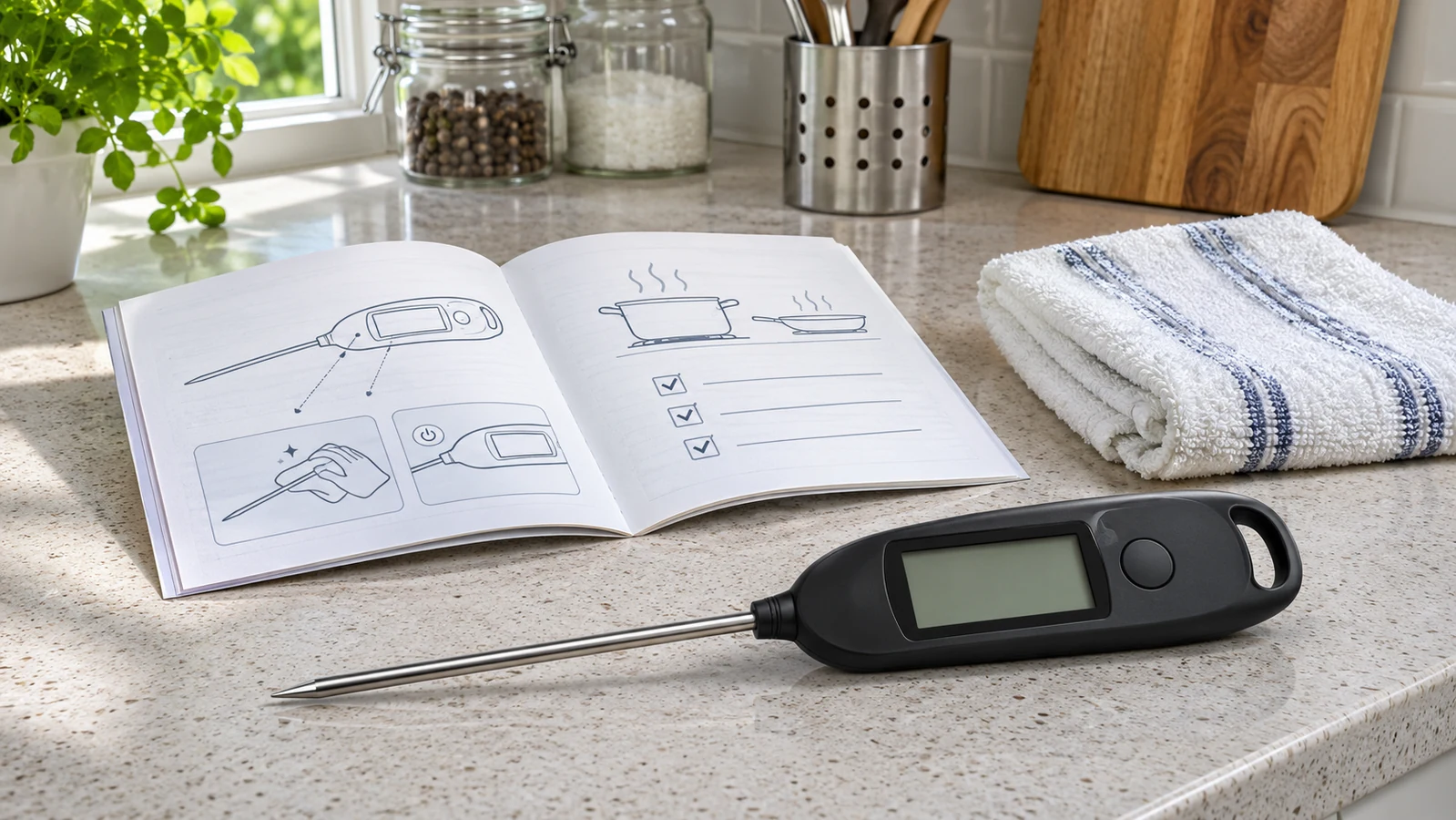
AI assisted with drafting, organization, and the original equipment illustration. Mr.Hotsia reviewed sourcing and clarity only; no clinical review or medical qualifications are implied.
Start with a measurement, not a reassuring colour
A golden crust, clear-looking juices, or a familiar cooking time can feel persuasive, but they are not measurements of a food’s internal temperature. FDA guidance explains that colour and texture are unreliable indicators of safety for meat, poultry, seafood, and egg products. A food thermometer answers a different question from whether a meal looks appetising. This guide concerns ordinary home cooking, not diagnosis of foodborne illness or a special diet. It brings together official food-safety guidance and university information about thermometer types, with practical editorial examples of how to keep those instructions available in a real kitchen.
Identify the tool before using it
Begin by checking what the device is designed to measure. A probe intended for food is not the same tool as a refrigerator thermometer measuring the surrounding air. Likewise, a familiar digital screen does not make every thermometer suitable for cooking. As an editorial preparation step, locate the model name and its actual instructions before putting it beside the stove. If the packaging or manual cannot establish that it is a food thermometer, do not guess from its shape. A borrowed device needs the same check: knowing who owns it does not tell you its permitted uses or cleaning requirements.
Read the sensing and timing instructions
University of Connecticut guidance describes meaningful differences between thermometer types, including their sensing areas and response times. Some instant-read devices are not intended to remain in food during cooking; other models have probes designed for that purpose. Read the model’s insertion, waiting, and heat-exposure instructions rather than applying one remembered rule to every instrument. In an editorial example, a cook writes three questions beside the manual: where does this model sense, when should I read it, and may it stay in the oven? These questions organize the task; they are not a substitute for the manufacturer’s answers.
Choose a suitable place to measure
Hong Kong’s Centre for Food Safety advises inserting a probe into the core or thickest part of the food. For soups and sauces, it recommends stirring before measurement and keeping the probe from touching the container’s bottom. The aim is to measure food rather than the vessel beneath it. Use the device instructions and food-specific official guidance when the shape makes positioning difficult. As an editorial example, deciding where to measure before lifting a hot dish is more useful than holding the dish while searching for instructions. This article does not supply a universal insertion depth for every probe or recipe.
Wait for a usable reading
The Centre for Food Safety says to record the temperature once the display is steady. The first number that appears is therefore not automatically the number to act on. Different devices need their own instructed reading process. An original checklist can separate positioning the probe, waiting as directed, and comparing the stable reading with the applicable target. If the display is unreadable, the probe cannot be positioned correctly, or the battery indication suggests a problem, do not describe an uncertain reading as a completed check. Pause to resolve the device question instead of choosing whichever fleeting number is most reassuring.
Match the target to the food
Use an official chart for the particular food. FoodSafety.gov lists 145°F (63°C), followed by a three-minute rest, for steaks, roasts, and chops of beef, pork, veal, and lamb. It lists 160°F (71°C) for ground meat such as beef or pork, and 165°F (74°C) for all poultry, including ground poultry. These categories are not interchangeable. The linked chart includes additional foods and exceptions; consult its actual row rather than extending these examples to everything on the plate. Check whether the thermometer displays Fahrenheit or Celsius so that a familiar-looking numeral is not compared with a target in the wrong unit.
Keep rest time attached to the instruction
Where a chart specifies rest time, keep that instruction together with the temperature rather than copying the number alone. FoodSafety.gov explains that rest time contributes to completing safe cooking for certain meats. An editorial example is a kitchen note with a separate space for the rest requirement, not merely a target temperature in large print. That note should identify its source and the relevant food category. Do not infer from one food’s instruction that every food needs the same rest, or that an unspecified rest automatically makes an under-temperature reading acceptable. Follow the complete applicable guidance, not a shortened version passed between cooks.
Clean the probe as part of the task
The Centre for Food Safety advises washing and disinfecting the probe before and after each use. Use an appropriate food-contact cleaning process together with the manufacturer’s directions for the actual device. Do not assume the entire electronic body can be immersed because its metal probe needs cleaning. In a practical editorial setup, identify a place for the cleaned thermometer that has not just held raw ingredients. This is an organizational suggestion, not a disinfectant formula or a claim that a towel sterilizes equipment. Avoid improvising chemical mixtures or treating a visibly clean probe as proof that every surface around it is safe.
A number does not replace safe handling
A thermometer is one part of food safety, not an all-purpose clearance certificate. CDC organizes prevention around cleaning, separating, cooking, and chilling. Correct cooking does not remove the need to keep raw ingredients and their juices away from ready-to-eat food, use clean utensils, or refrigerate perishables promptly. One measurement also does not describe an entire storage history. An editorial example is keeping the shopping-and-storage question separate from the cooking question: the temperature you read now cannot reconstruct what happened earlier. Do not use this guide to decide that cooking rescues recalled food or food with an uncertain history; follow the applicable official advice.
Treat microwave instructions as a sequence
Microwave cooking deserves its full sequence. FDA advises covering, stirring, rotating as appropriate, and allowing standing time before checking internal temperature. CDC likewise explains that standing time helps heat move from hotter areas into colder ones. Follow the package or recipe’s appropriate microwave directions rather than stopping as soon as the surface looks hot. As an editorial example, read the standing step before starting so it is included in the meal plan, rather than discovered after serving. This article does not invent a universal microwave time or wattage conversion, and one convenient reading should not be used to dismiss the stated preparation instructions.
Give the cook a workable setup
Make the equipment easy to use before the food needs attention. An original preparation list might include the official temperature chart, the model instructions, the thermometer, and a safe place for the hot dish. Decide who is checking the reading if several people are cooking. This planning advice is not a tested intervention or a guarantee against illness; it is a way to reduce missing information at the moment of use. If reading small print or the display is difficult, arrange a suitable way to access the information beforehand rather than assuming that somebody else will notice an uncertain measurement.
Ask a precise question about an unfamiliar device
Questions to a manufacturer are more useful when they identify the model and the specific task. An editorial example is asking whether that probe can read a thin food, what part senses temperature, and what waiting instruction applies. Another is asking whether the stated oven use applies to the whole device or only its designated probe arrangement. Keep the answer with the model information. A generic online demonstration may show a different instrument, even when the casing looks similar. This article is not an endorsement of a brand, a shopping ranking, or a claim that a higher price guarantees a better measurement.
Check accuracy without inventing a repair
UConn notes that some thermometers can be calibrated and others cannot, and advises checking the manufacturer’s information. Separate an accuracy question from a repair instruction. If you suspect damage or an inaccurate reading, seek the model’s checking, service, or replacement guidance rather than inventing an adjustment. This article does not prescribe a boiling-water procedure, tell readers to open an electronic device, or suggest mentally correcting every future reading by a guessed offset. An editorial record can say accuracy unresolved until the question has been properly addressed. An unknown is useful information when it stops a questionable device from being treated as verified.
Make shared instructions easy to follow
In a shared kitchen, keep the source of the instruction visible. An editorial note could identify the device model, the chart used, the food category, and any question that still needs an answer. Avoid reducing the note to a number with no unit or food name. If someone changes the ingredient or borrows another thermometer, revisit the relevant directions instead of assuming the previous note still fits. Such a record is a communication aid, not an official inspection form, a legal compliance certificate, or proof that every portion was checked. Its value comes from making the actual instructions clearer, not from the existence of paperwork.
Optional commercial reading has a separate purpose
The three optional commercial links here concern broader nutrition and wellbeing topics in the existing Blue Heron catalog. They are not food-safety training, thermometer manuals, or authorities for cooking temperatures. Their placement does not mean a weight, blood-pressure, or cholesterol program prevents foodborne illness or validates a meal. No purchase is needed to use the public sources below. If those separate subjects interest you, review the program’s own scope and limitations independently. Do not replace safe preparation or professional advice with a commercial book, and do not interpret the links as evidence for the practical measurement guidance in this article.
The takeaway and general-information disclaimer
The useful habit is to identify the right tool, read its instructions, measure appropriately, wait for a steady result, and compare it with the complete official instruction for that food. Keep hygiene and storage in view rather than asking one number to answer every safety question. This is general food-safety education, not personalized medical advice, a diagnosis, or treatment guidance. Seek qualified healthcare advice if you think food has made you ill. AI assisted with drafting, organization, and the generic equipment illustration. Mr.Hotsia reviewed sourcing and clarity only; no clinical review or medical qualifications are implied. The image is not a measurement demonstration or a tested product.
Sources and further reading
Medical information was checked against these public health sources on November 23, 2026.
- FDA — Safe Food Handling: appearance, cooking and microwave preparation ↗
- CDC — Preventing Food Poisoning: clean, separate, cook and chill ↗
- FoodSafety.gov — Safe Minimum Internal Temperature Chart: food categories and rest times ↗
- University of Connecticut — Using Thermometers in the Kitchen: device types and manufacturer instructions ↗
- Hong Kong Centre for Food Safety — Food thermometers: probe position, steady reading and cleaning ↗
This article is general health education, not a diagnosis or personal medical advice. Do not change treatment or supplements based on this article. Discuss individual results with a qualified healthcare professional.