Everyday health · Food safety
Microwave-Safe Containers: Match the Label to the Way You Heat
Check the container, lid, wrap, and instructions before heating. A storage box is not automatically microwave cookware, and the right container does not replace safe cooking and food handling.
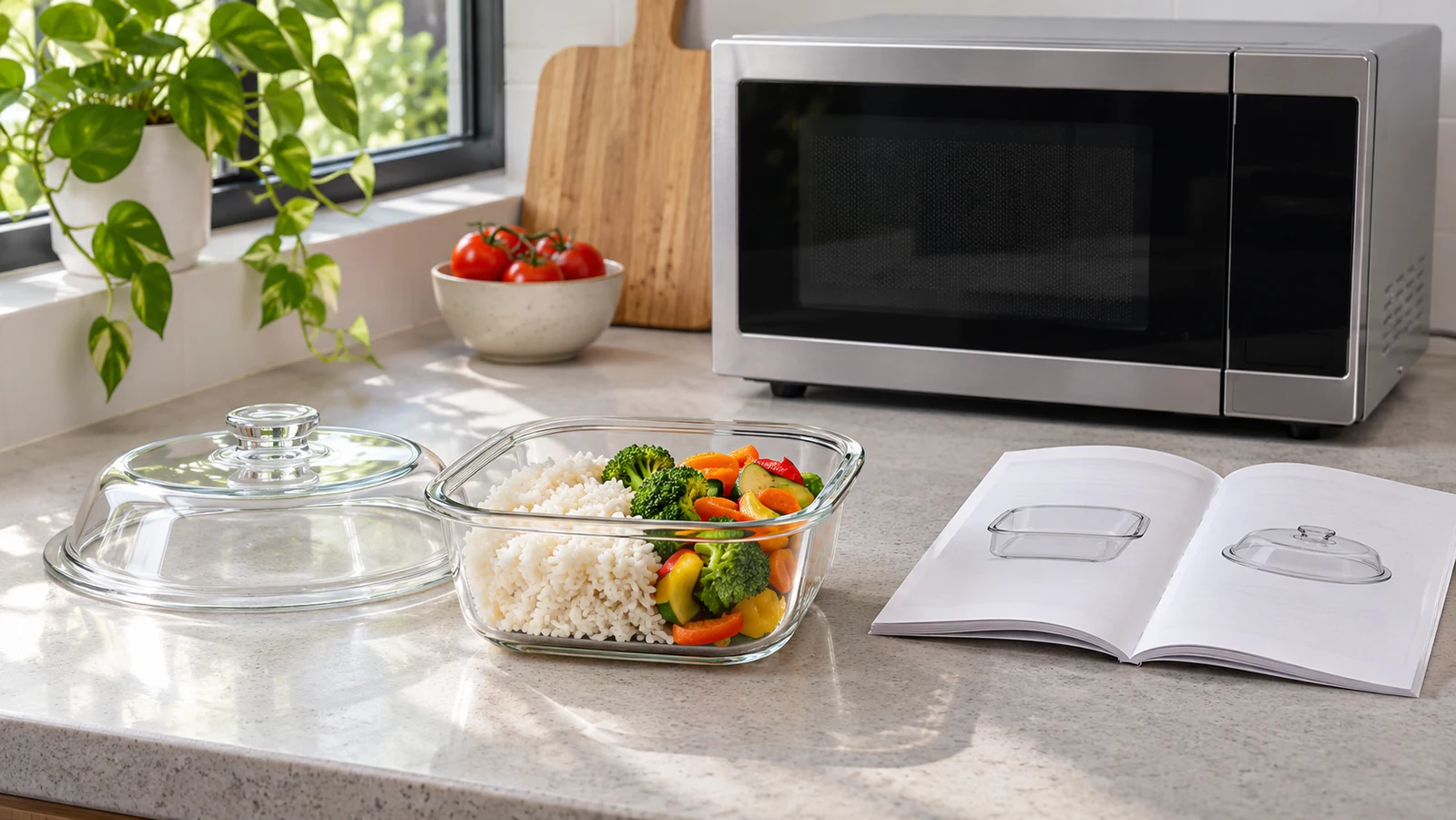
AI assisted with drafting, organization, and the original generic kitchen illustration. Mr.Hotsia is identified as reviewer for sourcing and clarity only; no clinical review or medical qualifications are implied.
Start with the task, not the shape of the box
A lunch box comes out of the refrigerator, and the simplest next step seems to be putting the whole thing in the microwave. Before doing that, pause over a different question: was this particular container, including its lid, intended for this heating task? This guide concerns choosing and using food-contact containers, rather than deciding how long leftovers can be stored. It combines public food-safety guidance with original planning examples. It does not test a product, rank brands, or promise that one material prevents illness. The useful starting point is the actual instruction attached to the item you own.
Read the intended use before pressing start
Health Canada emphasizes using cookware according to the manufacturer’s intended use and instructions. Treat that as a request for specific information, not simply a reassuring description on an online listing. An original household example is checking a container before filling it for tomorrow’s lunch: identify the model, locate its microwave directions, and notice whether they limit the task to reheating. This article does not invent a universal symbol or a permitted time for every container. If the relevant information is missing or unclear, resolve that uncertainty with the manufacturer or choose another container whose intended use you can establish.
A storage container is not automatically cookware
CSIRO warns that packaging designed for chilled or frozen products, such as ice cream or margarine containers, should not be exposed to high microwave temperatures. Being useful for carrying or storing food does not make the same package suitable for heating it. In an editorial example, a family keeps an empty tub because it has a convenient size. Its convenient size answers a storage question, not a microwave question. Separate those decisions rather than assuming that previous contact with food authorizes every future use. Reusing something responsibly still means respecting the purpose for which it was designed.
Check the lid and wrap separately
Health Canada’s microwave guidance applies to containers, lids, and wraps. Check each component rather than transferring a claim from the base to whatever cover happens to fit. An original example is a drawer containing several similar lids after a shared meal. A close fit does not identify the right lid or establish its heating instructions. Keep matching pieces together when possible, and look up the relevant information if they become separated. The purpose of this example is practical organization, not a new product standard. This article cannot decide that an unidentified lid is suitable by looking at its shape.
Leave steam a route out
A cover and a seal are not the same instruction. Health Canada advises using a microwave-safe lid or suitable wrap, leaving a small gap for steam to escape, and keeping wrap from touching the food. Follow the particular product’s directions for venting. An editorial preparation check is to find that step before starting, while the dish is still easy to handle. Do not replace a missing instruction with an improvised tightly sealed arrangement. This guide does not prescribe a universal gap measurement or a method for adapting a container whose maker has not supported the intended use.
Plastic is not one interchangeable material
The FDA explains that some plastics can melt from the heat of the food inside. Health Canada similarly distinguishes products by their intended use rather than treating every plastic container as equivalent. Neither observation requires declaring all plastic inherently unsuitable or all plastic automatically acceptable. A fictional shopper comparing two boxes can ask the same concrete question of each: what does its own manufacturer allow? Appearance, flexibility, price, or resemblance to another box cannot supply a missing instruction. This article does not provide chemical exposure calculations or claim that a particular purchase eliminates every potential concern about food-contact materials.
Damage is a reason to reassess the container
Health Canada advises avoiding visibly damaged, stained, or unpleasant-smelling plastic containers. CSIRO also advises discarding microwave plastics whose surfaces show signs of breaking down. An original maintenance habit is to check the items you actually use while putting clean dishes away. If a container’s condition raises a question, do not turn repeated previous use into proof that the next use is appropriate. Consult the maker’s replacement or care guidance. This is not a diagnosis of what any particular stain contains, nor a laboratory method for evaluating chemical migration from a photograph or a smell.
Glass and ceramic still need appropriate instructions
Choosing glass or ceramic does not remove the need for suitable-use instructions. The FDA directs users to their microwave manual for the kinds of containers to use and generally advises against metal pans or aluminum foil. An editorial example is an attractive serving dish that has no available heating information. Being a serving dish answers where food can be presented, not every question about how it may be heated. Avoid improvising a microwave test from a social-media clip. If a manual describes a test, follow that model’s complete directions rather than treating an online shortcut as a universal procedure.
The container can become hot too
A container can become hot from the food even when the microwave energy is not directly heating that material in the same way. The FDA discusses this distinction, and CSIRO cautions about unexpectedly hot crockery. Plan how you will handle the item before the heating step. An original example is clearing a stable landing place instead of searching for one while holding a hot dish. Follow the appliance and container precautions, and use appropriate protection for handling hot cookware. This article does not provide burn treatment or ask readers to judge a surface temperature by touching it.
Suitable packaging does not guarantee an evenly heated meal
The right container is only one part of preparing food safely. Health Canada notes that microwaves can heat unevenly and recommends following the food instructions, stirring or rotating as appropriate, observing standing time, and checking internal temperature. Keep the container question separate from the cooking question. An editorial checklist might have two lines: suitable vessel confirmed, and food preparation instructions completed. Ticking the first line does not answer the second. This guide gives no universal reheating time and cannot establish that a meal is safe simply because it was placed inside a container described as microwave-safe.
Keep a ready-meal package with its directions
Some meals arrive in packaging designed for their particular preparation instructions. CSIRO explains that microwave-meal packaging may be specifically engineered for heating. Do not turn that observation into permission to reuse every tray for another dish. In an original planning example, someone reads the complete meal directions before removing components, then follows the specified arrangement. Another meal may require transferring the food instead. The relevant question is what the actual package tells you, not which approach worked yesterday. This article does not override package directions or claim that a tray designed for one meal has unlimited uses afterward.
Do not extend one product’s claim to another
Keep claims attached to the item and task they describe. A fictional office kitchen might contain a familiar brand’s food box beside an unrelated promotional container. Familiarity with the first should not become a verdict about the second. This is an editorial way to organize decisions, not a claim from a product test. If several people share dishes, distinguish confirmed microwave cookware from containers with unresolved instructions. Avoid asking colleagues to guess from a logo or color. The aim is not to make the kitchen complicated; it is to stop unknown information from quietly being treated as known.
Make a small, practical kitchen reference
A small reference can be more useful than a collection of screenshots with no model names. An original note could record the container’s model, the source of its directions, the correct lid, and any stated restriction. Keep the note where the people using the item can find it. If the container or lid changes, check the information again. Such a note is only a communication aid. It is not an inspection record, a legal compliance certificate, or proof that every person followed the instructions. Clear, accessible information matters more than creating paperwork for its own sake.
Keep product questions specific
Questions to a manufacturer are easier to answer when they name the exact item and intended task. Editorial examples include asking whether a particular lid can remain on during reheating, whether the maker supports the intended food-heating use, and what damage means replacement is needed. Keep any answer connected to the model it covers. If an answer remains vague, do not add a reassuring detail that the maker did not provide. This guide does not certify products sold in any country, and the public sources below do not endorse the generic container shown in the illustration.
Optional broader nutrition reading is separate
The three optional commercial links on this page concern broader weight, blood-pressure, and cholesterol topics in the existing catalog. They are not container manuals, food-safety training, or evidence that a particular microwave method prevents disease. No purchase is necessary to use the public sources or understand the container checklist. If those separate nutrition-related subjects interest you, evaluate each program’s scope and limitations independently. Their placement does not mean that buying a book makes cookware safe or replaces individualized professional advice. Product-use questions belong with the relevant manufacturer and applicable public food-safety guidance.
The recap and general-information disclaimer
Before heating, identify the actual container, confirm the intended use, check the lid or wrap, follow venting instructions, and include the food’s complete preparation sequence. Keep uncertainty visible rather than filling gaps with assumptions. This is general food-safety education, not personalized medical advice, diagnosis, treatment, or a guarantee about a meal. Ask an appropriate healthcare professional if you think food has made you ill. AI assisted with drafting, organization, and the original generic kitchen image. Mr.Hotsia is identified as reviewer for sourcing and clarity only; no clinical review or medical qualifications are implied. The illustration is not a tested product.
Sources and further reading
Medical information was checked against these public health sources on November 23, 2026.
- FDA — Microwave Ovens: containers, heat and appliance instructions ↗
- Health Canada — Food safety tips for microwaves: lids, wraps and the full cooking sequence ↗
- Health Canada — The safe use of cookware and bakeware: intended use and condition ↗
- CSIRO — Microwave oven safety: containers, films and packaging ↗
This article is general health education, not a diagnosis or personal medical advice. Do not change treatment or supplements based on this article. Discuss individual results with a qualified healthcare professional.