Everyday health · Food safety
Washing Fresh Produce: Running Water, Not Soap
Wash whole fruits and vegetables before cutting, keep clean tools separate, and read ready-to-eat labels. Washing is a useful preparation step, not a guarantee that every risk has disappeared.
AI assisted with drafting, organization, and the original fictional image. Mr.Hotsia is identified as reviewer for sourcing and clarity only; no clinical review or medical qualifications are implied.
Begin with the preparation sequence
An apple, a cucumber, and a bag of salad can arrive in the same shopping basket without needing exactly the same preparation decision. The useful first step is to identify what you have: whole fresh produce, something already cut, or a package whose label says it is ready to eat. This guide focuses on ordinary household washing and the order of preparation. It combines public food-safety advice with original examples for planning a kitchen task. It does not certify a meal, test a product, diagnose illness, or provide a special diet. Reading the package remains part of the job, even when the food looks familiar.
What a rinse can and cannot establish
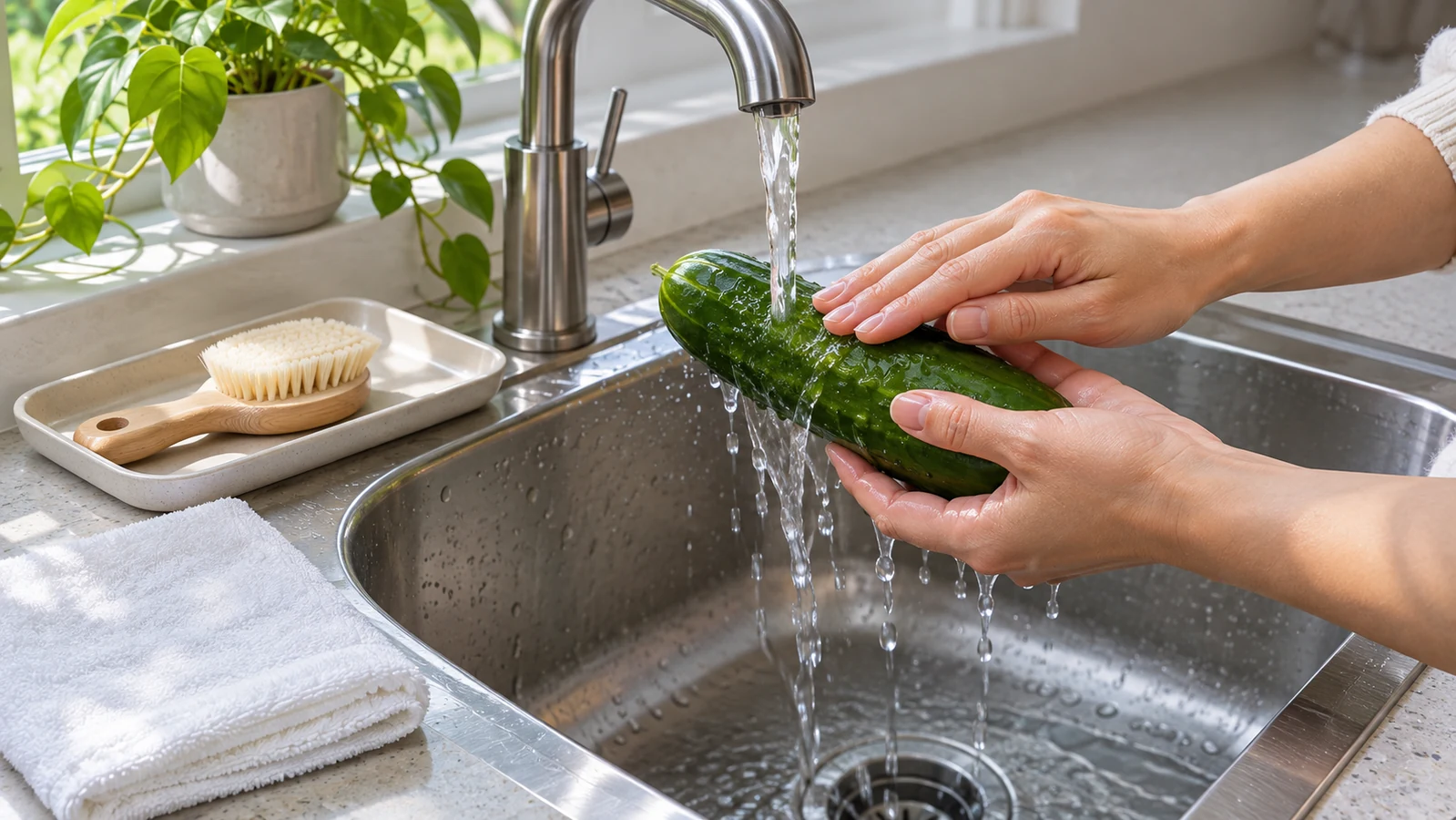
The FDA states that washing can reduce bacteria but does not remove all of them. Keep that limitation attached to any advice about rinsing. A shiny surface or clear-looking rinse water cannot establish that an individual item is free of harmful organisms. In an original example, a cook finishes washing a cucumber and then describes it as prepared for the next step, rather than guaranteed sterile. The difference is not merely wording: it leaves room for the other information and handling steps that still matter. This article gives no percentage reduction and no universal washing duration that would promise complete safety.
Use water intended for drinking
Health Canada recommends cool, running, drinkable water for washing fresh fruits and vegetables before eating or cooking them. That is more specific than saying any available water will do. A fictional household planning lunch can ask whether its water supply is suitable before starting, instead of focusing only on how forcefully the tap runs. If the supply is subject to an advisory, follow the relevant local authority rather than assuming this ordinary routine resolves the advisory. The article supplies no method for treating unsafe water and no substitute instructions for an emergency water situation.
Keep soap for hands and appropriate kitchen cleaning
Iowa State University Extension advises against washing produce with soap or bleach and says a special produce-washing product is unnecessary. Keep the distinction between cleaning food and cleaning the surrounding kitchen clear. An original planning example is removing household-cleaner bottles from the food-preparation decision instead of selecting whichever smells cleanest. This article offers no chemical mixing recipe, soaking formula, or ranking of commercial washes. Handwashing and cleaning equipment are separate tasks with their own appropriate directions. A substance used on a countertop should not quietly become an ingredient in a fruit-washing routine because the two jobs happen near the same sink.
Wash before the knife reaches the skin
The FDA advises washing even when the peel will not be eaten, because cutting or peeling can transfer contamination from the outside. Place that step before cutting rather than after the exposed flesh is already on a plate. In an original example, someone preparing melon checks the sequence before bringing out the knife: wash the whole item, then use suitable clean equipment for preparation. This does not mean that every peel is edible or that washing changes instructions for a specific food. It is an ordering principle, not permission to eat an unfamiliar plant part or ignore preparation requirements.
Match handling to the surface
Health Canada recommends a produce brush for firm-skinned items such as carrots, potatoes, melons, and squash. The FDA likewise mentions a clean produce brush for firm produce. Do not turn a method for a firm surface into an instruction to scrub delicate food aggressively. An original kitchen check is to identify the item and have the appropriate clean tool available before starting. The generic cucumber in the illustration is not evidence that one brush suits every fruit or vegetable. This guide does not test brush materials or determine whether a damaged tool can be restored to a suitable condition.
Read the ready-to-eat statement
The FDA explains that packaged produce labeled pre-washed and ready to eat can be used without further washing. If you choose to wash it again, avoid contact with unclean surfaces and utensils. Read the actual statement rather than assuming every bag has the same status. A fictional shopper can keep the package available until preparation is finished, instead of discarding the only place where the instructions appear. Ready to eat is not a synonym for unlimited storage, and a bag does not cancel its own storage directions. This section does not establish that a particular package is unaffected by a recall.
Drying belongs in the plan
Illinois Extension includes removing excess water with a salad spinner or paper towel in its handling guidance. Plan the drying step before producing a dripping pile of food with nowhere suitable to put it. An original example is setting out a clean bowl and the needed drying equipment first, then moving through the task without borrowing a used dishcloth. This is a workflow suggestion, not a claim that a particular drying device disinfects food. The article does not compare spinner brands or turn a dry-looking surface into proof that an item is free from contamination.
Choose the time you will actually use it
Iowa State advises waiting to wash until shortly before use, noting that washing before storage can encourage spoilage. That supports planning the task around the meal, rather than treating washing the entire shopping load as a compulsory first step. In a fictional example, a person prepares the amount intended for lunch and leaves the remaining whole produce stored appropriately until it is needed. This article does not assign one storage rule to every kind of fruit or vegetable. Check the item and package guidance, and keep preparation advice distinct from any specific instructions for freezing, preserving, or cooking.
A clean vegetable still needs clean equipment
Illinois Extension emphasizes clean utensils and separation from raw meat during preparation. Washing a vegetable does not clean a knife that has been used for a different task. An original shared-kitchen example is pausing before chopping to identify which board and utensil are ready for the produce, instead of choosing whichever is closest. The small pause is an organizational aid, not a laboratory test of the surface. This guide gives no improvised sanitizer concentration and does not replace product directions for cleaning equipment. The aim is to avoid undoing one careful step through an unrelated shortcut.
Keep a short shared-kitchen note
A shared-kitchen note can distinguish whole produce that still needs preparation from a package whose label already supplies different directions. In an original example, the note records where the instructions are kept and which clean equipment is available, not a guessed safety rating for the food. Keep it short enough that another person can actually use it. If the food or packaging changes, check again rather than carrying the old instruction forward automatically. This is an editorial communication suggestion, not a food-service inspection system, legal compliance record, or guarantee that every person will follow the same sequence.
Do not let a rinse overrule other information
A rinse should not become a universal answer to every concern. A fictional reader might encounter damaged food, an uncertain package history, or a notice about a particular product and ask whether extra washing settles the question. This guide does not authorize that conclusion. Return to the information specific to the item and the responsible authority or manufacturer. The practical lesson is about the limits of this article: it explains a routine washing task, not how to reverse every possible problem. Do not infer that repeated rinsing proves an unknown item suitable for eating simply because the action can be repeated.
Make questions about products specific
Questions are easier to answer when they identify the actual product and intended use. Original examples include asking what a package means by ready to eat, where its storage directions are located, or whether preparation instructions refer to the entire contents. Keep any answer tied to that product rather than applying it to unrelated foods. If information is missing, acknowledge the gap rather than inventing a reassuring explanation. The purpose is clearer decision-making, not creating paperwork for ordinary meals. This article cannot assess a product remotely from a photograph or establish the condition of food in a particular household.
Read public guidance within its scope
The references below are public household guidance from the FDA, Health Canada, Illinois Extension, and Iowa State University Extension. They support the preparation principles, not an endorsement of the generic kitchen shown here. Original scenarios are fictional and are not research participants or measured outcomes. Local water advice, product-specific directions, and an individual care plan can require different information. This guide does not extend household advice into commercial-processing rules or claim that advice from one country is the law everywhere else. Keep the source, its purpose, and the particular claim together when using it.
Optional broader nutrition reading
The three optional commercial links on this page concern separate weight, blood-pressure, and cholesterol subjects in the existing wellness catalog. They are not produce-washing manuals, food-safety credentials, or evidence that a method prevents illness. No purchase is required to follow the public references. If those broader nutrition subjects interest you independently, assess each program and its limitations on its own. Buying a book does not make food safe or replace individualized professional advice. The links remain separate from the evidence used for this article, and the public agencies cited here are not presented as endorsing those programs.
A practical recap and general-information disclaimer
Start with the item and label, use appropriate running water, wash whole produce before cutting, choose clean equipment, and plan drying and the next preparation step. Remember that washing reduces some contamination rather than guaranteeing its absence. This is general food-safety education, not personalized medical advice, diagnosis, treatment, or certification of a meal. Seek appropriate healthcare advice if you think food has made you ill. AI assisted with drafting, organization, and the original fictional kitchen image. Mr.Hotsia is identified as reviewer for sourcing and clarity only; no clinical review or medical qualifications are implied. No Google approval or unrestricted advertising eligibility is claimed.
Sources and further reading
Medical information was checked against these public health sources on November 24, 2026.
This article is general health education, not a diagnosis or personal medical advice. Do not change treatment or supplements based on this article. Discuss individual results with a qualified healthcare professional.