Nutrition literacy · Fruit and juice
Whole Fruit or 100% Juice? Compare the Form, Not Just the Fruit Name
An orange and orange juice share a fruit name, but not every nutritional feature. Understand fiber, label limits, and practical choices without turning a drink into a liver treatment.
AI assisted research, drafting and image creation. Listed public sources were checked. No clinical review was performed; Mr.Hotsia’s editorial role concerns sourcing and clarity, not medical qualifications or endorsement.
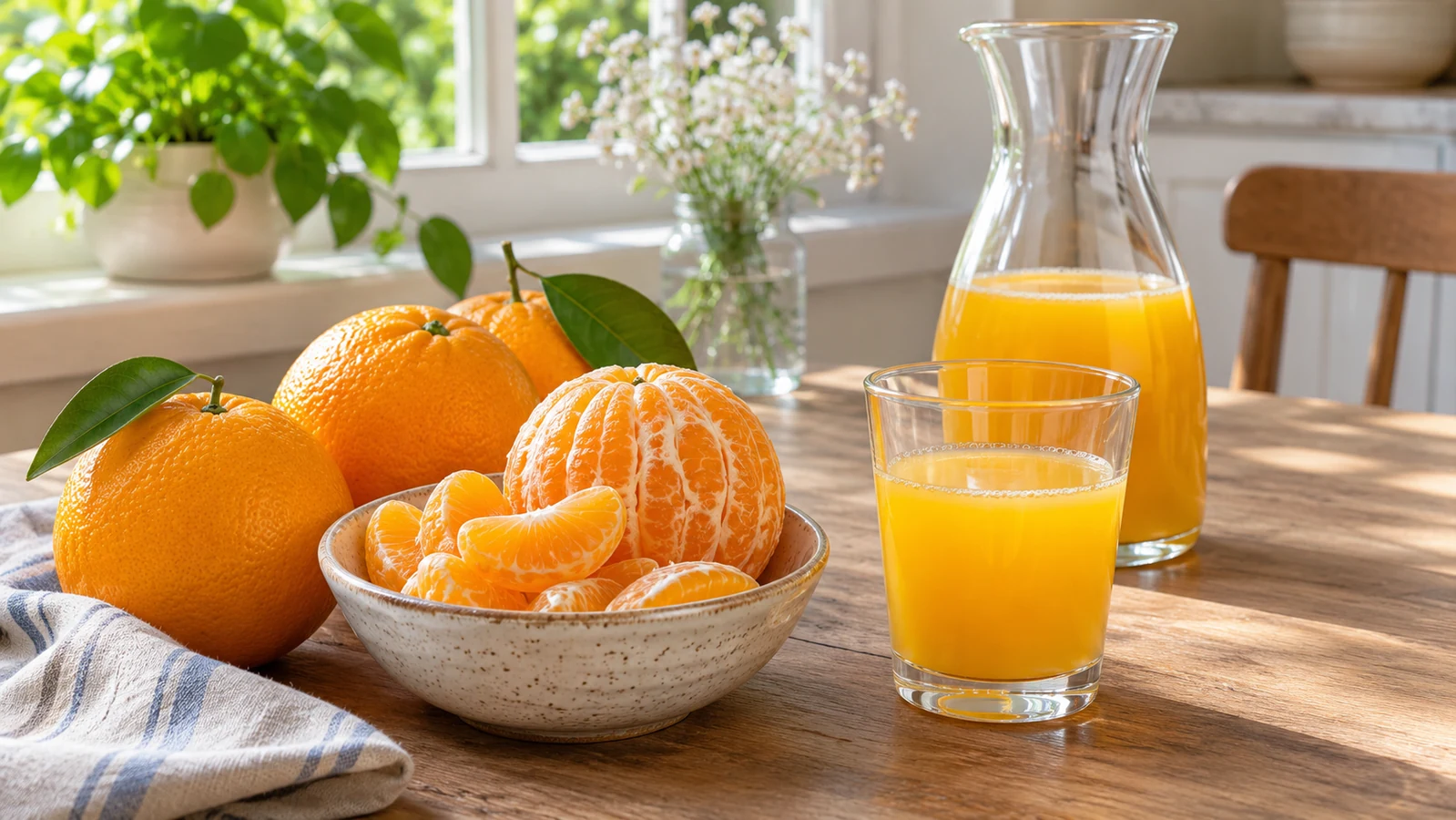
The same fruit name does not answer every question
An orange and a glass of orange juice can look like interchangeable ways to include fruit at breakfast. Both may belong in a discussion of food choices, but the shared fruit name does not make their form, fiber, or serving context identical. This article is for adults who want to compare those features without turning a grocery decision into a diagnosis. It focuses on ordinary nutrition information, not a juice cleanse, a liver-detox routine, or a treatment plan. The aim is to ask a clearer question than whether a package looks natural or carries an appealing percentage.
Start by identifying the form
First identify what is actually being compared: whole or cut-up fruit, juice, a juice drink, or a smoothie. An editorial example is pausing at the shelf to read the product description rather than deciding from a photograph of oranges. A picture of fruit does not supply the full ingredient list or nutrient panel. This is also a reason not to assume that every orange-colored drink is the same kind of product. Read the description on the specific package and keep its wording attached to that product, rather than extending one brand’s information to everything nearby.
Fiber is one meaningful difference
The USDA Food Buying Guide explains that fruit juice contains less dietary fiber than whole fruit. Its guidance is written for child nutrition programs, so its meal-crediting rules should not become an adult medical prescription. The general comparison about fiber is still useful: the form matters. An editorial example is comparing the fiber entry on a packaged juice with reliable information for the fruit you intend to eat. Do not invent a fiber number for a loose orange or assume a picture establishes it. The image accompanying this article is illustrative, not a measured nutrient comparison.
A juice percentage is not a complete nutrition score
A prominent 100% juice description does not answer every question about the drink. It is not a statement that the product reproduces every feature of whole fruit, supplies an individual’s required fruit intake, or improves a liver test. An original shopping exercise is to separate the package description from three other questions: what amount does the panel describe, what fiber does it list, and what sugars does it list? None of those questions requires declaring the drink forbidden. They simply prevent one piece of front-of-package information from taking over the whole decision.
No added sugar does not mean no sugar
FDA distinguishes total sugars from added sugars on U.S. Nutrition Facts labels. Total sugars include naturally occurring sugars as well as any added sugars present. Consequently, a product can have sugars even when it does not have added sugars. For a juice comparison, read the actual panel instead of treating an added-sugars statement as a sugar-free claim. This is a narrow label-reading point, not a reason to erase fruit from meals. It also does not make the sugar number the only useful information about food. Fiber, the amount described, and the wider eating pattern remain separate considerations.
Look at what the serving describes
FDA also explains that a labeled serving size is not a recommendation of how much to consume. Some packages contain more than one serving, and some panels also display whole-package information. An editorial example is checking the number of servings before treating a small bottle as one amount. The same care applies when comparing differently sized packages: two printed numbers may cover different volumes. Keep the quantity alongside the nutrient figure so that a comparison does not silently switch from one basis to another.
A fictional comparison that keeps its limits
Consider a fictional arithmetic exercise, not a real product test. A drink lists 12 grams of total sugars for 100 milliliters. An amount of 200 milliliters would contain twice that listed quantity, or 24 grams. Those figures describe the invented drink only. They do not tell you how many oranges it represents, how much fiber an orange contains, or which amount suits a particular person. They also cannot forecast liver fat or blood glucose. The exercise is useful because it keeps the volume visible without pretending that a simple calculation settles the entire nutritional comparison.
What the UK guidance actually says
NHS guidance offers another perspective. Its UK 5 A Day page limits fruit juice, vegetable juice, and smoothies to a combined 150 milliliters daily and counts that as one portion. It also advises having them with meals because of the effect on teeth. These are the NHS’s general public-health recommendations, not an individualized allowance issued by this article. The important comparison is that drinking more juice does not keep adding portions in that framework. Someone following professional dietary advice should discuss how the guidance fits their own needs rather than combining several different reference systems.
Keep different guidance systems separate
Keep the purpose of each source visible. The USDA page supports meal planning within specified U.S. child nutrition programs; FDA explains U.S. labeling; NHS describes the UK 5 A Day approach. They are not three competing prescriptions for one reader. An editorial example is noting which framework a number came from before copying it into a food diary. A school meal-crediting rule does not define an adult’s liver-care plan, and a package serving does not overrule that plan. Outside those jurisdictions, local labels and guidance may use a different format or terminology.
Why this belongs in a liver-wellness conversation
This topic fits liver-wellness education because NIDDK’s fatty-liver nutrition information discusses dietary patterns and includes juices among sources of fructose in its discussion of drinks containing large amounts of simple sugars. That does not mean a glass of juice diagnoses fatty liver or that avoiding it proves the condition has improved. Nor is it evidence that all fruit should be avoided. The page places diet changes in a conversation with a doctor. Here, it provides context for asking about beverages, not authority for a personalized restriction, weight-loss target, or promise that one substitution reverses liver disease.
Choose a practical whole-fruit option
Whole-fruit options do not have to mean a perfect fresh-fruit display. NHS includes fresh, frozen, and canned fruit within its guidance and suggests canned options in natural juice or water without added sugar. An editorial planning example is choosing a form that fits storage space, preparation time, and the meal in question. Read any preparation instructions on packaged food. Cost and availability matter too: an affordable option that someone can use is more practical than an idealized purchase that goes uneaten. This is not a ranking of fresh produce as morally better than other forms.
Make the comparison workable at home
At home, make the comparison concrete rather than punitive. An editorial example is keeping a familiar whole-fruit option available for a breakfast where juice has been the automatic choice, then deciding what works with that meal. There is no need to label the existing routine a failure or throw away every drink. Equally, adding fruit does not create a license to ignore the rest of the meal. The useful change is noticing the options and their different features, not building a rigid rule that every breakfast must look exactly the same.
Keep another person’s preferences in the decision
If you shop or cook for someone else, ask before replacing their usual choice. An original example is asking whether they would prefer peeled fruit, a different available fruit, or help preparing food, rather than announcing that their drink caused a medical problem. A health condition does not remove someone’s right to participate in everyday decisions. If eating or drinking is difficult, or a prescribed plan affects the choice, leave the individual decision with that person and their qualified care team. This article does not assess swallowing, dental conditions, allergies, or nutritional adequacy.
Read commercial guidance as commercial guidance
The optional catalogue guide associated with this article is The Fatty Liver Solution by Julissa Clay, whose seller also uses a Non-Alcoholic Fatty Liver Strategy title. The verified listing connects it with food and lifestyle topics. That association does not establish that the guide detoxifies a liver, reverses damage, or replaces medical care. A refund policy, testimonial, or book title is not clinical evidence. The public sources below support this explanation independently of the sales links. Read commercial material with those limits in mind; buying a guide is not required to understand this comparison.
Bring individual questions to your care team
For an individual question, bring the actual package or a clear photograph of its panel to a clinician or registered dietitian. An editorial question might be how juice and whole fruit fit an existing plan, rather than asking an online article to assign a universal daily amount. Mention relevant restrictions already given to you. Do not change medicines, skip monitoring, or start a restrictive juice-based diet because of this discussion. No clinical review of this article was performed. Its purpose is to clarify the choice, not to judge the adequacy of anyone’s current care.
The useful takeaway
The takeaway is modest: identify the form of fruit, notice fiber, read sugars in context, and keep the serving basis visible. Whole fruit and juice can share a name without being nutritionally interchangeable in every respect. Use guidance for the purpose it was written for, and keep personal dietary decisions within the appropriate care conversation. Neither an attractive package nor a dramatic detox promise can supply that context. General nutrition education can improve the questions you ask, but it cannot turn one food choice into proof of health, disease, or a successful liver treatment.
Sources and further reading
Medical information was checked against these public health sources on November 29, 2026.
A practical guide for readers interested in Liver wellnessA guide to Liver wellness
The Fatty Liver Solution
By Julissa Clay
Food-centered education and realistic lifestyle ideas for supporting long-term metabolic and liver wellbeing.
- Topic: Liver wellness
- Author: Julissa Clay
- Format: digital guide
 Trusted & secure checkout
This article contains affiliate links. We may earn a commission if you purchase through them, at no extra cost to you.
This article is general health education, not a diagnosis or personal medical advice. Do not change treatment or supplements based on this article. Discuss individual results with a qualified healthcare professional.